USD ($)
$
United States Dollar
Euro Member Countries
India Rupee
د.إ
United Arab Emirates dirham
ر.س
Saudi Arabia Riyal

Types of Data: Structured, Unstructured, Semi-Structured

Lesson 6/44 | Study Time: 15 Min

Data is fundamental to machine learning, analytics, and business intelligence. Understanding the distinctions among structured, unstructured, and semi-structured data is key to selecting appropriate storage, processing, and analysis methods. Each data type has unique attributes and challenges, influencing how organizations collect, manage, and extract value from data. 

Structured Data

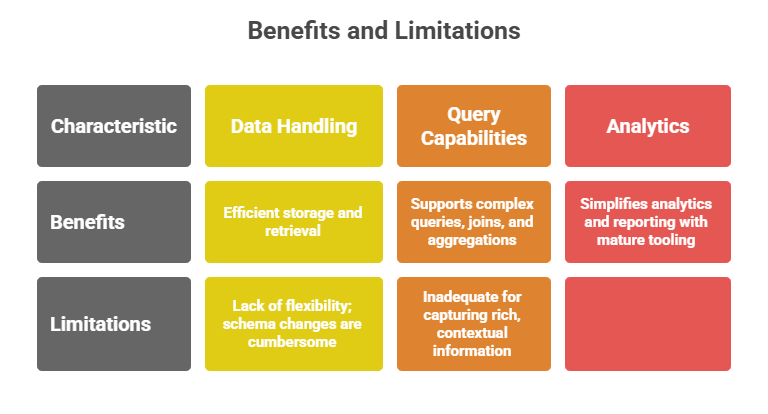
Structured data is highly organized and easily searchable in traditional databases.

Characteristics:

1. Organized in fixed fields within records, often stored as rows and columns in relational databases.

2. Easily searchable using standard query languages like SQL.

3. Highly suitable for numerical, categorical, and transactional information.


Examples: Customer databases, product inventories, and financial records.

Unstructured Data

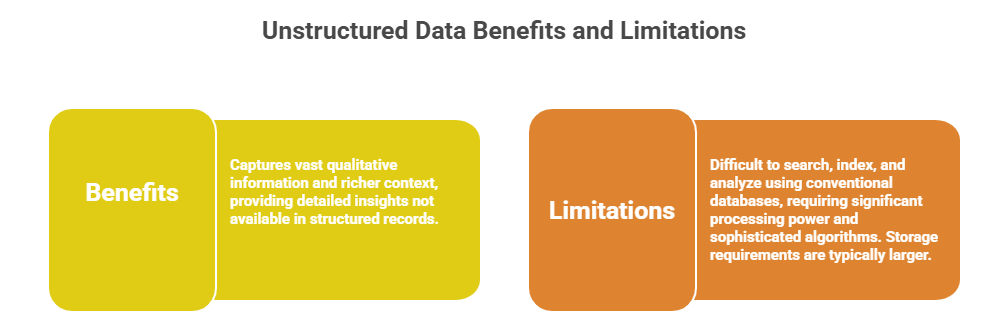
Unstructured data lacks a predefined format, encompassing vast and diverse formats like text, images, and videos

Characteristics:

1. No predefined format or organizational schema.

2. Includes text documents, emails, images, audio, video, social media posts, sensor data, etc.

3. Requires advanced processing techniques like NLP, computer vision, or speech recognition.

Semi-Structured Data

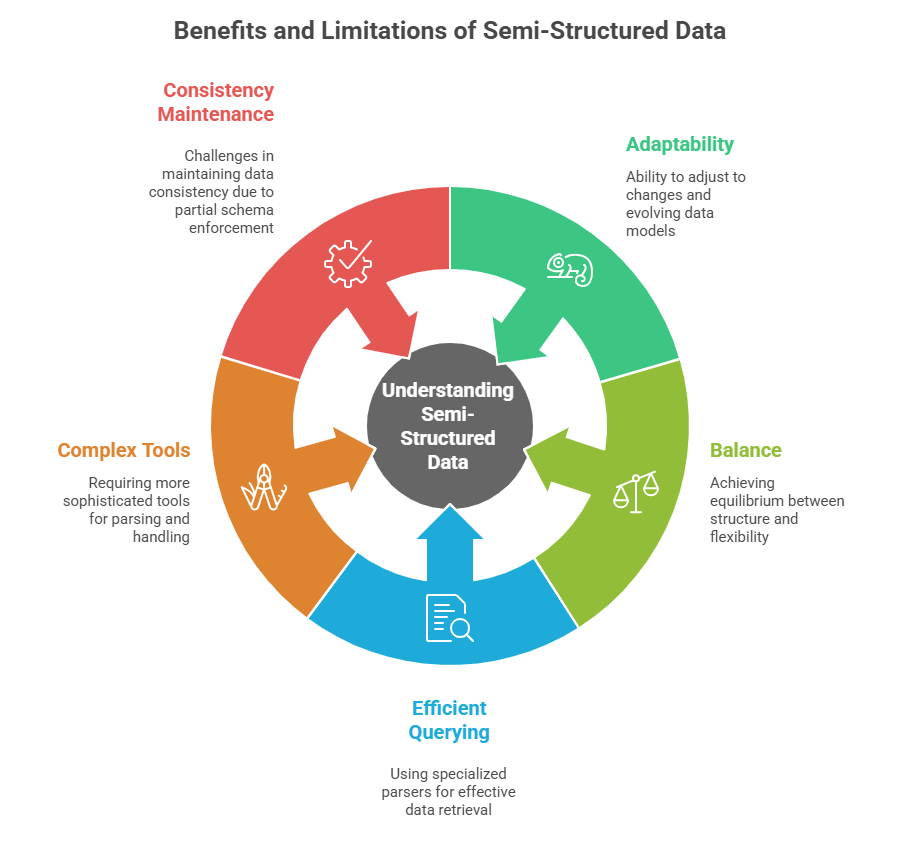
Semi-structured data bridges these two extremes, possessing organizational elements but without rigid tabular schemas. 

Characteristics:

1. Contains organizational properties through metadata or tags without strict relational schemas.

2. Formats include JSON, XML, YAML, and NoSQL databases.

3. More flexible and extensible than structured data, yet easier to analyze than unstructured data.

Chase Miller

Chase Miller

Product Designer
Profile

Class Sessions

1- What is Artificial Intelligence? Types of AI: Narrow, General, Generative 2- Machine Learning vs Deep Learning vs Data Science: Fundamental Differences 3- Key Concepts in Machine Learning: Models, Training, Inference, Overfitting, Generalization 4- Real-World AI Applications Across Industries 5- AI Workflow: Data Collection → Model Building → Deployment Process 6- Types of Data: Structured, Unstructured, Semi-Structured 7- Basics of Data Collection and Storage Methods 8- Ensuring Data Quality, Understanding Data Bias, and Ethical Considerations 9- Exploratory Data Analysis (EDA) Fundamentals for Insight Extraction 10- Data Splitting Strategies: Train, Validation, and Test Sets 11- Handling Missing Values and Outlier Detection/Treatment 12- Encoding Categorical Variables and Scaling Numerical Features 13- Feature Engineering: Selection vs Extraction 14- Dimensionality Reduction Techniques: PCA and t-SNE 15- Basics of Data Augmentation for Tabular, Image, and Text Data 16- Regression Algorithms: Linear Regression, Ridge/Lasso, Decision Trees 17- Classification Algorithms: Logistic Regression, KNN, Random Forest, SVM 18- Model Evaluation Metrics: Accuracy, Precision, Recall, AUC, RMSE 19- Cross-Validation Techniques and Hyperparameter Tuning Methods 20- Clustering Algorithms: K-Means, Hierarchical Clustering, DBSCAN 21- Association Rules and Market Basket Analysis for Pattern Mining 22- Anomaly Detection Fundamentals 23- Applications in Customer Segmentation and Fraud Detection 24- Neural Networks Fundamentals: Architecture and Key Components 25- Activation Functions and Backpropagation Algorithm 26- Overview of Deep Learning Architectures 27- Basics of Computer Vision: CNN Concepts 28- Fundamentals of Natural Language Processing: RNN and LSTM Concepts 29- Transformers Architecture 30- Attention Mechanism: Concept and Importance 31- Large Language Models (LLMs): Functionality and Impact 32- Generative AI Overview: Diffusion Models and Generative Transformers 33- Hyperparameter Tuning Methods: Grid Search, Random Search, Bayesian Approaches 34- Regularization Techniques: Purpose and Usage 35- Handling Imbalanced Datasets Effectively 36- Model Monitoring for Drift Detection and Maintenance 37- Fairness and Mitigation of Bias in AI Models 38- Interpretable Machine Learning Techniques: SHAP and LIME 39- Transparent and Ethical Model Development Workflows 40- Global Ethical Guidelines and AI Governance Trends 41- Introduction to Model Serving and API Development 42- Basics of MLOps: Versioning, Pipelines, and Monitoring 43- Deployment Workflows: Local Machines, Cloud Platforms, Edge Devices 44- Documentation Standards and Reporting for ML Projects