Data privacy and security form the ethical backbone of machine learning and data science, ensuring that sensitive information is handled responsibly and protected from misuse.
As organizations increasingly rely on data-driven decision-making, the volume of collected data—often including personal identifiers, behavioral patterns, and confidential records—has grown substantially.
This expansion heightens the risks associated with unauthorized access, data breaches, identity theft, and unethical exploitation of user information.
Privacy principles focus on controlling how data is gathered, stored, processed, and shared, ensuring individuals maintain rights over their personal information.
Security, on the other hand, revolves around defending digital systems from malicious intrusions, tampering, manipulation, or accidental exposure.
Effective security practices involve encryption, robust authentication, access management, network protections, and continuous monitoring.
Together, privacy and security work in tandem: privacy sets the rules for ethical handling, while security ensures these rules are practically enforceable.
Importance of Privacy and Security in Data Science and Machine Learning
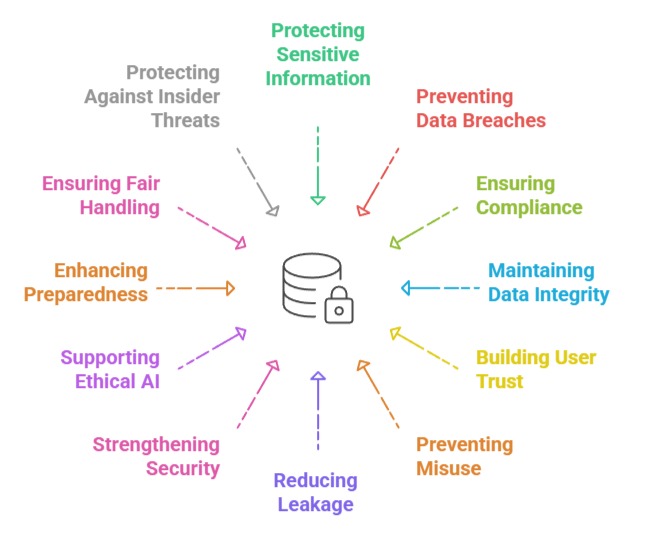
1. Protecting Sensitive User Information
Safeguarding personal data is one of the primary reasons privacy and security are vital in data science.
Many ML projects involve health records, financial transactions, or location patterns, all of which can cause severe harm if exposed.
Protection mechanisms like encryption, anonymization, and strict access controls keep this information inaccessible to unauthorized individuals or systems. Ensuring confidentiality helps prevent identity theft, reputational damage, and exploitation.
By embedding privacy considerations from the beginning, organizations reinforce trust with users and demonstrate ethical handling of their data. Strong privacy protections also support compliance with regulations and industry standards.
2. Preventing Data Breaches and Cyberattacks
Security measures shield digital assets from external threats such as hacking attempts, malware infiltration, data poisoning, and denial-of-service attacks.
Modern ML systems, especially those connected to cloud platforms, face continuous risk from cybercriminals looking for vulnerabilities. Implementing firewalls, intrusion detection systems, and secure network protocols helps reduce exposure to such threats.
These protections are crucial not only for preserving datasets but also for maintaining the integrity of trained models.
Without robust security, attackers could manipulate training data, degrade predictions, or steal proprietary algorithms, leading to major operational and financial consequences.
3. Ensuring Compliance with Legal and Ethical Standards
Privacy and security frameworks are deeply connected to laws such as GDPR, CCPA, HIPAA, and other regional data protection acts.
These regulations dictate how personal data must be collected, processed, and stored, emphasizing user consent and transparency.
Compliance reduces the risk of penalties, lawsuits, and reputational damage. Beyond legal obligations, ethical guidelines promote responsible behavior by encouraging organizations to respect user autonomy and minimize harm.
Meeting these standards strengthens long-term credibility and supports sustainable, trustworthy AI adoption across organizations and industries.
4. Maintaining Data Integrity and Reliability
Integrity ensures that data remains accurate, consistent, and untampered throughout its lifecycle. Without proper security controls, malicious actors could alter or corrupt datasets—either subtly or drastically—compromising model performance.
Even minor manipulations can trigger flawed predictions, leading to harmful or biased outcomes.
Techniques like hashing, digital signatures, and audit trails protect against unauthorized modification.
Ensuring high data integrity also enhances model reliability, as algorithms rely on stable and truthful inputs.
This foundational stability supports fair decision-making and prevents cascading errors in downstream applications.
5. Building User Trust in Data-Driven Systems
Users are more likely to engage with platforms that clearly demonstrate how their information is handled and secured.
Transparent privacy practices, secure storage systems, and ethical data governance signal responsibility and reliability.
When organizations treat data with care, individuals feel more comfortable sharing information that fuels ML insights.
Trust becomes especially critical in applications such as healthcare, finance, and social platforms, where personal data is central.
Maintaining trust also reduces user resistance to technology adoption and encourages smoother integration of AI-driven solutions across everyday services.
6. Preventing Misuse and Unauthorized Sharing of Data
Without proper privacy safeguards, personal information may be shared, sold, or repurposed without user consent.
This misuse could lead to targeted manipulation, discrimination, or financial exploitation.
Security frameworks restrict who can access the data and under what conditions, enabling strict control over distribution.
Ethical data stewardship ensures that collected information is used strictly for intended and communicated purposes.
Combined privacy and security protections restrict internal misuse as well, preventing employees from misappropriating or leaking sensitive information.
These constraints preserve organizational accountability and uphold user rights.
7. Reducing Risks of Data Leakage Across ML Pipelines
Data often moves through several stages—collection, preprocessing, model training, evaluation, and deployment.
At each step, there is a chance of exposure if safeguards are not properly implemented.
Strong privacy and security controls ensure that information remains protected throughout the pipeline, not just at a single point.
This includes secure data transfer protocols, controlled environments for model development, and encrypted storage systems.
By minimizing leakage risks at every stage, organizations preserve the confidentiality of user data and maintain ethical standards.
This layered protection significantly reduces the likelihood of accidental disclosure or system weaknesses being exploited.
8. Strengthening the Security of Deployed Models and APIs
Machine learning models often operate through APIs that interface with external systems, making them attractive targets for attackers.
Securing these endpoints is essential to prevent unauthorized access, model extraction attacks, or attempts to manipulate outputs.
Techniques like rate limiting, token-based authentication, and encrypted communication channels help protect these interfaces.
Securing deployed models also ensures they cannot be reverse-engineered or cloned by competitors.
By reinforcing the security of deployment pipelines and model-serving environments, organizations guarantee reliable and safe operation even under uncertain or hostile conditions.
9. Supporting Ethical AI Development Through Transparency
Transparency is a core principle of ethical AI, and privacy practices contribute directly to this value.
When organizations clearly explain what data is collected, why it is needed, and how it will be handled, users gain better insight and control.
Transparent communication discourages deceptive practices and prevents misuse of personal information for unapproved purposes.
It also encourages users to make informed decisions about data sharing.
As transparency becomes more mainstream, organizations can build stronger relationships with stakeholders and promote responsible AI culture across teams and industries.
10. Enhancing Organizational Preparedness Through Risk Assessments
Conducting periodic risk assessments allows organizations to identify vulnerabilities before they cause harm.
These assessments review data flow, access controls, network security, and compliance frameworks to uncover weak points in current systems.
Regular evaluations help businesses update their privacy and security practices to match evolving threats.
They also prepare organizations for audits, regulatory reviews, or security certifications.
A proactive approach to risk management minimizes the impact of potential breaches and reinforces the overall resilience of the data ecosystem.
This preparedness contributes to long-term business stability and ethical operations.
11. Ensuring Fair and Unbiased Data Handling
Privacy and security mechanisms help ensure that data is stored and used in ways that do not compromise fairness or create discriminatory outcomes.
When personal identifiers are protected or masked properly, models are less likely to unintentionally incorporate them into decision-making processes.
Secure handling also reduces the influence of malicious data manipulation that could introduce bias.
By managing data responsibly, organizations preserve ethical fairness across ML models and reduce the risk of discriminatory or harmful predictions.
This makes ethical safeguards an important companion to data privacy practices.
12. Protecting Against Insider Threats and Internal Misuse
Not all data threats originate from outside; employees, contractors, or system administrators may misuse access intentionally or unintentionally.
Privacy frameworks establish strict internal controls such as role-based permissions, activity monitoring, and audit logging.
Security policies ensure that only individuals with the proper authorization can view or modify sensitive datasets.
These measures reduce opportunities for internal exploitation, accidental data corruption, or unauthorized sharing.
Protecting systems from insider risks is essential for maintaining long-term data integrity and upholding ethical standards within the organization.