Data Science plays a central role in modern organizations by transforming raw data into actionable intelligence that guides strategic, operational, and customer-focused decisions.
As industries generate vast volumes of data—through digital transactions, IoT devices, sensors, applications, and cloud systems—Data Science provides the tools to analyze, model, and optimize complex processes.
Its importance has grown exponentially with advancements in machine learning, big data infrastructures, real-time analytics, and automation.
Whether predicting equipment failure, understanding customer behavior, managing financial risks, or delivering personalized experiences, Data Science enables organizations to operate more efficiently and competitively.
Applications of Data Science span nearly every industry, from healthcare and finance to marketing, logistics, manufacturing, and government services.
Each sector uses data differently, yet all rely on the ability to discover patterns, forecast outcomes, and build intelligent systems.
As technologies like generative AI, edge computing, and autonomous systems evolve, the demand for data-driven insights continues to expand.
The importance of Data Science lies not only in improving decision quality but also in enabling innovation, reducing uncertainty, enhancing productivity, and building future-focused digital ecosystems.
In today’s world, industries that fail to leverage Data Science risk falling behind in efficiency, customer satisfaction, and technological advancement.
Importance of Data Science
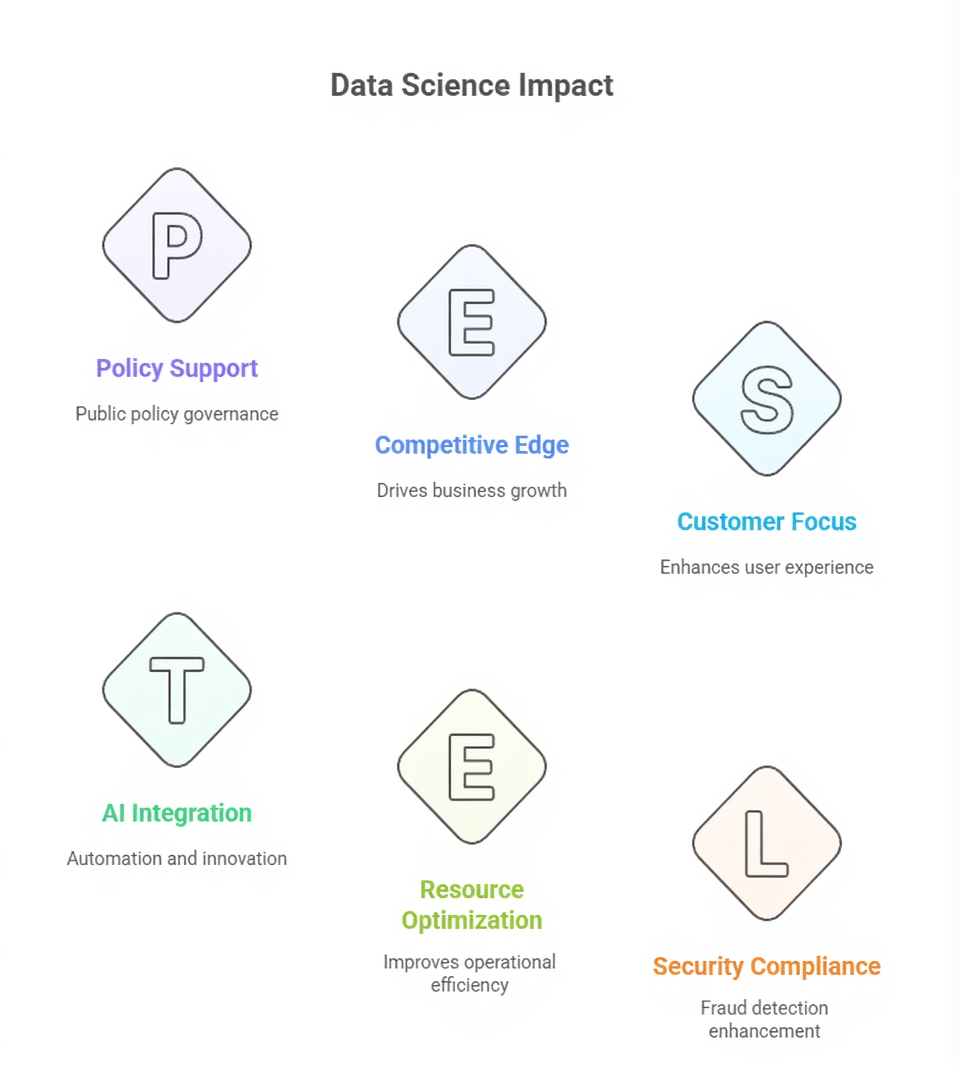 1. Enables Data-Driven Decision-Making
Data Science moves organizations away from guesswork and toward decisions supported by evidence, trends, and analytical models.
Leaders can evaluate scenarios using predictive outcomes instead of relying purely on experience.
This reduces uncertainty, improves judgment, and helps define long-term strategies.
Over time, data-driven cultures become more agile and adaptive to changes.
By continuously feeding data into models, companies refine their decisions as the environment evolves. This foundation makes organizations more resilient and competitive in fast-changing markets.
2. Improves Operational Efficiency
Data Science identifies inefficiencies in workflows, resource usage, and service processes.
Through automation, anomaly detection, and optimization techniques, organizations significantly reduce operational bottlenecks.
Predictive insights help allocate resources more intelligently, avoiding waste and delays. Operations teams use real-time dashboards to monitor performance and respond quickly to issues.
ML algorithms also streamline repetitive tasks, freeing human workers for high-value activities.
This holistic improvement in efficiency leads to cost savings and better service quality.
3. Enhances Customer Experience
Data Science analyzes user behavior, preferences, and interactions to deliver personalized experiences.
Recommendation systems, adaptive interfaces, and targeted promotions help businesses improve satisfaction and engagement.
By understanding customer needs before they express them, companies provide proactive services.
Sentiment analysis helps detect dissatisfaction in real time, allowing rapid improvement.
Customer lifetime value models guide long-term relationship strategies. This creates stronger loyalty and a more meaningful customer journey.
4. Strengthens Risk Management
Through predictive modeling, anomaly detection, and probability analysis, Data Science helps organizations identify risks early.
Financial institutions detect fraudulent transactions instantly using ML algorithms.
Supply chains forecast disruptions and prepare mitigation plans. Healthcare providers anticipate patient complications.
With advanced simulations, companies evaluate the impact of uncertainty and protect themselves from loss.
Robust risk management systems improve trust and protect organizational reputation.
5. Drives Innovation and New Product Development
Data Science uncovers unmet needs, emerging trends, and opportunities hidden within data. Companies design new features, business models, and digital products based on insights about user behavior and market gaps.
Machine learning enhances product functionality through personalization and automation.
Data-driven R&D accelerates experimentation and validation cycles.
Industries that rely on innovation—like tech, healthcare, and finance—use Data Science to lead transformation and outperform competitors.
6. Supports Real-Time Decision Systems
Modern industries require instant responses to dynamic data.
Real-time analytics enables fraud alerts, sensor-based automation, automated trading, demand prediction, and autonomous operations.
Data Science integrates with streaming platforms and edge devices to process information instantly.
This reduces delays, enhances safety, and powers intelligent systems. Real-time decisions are crucial in sectors like transport, cybersecurity, and finance. It marks a shift from reactive to proactive decision-making.
7. Improves Forecasting and Planning Accuracy
Time series forecasting and predictive analytics allow organizations to estimate future trends with greater precision.
Demand planning, workforce scheduling, inventory management, and revenue forecasting become more reliable.
Accurate predictions reduce operational surprises and enhance strategic readiness.
Forecasting also supports budgeting and resource allocation. Industries gain foresight into uncertainties, helping them stay competitive.
8. Drives Competitive Advantage
Organizations that effectively use Data Science outperform competitors in speed, accuracy, and innovation.
They discover market patterns earlier, optimize costs better, and meet customer needs more precisely.
Data-driven companies adapt faster to industry disruptions and technological changes.
Machine learning amplifies these advantages by automating complex tasks. Over time, Data Science becomes a core differentiator in crowded markets.
9. Supports Automation Through AI and ML
Automation powered by ML reduces human workload, minimizes errors, and speeds up decision-making. Intelligent systems handle repetitive tasks, enabling staff to focus on strategy and creativity.
Automated pipelines improve efficiency in data processing, quality checks, and report generation.
This reduces costs and enhances scalability. Automation is especially impactful in manufacturing, IT operations, and logistics where repetitive routines dominate.
10. Enhances Data Security and Fraud Detection
Data Science strengthens cybersecurity by monitoring patterns and detecting unusual activities in real time.
ML models identify suspicious behaviors, whether in financial transactions, login attempts, or network traffic.
Threat detection systems evolve as attacks change. Predictive analytics help prevent losses before they occur.
This builds safer digital ecosystems for both organizations and individuals.
11. Supports Evidence-Based Public Policy and Governance
Governments use Data Science to analyze demographics, monitor public services, allocate budgets, and optimize infrastructure planning.
Policies based on real data produce fairer and more effective outcomes.
Predictive models help evaluate the long-term impact of policy decisions.
Data dashboards enhance transparency and public accountability. Smart city initiatives heavily rely on Data Science to manage transportation, waste, and utilities.
12. Facilitates Scalability and Growth
As businesses grow, Data Science helps manage increasing data complexity through automation, cloud solutions, and scalable ML models. Organizations expand operations without compromising efficiency.
Scalable analytics supports rapid experimentation and faster decision cycles.
It enables smooth adaptation to new markets, product lines, and consumer demands. Long-term growth becomes more structured and data-aligned.
Applications of Data Science in Various Industries
Across every major industry, Data Science powers prediction, personalization, and optimization at scale. By combining analytics, machine learning, and real-time data, businesses and governments are solving problems faster and creating sustainable competitive advantages.
1. Healthcare Analytics and Diagnosis
Data Science helps detect diseases early through predictive models, medical imaging analysis, and patient-risk scoring.
Hospitals use algorithms to identify high-risk patients and adjust treatment plans.
Wearable devices generate continuous data for remote monitoring. AI-assisted diagnostics improve accuracy and speed.
Drug discovery becomes faster with ML-based pattern recognition. This improves patient outcomes while reducing healthcare costs.
2. Finance and Fraud Detection
Financial institutions use Data Science for credit scoring, fraud detection, algorithmic trading, and risk modeling.
ML algorithms spot suspicious activity in real time, reducing financial crime.
Predictive models assess loan default probability more accurately than traditional methods.
Portfolio management systems optimize investment strategies. Banks also personalize financial products based on customer behavior. This builds safer and more efficient financial systems.
3. Retail and E-Commerce Personalization
Retailers analyze purchasing patterns, browsing behavior, and customer preferences to personalize product recommendations.
Dynamic pricing optimizes revenue based on demand and trends. Inventory forecasting ensures products are stocked efficiently.
Customer segmentation drives targeted marketing. Retail analytics improves store layouts and online user experiences.
These capabilities significantly boost sales and customer satisfaction.
4. Manufacturing and Predictive Maintenance
Sensors and IoT devices generate machine data that Data Science uses to predict equipment failures before they occur.
Predictive maintenance reduces downtime and repair costs. Production lines are optimized using real-time analytics.
Quality control becomes more accurate with computer vision systems.
This enhances productivity and safety. Data-driven manufacturing supports Industry 4.0 and smart factory initiatives.
5. Transportation and Autonomous Systems
Data Science powers route optimization, traffic prediction, demand planning for public transport, and vehicle-tracking systems.
Ride-sharing companies use algorithms for pricing and driver allocation.
Autonomous vehicles rely heavily on ML for perception, navigation, and decision-making.
Airlines optimize schedules and fuel usage using predictive analytics. These advancements create safer, faster, and more efficient mobility solutions.
6. Marketing and Customer Insights
Marketers use Data Science to understand customer journeys, campaign performance, and market trends.
Predictive models identify which customers are likely to purchase or churn. Sentiment analysis evaluates public opinion.
ML-driven targeting improves campaign ROI. Marketing automation optimizes interactions across channels.
This results in stronger engagement and higher conversion rates.
7. Supply Chain and Logistics Optimization
Supply chains use Data Science to forecast demand, optimize routes, reduce delivery time, and prevent stockouts.
Predictive analytics identifies risks such as delays or disruptions. Real-time tracking improves visibility across the supply network. Optimization algorithms reduce transportation costs.
These capabilities enhance reliability and customer satisfaction. Data-driven logistics is critical for e-commerce and global trade.
8. Energy and Utilities Management
Data Science helps monitor energy consumption, predict demand, and optimize grid performance.
Smart meters generate real-time usage data. Predictive maintenance prevents outages and equipment failures.
Renewable energy forecasting improves sustainability initiatives. AI supports automation in power distribution. This leads to cost savings and reduced environmental impact.
9. Education Analytics and Personalized Learning
Educational institutions analyze student performance, learning patterns, and engagement to personalize learning pathways.
Predictive models identify students at risk of dropping out. Adaptive learning platforms customize content difficulty.
Institutions evaluate curriculum effectiveness using analytical insights. Data Science also supports resource planning and academic improvements. This enhances learning outcomes for students.
10. Government and Public Sector Optimization
Governments rely on Data Science for urban planning, tax analysis, resource allocation, and public health monitoring.
Smart city systems use real-time data to manage traffic, pollution, and waste. Predictive models inform disaster management and emergency response.
Social welfare programs become more efficient through analytics. This ensures better governance and citizen services.
11. Agriculture and Food Technology
AgriTech uses Data Science for crop yield prediction, soil analysis, weather forecasting, and pest detection.
Drones and sensors monitor field conditions. ML models optimize irrigation and fertilizer usage.
Supply chains become more efficient through demand forecasting. Smart farming increases productivity and sustainability. This modernizes agriculture for a growing global population.
12. Media, Entertainment, and Streaming Platforms
Streaming platforms analyze user preferences to recommend content and predict engagement patterns.
Data Science drives content development decisions by identifying trending genres and audience behavior.
ML models detect copyright violations and automate moderation. Personalized advertising boosts revenue.
These insights help platforms retain users and deliver engaging experiences.