Basic programming concepts form the backbone of all data science and machine learning workflows.
They help learners understand how instructions are structured, how computers execute those instructions, and how logic is built into code.
In Python—the most widely used language in DS/ML—syntax refers to the specific rules that define how statements must be written so they run correctly.
Concepts such as variables, data types, conditional statements, loops, functions, and indentation create the framework for building data pipelines, transformation scripts, and machine learning algorithms.
For example, defining variables allows you to store dataset paths, model hyperparameters, or intermediate results.
Conditional statements help control model behavior based on performance metrics, while loops simplify repetitive tasks such as iterating through rows, training models across different configurations, or generating batches of data.
These fundamentals may seem simple, but they become the fuel that powers all advanced topics in machine learning, from feature engineering to model deployment.
Examples
1. Variables
learning_rate = 0.01

dataset_path = "data/train.csv"
2. Conditional Statements
if accuracy > 0.90:

    print("Model is performing well!")
3. Loops
for epoch in range(10):

    model.train()
4. Functions
def normalize(x):

    return (x - x.mean()) / x.std()
Importance of Basic Programming
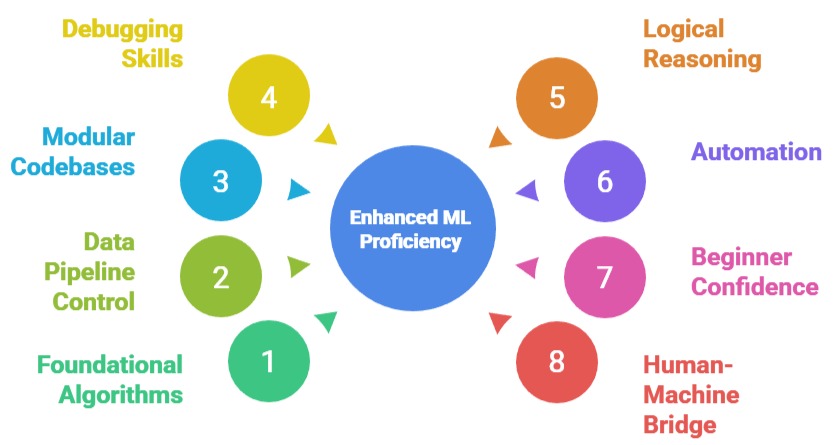
1. Establishes the Foundation for All ML Algorithms
Understanding basic programming constructs gives learners the grounding needed to implement machine learning algorithms from scratch.
Concepts like loops and conditionals allow you to mimic what libraries do internally, such as calculating loss functions or updating weights.
Variables help store intermediate values as models process data, while proper syntax ensures the logic flows without errors.
Even though ML libraries automate many tasks, knowing the fundamentals enables debugging and customization when models do not behave as expected.
This foundation empowers developers to go beyond prebuilt tools and explore algorithm-level improvements.
2. Enables Precise Control Over Data Pipelines
Data preparation is the most time-consuming part of data science, and basic programming elements make it manageable.
By using loops, conditionals, and functions, one can automate tasks like cleaning missing values, applying transformations, or filtering outliers.
Proper syntax ensures data flows through each step in a predictable and reproducible manner.
These constructs also support integrating multiple datasets, creating repeatable workflows, and implementing logic-based rules for preprocessing.
Without these basics, building scalable data pipelines would be far less efficient and more prone to errors.
3. Helps Build Modular and Maintainable Codebases
Functions, variables, and indentation rules in Python encourage a clean programming style where tasks are broken down into smaller units.
In a machine learning workflow, modular code allows data loading, preprocessing, model training, and evaluation to remain organized and independent.
This structure improves readability, especially in collaborative environments.
It also becomes easier to test individual components, replace parts of a pipeline, or expand functionality without rewriting everything.
By mastering these basic concepts, developers create workflows that are both elegant and adaptable.
4. Enhances Debugging and Error Handling Skills
Syntax mastery reduces errors and makes troubleshooting more systematic.
When code breaks during model training or data transformation, the ability to interpret error messages and trace back to faulty logic becomes essential.
Basic constructs like try–except blocks provide mechanisms to gracefully handle unexpected scenarios such as missing files or incompatible datatypes.
Debugging often reveals deeper insights into how algorithms and libraries operate, strengthening the developer’s grasp of computational thinking. This skill becomes indispensable when working on complex ML tasks.
5. Strengthens Logical Reasoning and Problem-Solving Abilities
Programming constructs such as loops, branching logic, and functions require analytical reasoning.
Writing code naturally develops the ability to break down a complex ML task—like hyperparameter tuning—into step-by-step instructions.
This mindset helps data scientists navigate challenges such as optimizing models, organizing experiments, or analyzing performance bottlenecks.
Logical thinking also ensures that each operation contributes meaningfully to the final output.
Over time, problem-solving becomes faster and more intuitive, allowing developers to design smarter and more efficient ML workflows.
6. Supports Automation and Reusability Across ML Projects
Machine learning often involves repetitive processes: reading datasets, training models multiple times, evaluating metrics, or generating visualizations.
Basic programming syntax enables automation through functions and loops, significantly reducing manual effort.
This leads to reproducible experiments where results can be regenerated with minimal effort.
Reusable code segments also speed up future projects, as components such as scaling functions, validation routines, or plotting scripts can be applied repeatedly.
Automation directly contributes to higher productivity and improved research consistency.
7. Gives Beginners Confidence to Explore Advanced Tools
Mastering the basics removes intimidation and allows learners to interact comfortably with advanced libraries like scikit-learn, TensorFlow, PyTorch, or XGBoost.
Understanding syntax prevents confusion when reading documentation or interpreting examples.
As students feel more confident writing simple scripts, they gradually develop the mindset needed to structure complex ML experiments.
This confidence often accelerates learning and encourages deeper exploration into specialized topics like deep learning, model deployment, and MLOps.
8. Bridges Human Thought and Machine Execution
Programming syntax is the language that converts analytical ideas into actionable steps that a computer can understand.
This bridge is essential in machine learning, where concepts like loss minimization, gradient computation, or data encoding become executable processes.
Proper syntax ensures the computer processes instructions in the precise order intended.
This translation from conceptual reasoning to runnable code is what transforms theoretical ML knowledge into real-world applications.
Without this skill, even the most advanced ML concepts would remain entirely abstract.