Machine Learning (ML) is a branch of artificial intelligence that focuses on enabling systems to learn patterns from data and make predictions or decisions without being explicitly programmed for every situation.
Instead of relying on rigid rules, ML models examine examples, identify relationships, adjust internal parameters, and continuously improve their performance as more data becomes available.
This allows machines to automate complex tasks such as classification, forecasting, anomaly detection, recommendation, and decision-making.
In modern data-driven industries, ML sits at the core of intelligent applications—ranging from fraud detection and customer segmentation to self-driving vehicles and personalized healthcare.
Depending on the nature of the data and the learning objective, ML is broadly categorized into three major paradigms: supervised learning, unsupervised learning, and reinforcement learning, each offering unique capabilities and use cases.
Supervised Learning
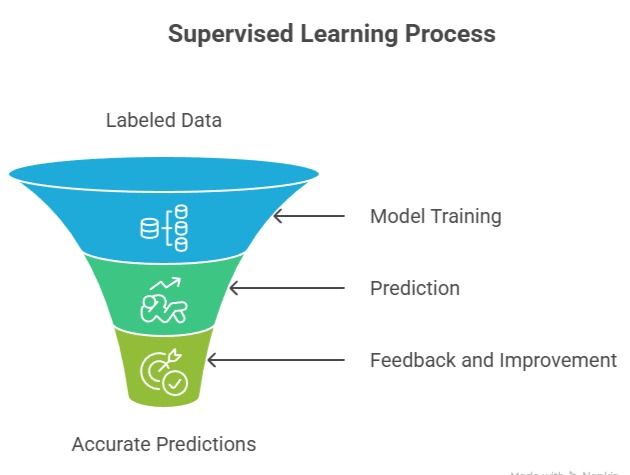
Supervised learning is a branch of machine learning where the model is trained using labeled examples.
Each data point comes with an input and a known output, allowing the algorithm to learn the mapping between the two.
The goal is to generalize this mapping so the system can predict outputs for unseen data.
It is widely used when historical data clearly defines the correct outcomes. Because it relies on explicit labels, supervised learning typically delivers highly accurate predictions in well-structured environments.
1. Learns from labeled examples to predict outcomes
Supervised learning relies on datasets where each input is paired with a correct answer (label).
The model’s goal is to learn the mapping between features and labels so it can predict unseen outcomes accurately.
This setup is commonly used in spam detection, where emails are tagged as “spam” or “not spam,” or in price prediction tasks where numerical outputs are required.
The model learns patterns through iterative training, minimizing errors between predicted and actual labels.
2. Supports both classification and regression tasks
Two broad categories exist under supervised learning: classification for predicting categories and regression for predicting continuous values.
Classification tasks may involve determining whether a customer will churn, while regression tasks may estimate house prices.
These two dimensions allow supervised learning to solve a wide range of structured prediction problems.
3. Requires high-quality labeled data
Since the model learns directly from examples, the dataset must be accurate and representative.
Poor labeling or unbalanced classes can misguide learning and degrade model performance.
For instance, a medical image classifier trained on biased labels may fail to generalize across different demographics.
4. Example
Predicting student exam scores based on study hours, attendance, and practice tests is a regression-based supervised learning problem.
Unsupervised Learning
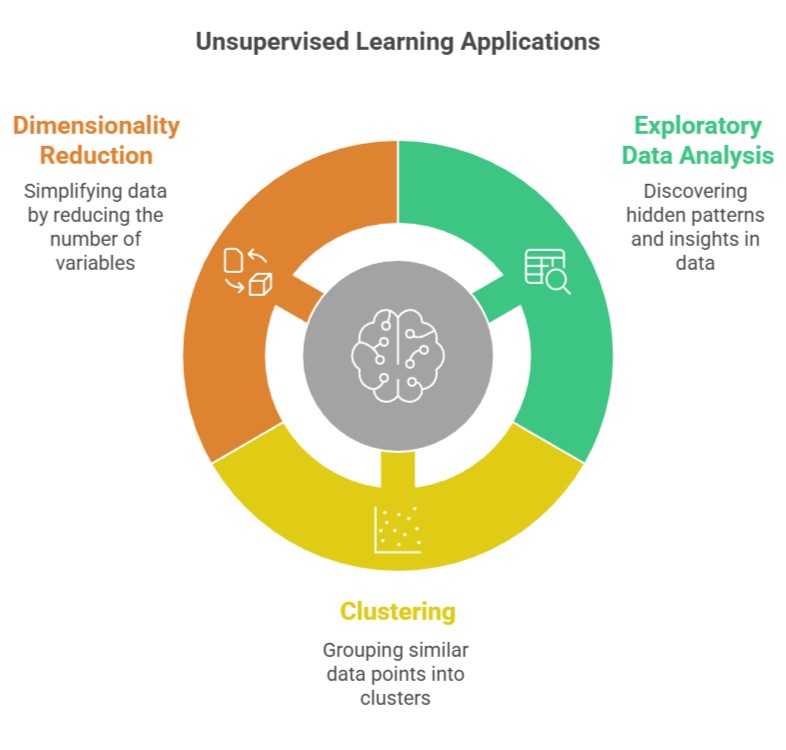
Unsupervised learning focuses on exploring data that has no predefined labels.
The system is tasked with uncovering natural structures, relationships, or patterns within the dataset.
Instead of predicting a specific outcome, it discovers hidden insights that may not be obvious through manual analysis.
This is especially useful when datasets are large, complex, or unorganized.
1. Discovers hidden patterns without predefined labels
In unsupervised learning, the algorithm receives raw data without any guidance on what the correct output should be.
The model aims to uncover structure, group items, detect anomalies, or extract key features.
This makes it extremely valuable when labels are expensive or impractical to obtain, such as in large-scale customer datasets.
2. Common techniques include clustering and dimensionality reduction
Clustering algorithms like K-Means group similar items together, while dimensionality reduction methods like PCA simplify high-dimensional data for easier visualization.
These approaches help analysts explore complex datasets and identify natural groupings.
3. Enables pattern discovery for downstream ML tasks
Unsupervised learning often acts as a preliminary step for supervised tasks.
For example, clustering customers by behavior can enhance targeted marketing strategies. Similarly, PCA reduces noise and accelerates model training in high-dimensional spaces.
Example: Segmenting customers into behavior-based groups using purchasing history is a typical unsupervised learning application.
Reinforcement learning
Reinforcement learning revolves around the concept of learning through interactions.
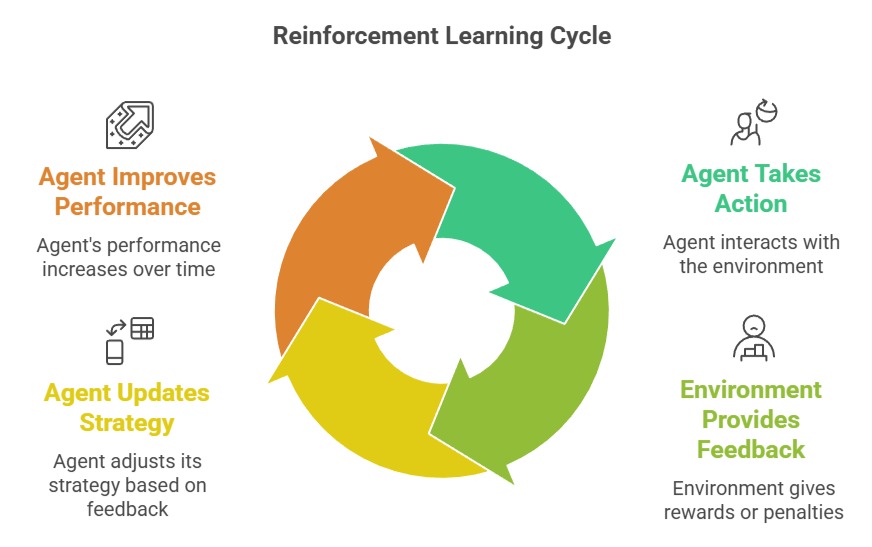
Rather than relying on labeled data, the algorithm continuously makes decisions in an environment, receives feedback in the form of rewards or penalties, and adapts based on the consequences of its actions.
Over time, it learns strategies that maximize long-term rewards. This approach shines in situations where sequential decision-making and exploration are essential.
1. Learns by interacting with an environment and receiving feedback
Reinforcement learning (RL) differs from supervised and unsupervised learning by using trial-and-error interactions.
The model, called an agent, observes the environment, performs actions, and receives rewards or penalties.
Its objective is to maximize long-term cumulative reward.
2. Ideal for decision-making and sequential tasks
RL is well-suited for scenarios where actions influence future states, such as navigation, robotics, supply chain optimization, and game-playing.
The agent continuously refines its strategy (policy) through repeated episodes of exploration and exploitation.
3. Balances exploration vs. exploitation
A key challenge in RL is deciding when to test new strategies (exploration) versus relying on known successful actions (exploitation).
Effective balancing leads to optimal policy discovery, particularly in large or uncertain environments.
Example: Teaching a robot to move through a maze by rewarding correct turns and penalizing collisions is a classic reinforcement learning task.