Data Science is an interdisciplinary field that involves collecting, processing, analyzing, and modeling data to extract meaningful insights, identify patterns, and support decision-making using techniques from statistics, computer science, and machine learning.
Modern Data Science goes beyond just analysis; it integrates automation, large-scale data processing, cloud computing, and AI-driven models.
It also emphasizes ethical responsibility, transparency, and fairness as data-driven solutions impact societies and industries.
Whether predicting market behavior, optimizing healthcare systems, enabling personalized recommendations, or improving supply chain efficiency, Data Science is central to strategic decision-making and innovation.
With the rise of generative AI, MLOps, and real-time analytics, Data Science continues to evolve, demanding continuous learning and adaptability from practitioners.
Key Important Points of Data Science
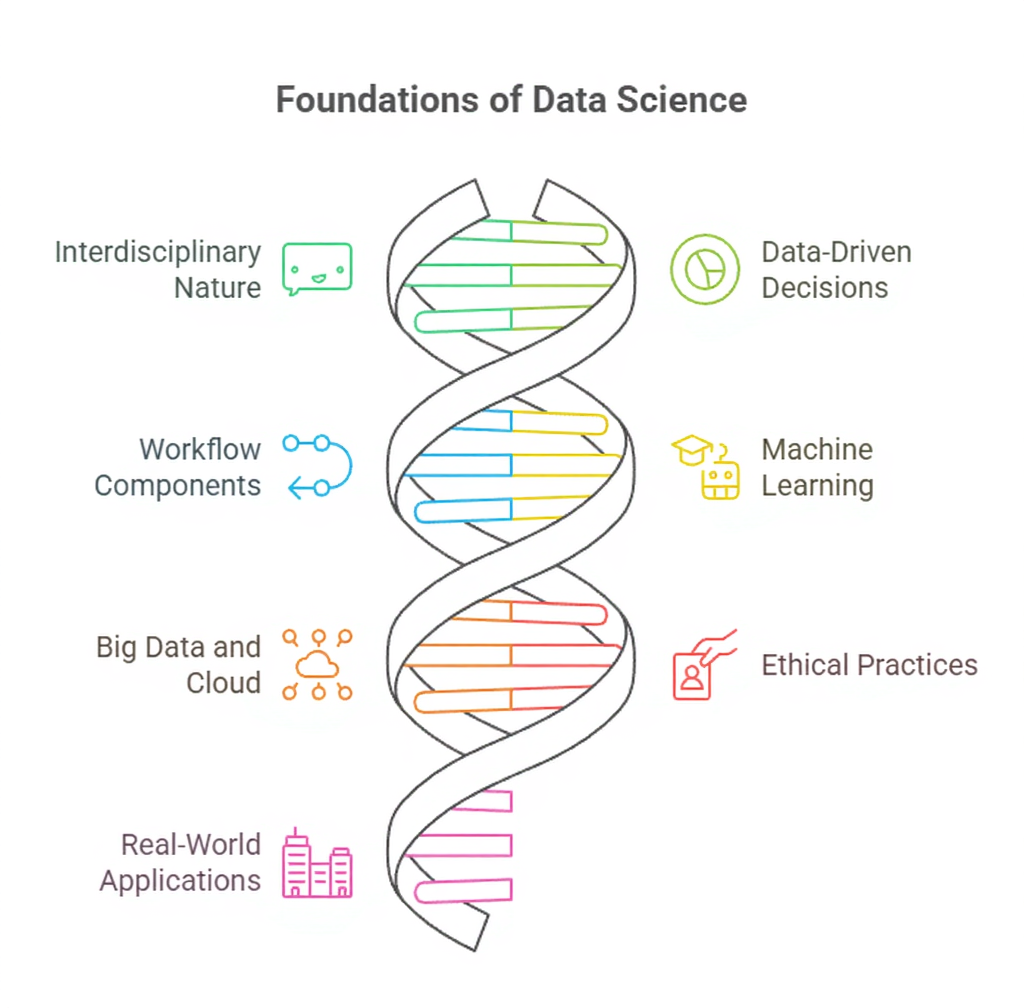
1. Data Science as an Interdisciplinary Field
Data Science brings together statistics, computer science, mathematics, and domain expertise to uncover insights from data.
It requires understanding how data behaves, how to manipulate it, and how to model real-world phenomena.
The interdisciplinary nature enables analysts to ask the right questions and design solutions grounded in industry needs.
Collaboration among experts leads to more accurate and robust outcomes. A data scientist must balance technical skills with critical thinking and creative problem-solving.
2. Role of Data in Modern Decision-Making
Data Science empowers organizations to move from intuition-based choices to evidence-driven strategies.
Companies rely on data patterns to forecast demand, optimize operations, and personalize customer experiences.
Real-time analytics helps detect anomalies, improve security, and enhance product performance.
Decision-makers can evaluate alternative scenarios using predictive models, reducing uncertainty. With data at scale, organizations gain competitive advantages by identifying trends earlier.
3. Core Components of Data Science Workflow
A typical Data Science project follows a systematic process: data collection, preparation, exploration, modeling, and deployment.
Each phase ensures that insights are accurate, reliable, and actionable.
Data cleaning removes errors and inconsistencies that could distort results. Exploratory analysis helps uncover relationships and anomalies that guide model selection.
learning models transform raw data into predictions and classifications.
4. Importance of Machine Learning in Data Science
Machine learning is a foundational pillar of Data Science, enabling systems to learn from data rather than relying on explicit programming.
Supervised, unsupervised, and reinforcement learning methods power applications such as fraud detection, recommendation engines, and autonomous systems.
ML enhances pattern recognition and prediction accuracy, especially with large datasets. Advances in deep learning have unlocked capabilities such as image recognition, speech processing, and generative AI.
5. The Role of Big Data and Cloud Technologies
As data volume grows, traditional systems fail to handle scale. Big data technologies like Hadoop, Spark, and NoSQL databases support distributed processing and high-speed analytics.
Cloud platforms—AWS, Azure, GCP—enable on-demand storage, scalable computing, and automated model deployment. These tools democratize Data Science by reducing infrastructure costs and complexity.
6. Ethical, Transparent, and Responsible Data Practices
Modern Data Science emphasizes responsible use of data to avoid bias, discrimination, and privacy violations.
Ethical frameworks guide how data is collected, stored, and analyzed. Transparency in algorithms ensures stakeholders understand how decisions are made.
Explainability tools like SHAP and LIME help uncover how models behave internally.
7. Real-World Applications Across Industries
Data Science powers innovation in healthcare, finance, marketing, manufacturing, logistics, education, and more.
Predictive analytics helps doctors diagnose diseases earlier, financial institutions detect fraud, and retailers forecast sales.
Recommendation systems enhance user engagement on platforms like Netflix and Amazon.