Ethical product design and user experience (UX) focus on creating digital products, services, and AI systems that are not only functional and engaging but also aligned with ethical principles, societal norms, and user well-being.
This submodule emphasizes designing systems that prioritize user rights, privacy, fairness, accessibility, and informed interaction, ensuring technology supports human values rather than exploiting vulnerabilities.
In today’s data-driven world, user experience is intertwined with ethical considerations. Poorly designed interfaces, opaque decision-making, or manipulative features can lead to harm, discrimination, or mistrust.
Ethical product design goes beyond visual aesthetics and usability—it integrates responsible data handling, transparent algorithms, and inclusive design practices into every stage of the product lifecycle.
Ethical User Experience (UX) Design in Responsible AI
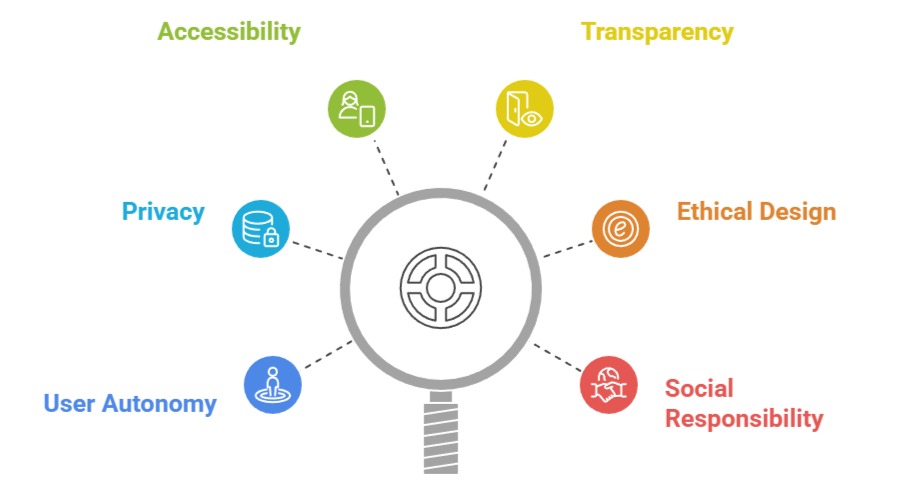
1. Designing for User Autonomy and Informed Choice
Ethical product design ensures users retain control over decisions and understand the implications of their interactions.
Features like clear consent, customizable settings, and transparent algorithmic outputs empower users to make informed choices.
Protecting autonomy prevents manipulation through dark patterns, excessive nudges, or hidden defaults.
This approach fosters trust and ensures that technology supports rather than coerces human behavior.
Respecting autonomy is central to ethical engagement and long-term user satisfaction.
2. Integrating Privacy and Data Protection
Products must safeguard personal data, providing transparency about what is collected, stored, and shared.
Ethical design incorporates privacy-by-design principles, anonymization techniques, and clear communication about data usage.
Protecting sensitive information builds user confidence, reduces regulatory risk, and prevents exploitation of personal data.
Privacy-conscious UX also ensures that users feel safe while interacting with the product, creating a foundation of trust and responsible engagement.
3. Accessibility and Inclusive User Interfaces
Ethical UX considers diverse user needs, including disabilities, cultural differences, and varying technological literacy.
Interfaces should support screen readers, high-contrast visuals, voice commands, and adaptable navigation.
Inclusive design ensures equitable access and prevents marginalization of underrepresented groups.
Ethical accessibility increases usability, widens audience reach, and demonstrates commitment to social responsibility in technology deployment.
4. Transparent Algorithmic Interactions
Users should understand how product features powered by AI or algorithms make decisions that affect them.
Providing explanations, confidence levels, or visual cues about automated processes enhances interpretability.
Transparency reduces confusion, builds accountability, and allows users to challenge or verify outputs.
Ethical design ensures that algorithmic interactions are not opaque or manipulative, promoting fairness and trust in the product.
5. Avoiding Dark Patterns and Manipulative Design
Ethical product design actively avoids tactics that manipulate user behavior for commercial or organizational gain, such as misleading prompts, hidden opt-outs, or forced choices.
By removing coercive design elements, products respect user autonomy and enhance satisfaction.
Ethical UX discourages exploitative engagement strategies, aligning business goals with responsible and transparent user interaction.
6. Socially Responsible Personalization
While personalization can enhance user experience, it must be applied without reinforcing biases or creating filter bubbles.
Ethical design evaluates personalization mechanisms for fairness, privacy, and potential negative societal effects.
Responsible personalization ensures equitable access to information and opportunities, maintaining inclusivity while enhancing relevance.
Ethical UX balances engagement with respect for user diversity and social impact.
Importance of Ethical Product Design and User Experience
1. Protects Users from Harm
Ethical product design ensures that users are safeguarded from manipulation, privacy violations, and discriminatory outcomes.
By integrating safeguards against exploitative features, misleading interfaces, and coercive design patterns, products prevent both direct and indirect harm.
This includes protecting sensitive personal data and avoiding features that encourage compulsive behavior.
Designing responsibly also reduces the likelihood of reputational damage or legal repercussions for organizations.
Ultimately, harm prevention is central to building technology that respects human rights, supports well-being, and fosters a safe user environment.
2. Enhances User Trust and Confidence
Transparent and responsible design builds credibility between users and technology providers.
When users clearly understand how data is collected, how algorithms function, and how their choices affect outcomes, they are more likely to trust the product.
Trust also encourages long-term engagement, loyalty, and advocacy.
Ethical UX demonstrates that the organization values user autonomy, consent, and privacy.
This trust is particularly important in sensitive domains such as healthcare, finance, and education, where confidence in the system is essential for adoption and compliance.
3. Promotes Inclusivity and Accessibility
Designing ethically means considering the diverse abilities, cultural backgrounds, and technological literacy of all users.
Accessible interfaces allow people with disabilities, language barriers, or varying digital experience levels to interact effectively.
Inclusive design not only widens the product’s reach but also ensures equitable access to technology and prevents the marginalization of underrepresented groups.
Products that prioritize accessibility demonstrate social responsibility and a commitment to fairness, creating a more just and inclusive technological environment.
4. Reduces Bias and Promotes Fairness
Ethical product design mitigates the risk of bias in algorithms, content delivery, and user interfaces.
By auditing data sources, considering diverse user scenarios, and testing outcomes across multiple demographics, designers can prevent discriminatory patterns.
Fairness ensures that no group is disproportionately disadvantaged or excluded. Incorporating fairness into UX strengthens societal equity and prevents systemic harm.
Bias reduction also contributes to regulatory compliance and protects organizations from ethical and legal controversies.
5. Supports Compliance with Laws and Regulations
Products designed ethically align with laws governing privacy, accessibility, data protection, and consumer rights.
Compliance with standards such as GDPR, ADA, and emerging AI ethics guidelines reduces the risk of penalties and litigation.
Ethical design integrates legal obligations into the development process rather than treating them as afterthoughts.
This proactive approach protects both users and organizations while demonstrating a commitment to responsible innovation. Meeting regulatory requirements also signals credibility and accountability to stakeholders.
6. Facilitates Long-Term Sustainability and Societal Benefit
Ethical product design considers not only immediate usability but also long-term social, cultural, and environmental impacts.
Sustainable design reduces negative consequences, such as digital exclusion, environmental waste, or misuse of AI systems.
Products that are socially responsible create lasting value for users and society at large.
Organizations that embed ethics into design are better prepared for future challenges and can maintain relevance, trust, and credibility over time.
Long-term thinking strengthens resilience and aligns technology with human values.
7. Encourages Continuous Improvement Through Feedback
Ethical design integrates mechanisms for user feedback and iterative refinement. Collecting input from diverse populations helps identify potential issues, unintended consequences, or areas of improvement.
Iterative evaluation ensures that products evolve responsibly and remain aligned with ethical and human-centered principles.
Continuous improvement also helps organizations respond to emerging societal norms, technological advancements, and user expectations.
A feedback-driven approach strengthens product reliability, fairness, and inclusivity over time.
8. Builds Organizational Reputation and Competitive Advantage
Organizations that implement ethical product design signal their commitment to responsibility, fairness, and user welfare.
Ethical practices enhance public perception, attract socially conscious customers, and foster trust among employees and partners.
Demonstrating leadership in ethical UX differentiates companies in competitive markets.
Moreover, ethical credibility reduces the risk of controversies, lawsuits, and regulatory scrutiny. By integrating ethics into design, organizations can achieve both social impact and business success.
Recommendations and Next Steps
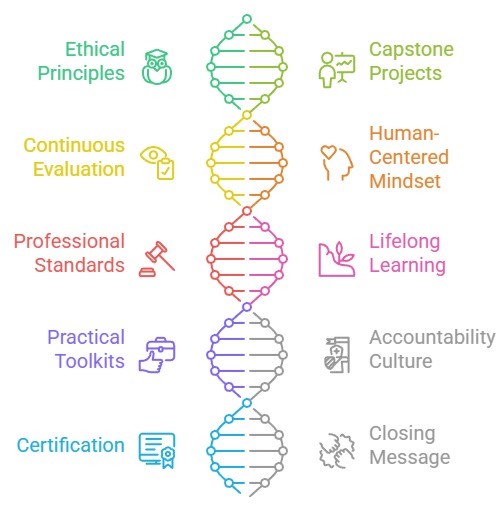
1. Reflect on Ethical Principles Across Modules
Encourage learners to revisit key concepts from all previous modules—data privacy, fairness, bias, transparency, and human-centered design.
Reflecting on how these principles interconnect reinforces the importance of a holistic ethical approach.
Consider assigning a short reflective activity or discussion where learners summarize how ethical design influences real-world outcomes.
2. Apply Learning Through Capstone Projects
Conclude the course with a hands-on project where learners design a small AI or data-driven product with ethical considerations embedded. Tasks can include
Ensuring user privacy and data protection
Designing accessible and inclusive interfaces
Identifying potential biases and mitigating them
Creating transparent and explainable workflows
This practical exercise consolidates theoretical knowledge and demonstrates how ethical principles translate into actionable design.
3. Encourage Continuous Ethical Evaluation
Ethical product design is iterative, not one-time. Learners should understand that monitoring, auditing, and feedback are ongoing processes.
Encourage learners to implement continuous evaluation frameworks, perform impact assessments, and update systems as societal norms and regulations evolve.
4. Foster a Human-Centered Mindset
Conclude by emphasizing the importance of empathy, inclusivity, and user advocacy in all future projects.
Encourage learners to always consider diverse perspectives, prioritize user well-being, and make design decisions that respect autonomy and fairness.
Human-centered thinking ensures ethical sustainability in any data science role.
5. Introduce Professional Standards and Guidelines
Recommend that learners familiarize themselves with ethical frameworks and professional standards, such as
IEEE Ethically Aligned Design Guidelines
ACM Code of Ethics for Data and AI
GDPR and accessibility regulations (ADA, WCAG)
Understanding these standards equips learners to apply ethics consistently in professional environments.
6. Encourage Lifelong Learning in Ethics
Ethics in data science evolves with technology, societal expectations, and legal regulations.
Conclude the course by stressing the importance of staying updated with emerging challenges in AI, automation, IoT, and human-centered design.
Encourage learners to read research papers, attend webinars, and participate in professional networks to maintain ethical awareness.
7. Provide Practical Toolkits and Resources
End with actionable resources to support ethical practices:
Checklists for ethical UX design and AI model evaluation
Guides for bias detection and mitigation
Tools for data anonymization, transparency, and monitoring
Case studies demonstrating successes and failures in ethical design
These resources allow learners to immediately apply course concepts in real-world scenarios.
8. Promote a Culture of Accountability
Encourage learners to become advocates for ethical practices in their organizations.
Ethical responsibility is not only a personal commitment but also a professional obligation.
By promoting accountability, learners can influence team decisions, design processes, and product outcomes positively.
9. Certification or Portfolio Development
As a final step, learners can create a portfolio demonstrating their understanding of ethical design and human-centered UX.
This can include ethical audits of hypothetical or real projects, redesigns addressing inclusivity, or case study analyses.
A tangible portfolio reinforces learning and is valuable for career development.
10. Closing Message
Conclude the course by reinforcing the core idea: ethics is not a constraint—it is a catalyst for innovation, trust, and societal impact.
Encourage learners to carry forward the principles of responsibility, transparency, inclusivity, and human-centered design into every data science decision they make.