Fairness in machine learning refers to designing predictive models that make decisions without causing unjust or discriminatory outcomes for specific individuals or demographic groups.
As ML systems increasingly influence hiring, lending, medical diagnosis, insurance pricing, policing, and educational recommendations, ensuring fairness is no longer optional—it is a moral, legal, and societal necessity.
Predictive models learn from historical data, which often contains human biases, structural inequalities, or skewed patterns.
Without careful testing, these models can unintentionally reproduce or even amplify those biases.
Fairness in ML involves understanding how predictions differ across demographic groups, evaluating disparities through statistical fairness metrics, and applying techniques to correct unfair behavior.
Fairness as a Core Ethical Principle in Machine Learning
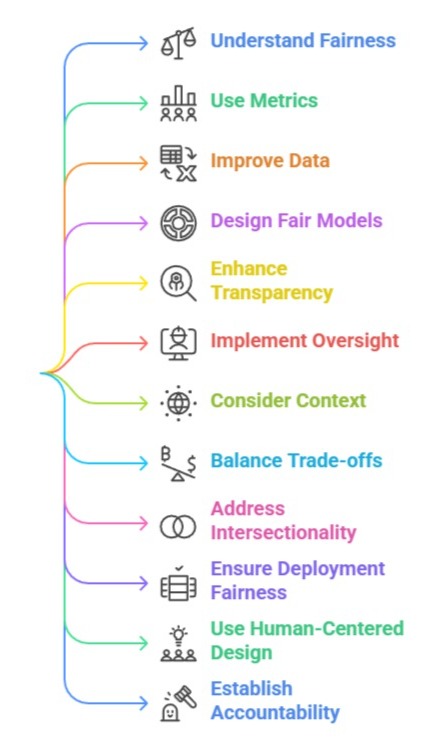
1. Understanding Fairness as a Multi-Dimensional Concept
Fairness in ML is not a single rule but a set of principles that differ depending on context and societal values.
It includes fairness in outcomes, fairness in opportunity, and fairness in treatment across groups.
Developers must decide what type of fairness aligns best with the domain—whether equal false-positive rates, equal acceptance rates, or equal accuracy across groups.
Fairness also requires understanding the social impact of decisions and the potential harm unfair models may cause.
Because different fairness definitions can conflict, selecting the right fairness goal is a critical ethical responsibility.
2. Statistical Fairness Metrics and Evaluation Approaches
Fairness metrics such as demographic parity, equal opportunity, equalized odds, predictive parity, and disparate impact help measure whether predictions treat groups equitably.
Each metric captures a different aspect of fairness—some focus on acceptance rates, others on error distribution or calibration.
These metrics are used to audit models during development and deployment to detect disparities.
Choosing the right metric involves considering legal standards, domain-specific norms, and the ethical implications of each trade-off. Fairness evaluation must be performed continuously, not just once during model training.
3. Ensuring Fairness Through Data Quality and Representation
Data quality plays a foundational role in ML fairness. Underrepresentation of certain groups can lead to higher error rates for those populations, while noisy or biased labels can distort model learning.
Fairness begins with data profiling, identifying demographic gaps, and correcting imbalances through sampling techniques or targeted data collection.
Developers must examine labels for hidden stereotypes and ensure features do not indirectly encode sensitive attributes.
High-quality, diverse, context-aware data is essential for building equitable predictive models.
4. Fair Model Design and Algorithm Selection
Some algorithms are more interpretable and fairness-friendly, while others may encode complex patterns that hide bias.
Linear and rule-based models offer transparency but may lack expressiveness, while deep models can learn subtle biases if not monitored.
Fairness-aware algorithms incorporate constraints or regularizers that limit discriminatory behavior during training.
Adversarial debiasing, reweighting, and fairness-optimized loss functions help embed fairness directly into the model.
Selecting algorithms based on fairness as well as accuracy leads to more ethical outcomes.
5. Explainability and Transparency as Fairness Enhancers
Explainable AI tools such as SHAP, LIME, and model interpretability frameworks help developers understand why models behave a certain way. Transparency exposes whether predictions depend on sensitive attributes or their proxies.
Explainability is essential for regulatory compliance, stakeholder trust, and ethical validation.
When explanations reveal discriminatory factors, developers can adjust features, redesign the model, or apply fairness techniques.
Explainable models allow organizations to justify decisions, reduce hidden bias, and build public confidence.
6. Human Oversight and Governance for Fair Predictive Models
Fairness cannot rely solely on algorithms—human oversight is essential.
Domain experts validate fairness from real-world perspectives, while governance structures ensure accountability.
Ethics boards, audit committees, and fairness review teams establish guidelines for acceptable bias levels and conduct regular checks.
User feedback loops allow impacted individuals to report unfair outcomes.
Human oversight ensures that fairness decisions are ethically grounded, context-aware, and aligned with societal expectations.
7. Contextual and Domain-Specific Fairness Requirements
Fairness expectations differ across industries—healthcare may prioritize minimizing harm, while credit scoring must comply with anti-discrimination laws. Education systems require fairness in student evaluations, while hiring algorithms must ensure equal opportunity across genders and ethnicities.
Understanding domain-specific fairness allows ML developers to align models with legal standards, ethical norms, and societal impact. Contextual fairness ensures that models serve communities responsibly rather than applying one-size-fits-all rules.
8. Trade-offs Between Fairness, Accuracy, and Utility
In real-world applications, fairness often competes with model accuracy or business objectives.
For example, enforcing demographic parity may reduce an algorithm’s ability to optimize purely for predictive precision.
Ethical data teams must evaluate what trade-offs are acceptable and how they impact affected communities.
Some fairness constraints may slightly reduce performance but significantly improve equity and trust.
Balancing these priorities requires organizational consensus, domain expertise, and transparent communication of impacts.
Recognizing and negotiating these trade-offs is essential for responsible AI deployment.
9. Intersectional Fairness Considerations
Fairness challenges often become more complex when considering overlapping identities such as “Black women,” “young immigrants,” or “senior rural populations.
” A model may be fair for each group individually but still unfair for intersectional combinations.
Intersectional bias is especially common in facial recognition, hiring systems, and healthcare diagnostics where social identity layers multiply risks.
Evaluating fairness at these granular intersections helps uncover deeper systemic issues and ensures that vulnerable subgroups are not overlooked.
10. Fairness in Model Deployment & Real-Time Decision Systems
Even a fair model can become unfair once it enters production due to user behavior changes, shifting demographics, or new data drift.
Deployment pipelines must include fairness checkpoints, alert systems, and multi-group performance trackers.
Real-time fairness interventions (e.g., adaptive decision thresholds, human review for low-confidence cases) help preserve fairness over time.
Continuous retraining with updated and diversified data keeps the system aligned with ethical expectations.
11. Fairness Through Human-Centered Design
Embedding fairness requires designing models around the people who will be directly impacted by the decisions.
Human-centered ML involves interviewing affected populations, understanding cultural contexts, and validating outcomes with community stakeholders.
This approach prevents designers from imposing assumptions and ensures that fairness definitions match real-world values.
12. Organizational Accountability and Ethical Governance
Fairness becomes stronger when organizations establish governance frameworks such as AI ethics committees, model documentation standards, audit trails, and fairness guidelines.
These structures ensure that ML teams follow clear processes, evaluate risks, and maintain compliance with laws such as GDPR, DPDP, and emerging AI regulations.
Governance transforms fairness from a technical option to a mandatory business practice.
Real-World Case Studies
1. COMPAS Recidivism Prediction Bias (U.S.)
The COMPAS model used in criminal justice risk assessments was found to predict higher recidivism risk for Black defendants compared to white defendants with similar histories.
An independent audit revealed disparities in false-positive rates.
This case highlighted the ethical dangers of using biased historical crime data and sparked global discussions on fairness metrics, algorithm transparency, and eliminating racial bias in predictive policing.
2. Amazon Hiring Algorithm Failure
Amazon tested an AI hiring tool that ranked candidates based on patterns learned from past résumés.
Because previous hiring was male-dominated, the model learned to downgrade résumés containing terms like “women’s soccer team.”
After the bias was discovered, Amazon discontinued the system.
This case illustrates how biased training data can perpetuate discrimination even when features appear neutral.
3. Google’s Facial Recognition Bias Incident
Google and other vision systems showed significantly higher error rates for darker-skinned individuals, particularly women.
After major audits, companies invested in more diverse datasets, fairness-focused training methods, and robust pre-deployment testing.
The incident emphasized the importance of dataset diversity and intersectional fairness evaluation in computer vision applications.
4. Apple Card Gender Bias Investigation
Reports surfaced that women were receiving lower credit limits than men with similar financial profiles.
Regulators began formal investigations into the fairness of the credit scoring model being used.
Although Apple denied intentional discrimination, the case demonstrated how opaque decision algorithms can produce unfair outcomes and erode public trust.
5. Healthcare Predictive Model Bias
A widely used algorithm for predicting patient health risk systematically underestimated the needs of Black patients.
The model incorrectly used healthcare spending as a proxy for health need—even though marginalized communities historically spend less due to lack of access. After correction, the number of identified high-risk Black patients increased dramatically.
This case shows how fairness issues arise from flawed proxy variables rather than explicit discrimination.
6. LinkedIn Fair Job Recommendation Success Story
LinkedIn discovered gender bias in job recommendations caused by engagement-driven ranking signals.
By implementing fairness constraints, performing regular audits, and adjusting model weights, they successfully reduced disparities in job visibility.
This stands as a positive example of large-scale fairness interventions improving equality in employment opportunities.

Class Sessions
Sales Campaign

We have a sales campaign on our promoted courses and products. You can purchase 1 products at a discounted price up to 15% discount.