Ethics refers to the principles, values, and moral frameworks that guide human behavior and decision-making.
In the context of data science, ethics acts as the foundation for responsible development, deployment, and use of data-driven technologies. As data collection, automation, and
AI systems increasingly influence everyday life—shaping decisions in finance, healthcare, hiring, marketing, security, and more—ethical considerations ensure that these systems do not cause harm or reinforce unfair practices.
Understanding ethics helps data scientists navigate complex situations involving privacy, consent, fairness, transparency, accountability, and the societal impact of their models.
It encourages professionals to think beyond technical accuracy and efficiency, considering how their work affects individuals, communities, and institutions.
With rapid advancements in machine learning, algorithmic decision-making, and generative AI, ethics has become not just an academic concept but a practical requirement for all data-driven projects.
Ethics ensures that data science remains trustworthy, aligns with legal standards, protects vulnerable groups, and supports long-term sustainability.
Ultimately, ethical awareness empowers practitioners to create solutions that are innovative yet responsible, fair, and aligned with human values.
Ethical Frameworks for Responsible Data-Driven Decision Making
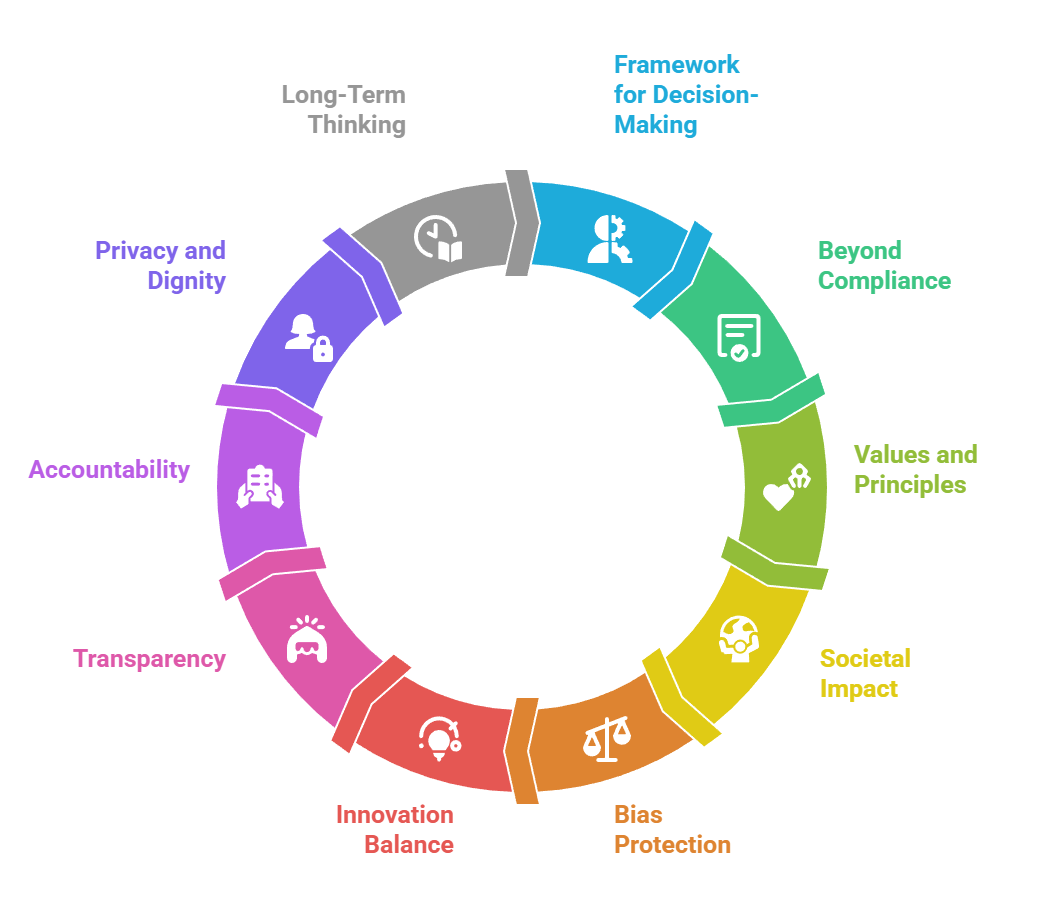 Ethical Frameworks for Responsible Data-Driven Decision Making provide structured principles that help guide how data and AI systems are designed, deployed, and evaluated.
They ensure decisions are fair, transparent, accountable, and aligned with societal values, going beyond technical performance alone.
1. Ethics as a Framework for Responsible Decision-Making
Ethics provides a structured way to analyze decisions, ensuring that choices made by data scientists are fair, respectful, and considerate of broader consequences.
It helps professionals evaluate whether a model should be built—not just whether it can be built—encouraging thoughtful assessment of potential harm. Within data projects, ethics acts like a compass that aligns technical work with moral responsibility and societal expectations.
This framework helps prevent misuse of data, protects individuals from unintended outcomes, and sets standards for transparency and accountability.
As AI systems become more autonomous, this guiding framework becomes essential in reducing risks and ensuring that innovation is controlled and beneficial. Overall, ethics grounds data science in values that support equity, trust, and long-term societal well-being.
2. Ethics Beyond Compliance and Legal Requirements
While laws define what is legally permissible, ethics define what is morally right, which is often a higher standard than basic compliance.
Data scientists may encounter situations where certain actions are legal but still harmful, biased, or intrusive, making ethical judgment crucial.
Ethical evaluation pushes practitioners to consider the unintended consequences of using sensitive data, predictive models, or automated systems.
It encourages organizations to go beyond minimal legal obligations and adopt practices that genuinely protect users and communities.
This broader lens helps prevent reputational damage, regulatory intervention, and loss of public trust, all of which arise when ethical concerns are ignored.
As technology evolves faster than regulations, ethics fills the gap by guiding responsible behavior. Ultimately, ethics ensures that data science practices contribute positively to society rather than exploiting loopholes.
3. The Role of Values, Principles, and Moral Judgments
Ethics is rooted in values such as fairness, respect, transparency, autonomy, and accountability—principles that guide how data should be collected, interpreted, and applied.
These values help data scientists evaluate whether a dataset is representative, whether a model treats groups equitably, and whether users deserve explanations for automated outcomes.
Moral judgment becomes critical when making decisions that impact people’s lives, such as approving loan applications or determining eligibility for public services.
By grounding decisions in values, data science becomes more human-centered, minimizing harm and maximizing societal benefit.
Ethical principles also encourage reflexive thinking, where professionals continuously question their assumptions, biases, and methodologies.
This value-driven approach helps maintain integrity and ensures that data science aligns with social expectations and norms. In practice, these principles form the backbone of ethical guidelines and professional conduct standards.
4. Ethics as a Tool for Evaluating Impact on Society
Ethics helps data scientists evaluate how their work affects individuals, communities, and society at large, especially when models can influence economic opportunities, access to services, or personal freedoms.
Ethical analysis encourages deeper exploration of long-term and indirect consequences, such as reinforcing inequality or enabling surveillance.
It prompts professionals to ask critical questions: Who benefits from this model? Who might be harmed? What groups are most vulnerable? By adopting a societal viewpoint, data science interventions become more inclusive, equitable, and sensitive to context.
This approach is increasingly important as AI systems are deployed globally across diverse cultures and communities.
Ethical impact evaluation supports responsible innovation, ensuring that data science contributes to progress without creating new forms of injustice. It shifts focus from pure accuracy to holistic, human-centered outcomes.
5. Ethics as Protection Against Bias and Discrimination
Ethics helps data scientists recognize and mitigate biases that may be hidden in datasets, modeling choices, evaluation metrics, or deployment environments.
It encourages critical thinking about whether historical data reflects systemic inequalities, and whether a model might unintentionally reinforce those patterns.
By applying ethical judgment, professionals can identify unfair outcomes—such as discriminatory loan approvals, biased hiring algorithms, or unequal healthcare predictions.
Ethical practice also ensures that vulnerable or marginalized groups are not disproportionately impacted by automated systems.
It promotes transparency in how models are built and urges teams to test fairness across demographic segments.
Through ethical vigilance, organizations reduce reputational and legal risks while fostering trust. Ultimately, ethics creates a more equitable foundation for data-driven decision-making.
6. Ethics Helps Balance Innovation with Responsibility
As new technologies—like generative AI, autonomous systems, and real-time analytics—rapidly emerge, ethics helps maintain a balance between innovation and societal safety.
It encourages data scientists to consider not only the benefits of new tools but also the risks, such as misinformation, fraud, privacy breaches, or manipulation.
Ethical principles ensure that innovation aligns with human rights and societal norms rather than causing harm or unintended consequences.
They push organizations to adopt responsible AI frameworks, risk assessments, and continuous monitoring practices for deployed systems. Ethics also safeguards public trust by showing that advancements are developed with careful consideration.
In a world where AI evolves faster than regulations, ethics serves as a protective layer that keeps progress sustainable. This balance is essential for long-term acceptance and success of data-driven technologies.
7. Ethics Encourages Transparency and Explainability
Ethics promotes clear communication about how data is collected, processed, and used—ensuring users understand how decisions are being made.
Transparent practices help reduce information asymmetry, where organizations know far more about individuals than individuals know about the system.
Ethical explainability becomes essential in high-stakes domains like healthcare, finance, or criminal justice, where automated decisions must be justified.
By adopting transparency, data scientists help build trust, reduce fear around algorithms, and prevent misconceptions.
It also enables auditors, regulators, and the public to evaluate whether a system is functioning fairly.
Ethical transparency encourages documentation, model cards, datasheets, and responsible reporting practices.
When users are informed and empowered, data-driven systems are more widely accepted and respected.
8. Ethics Supports Accountability in Data and AI Systems
Ethical frameworks ensure that someone is always responsible for the outcomes produced by data-driven systems, preventing a “black box” excuse for harmful decisions.
Accountability requires teams to define who owns each step—data collection, model building, deployment, and monitoring—and who must intervene if issues arise.
It encourages the creation of internal guidelines, audit trails, and escalation mechanisms for ethical violations.
By promoting accountability, ethics reduces the risk of blame-shifting between data scientists, developers, managers, and organizations.
It also ensures that users know whom to contact when they experience harm or unfair treatment from an automated system.
Regulators increasingly demand accountability as AI becomes more integrated into society. This principle helps maintain order, trust, and fairness in large-scale data practices.
9. Ethics Promotes Respect for Privacy and Human Dignity
Ethics emphasizes that data represents real people—not just numbers—who have rights, expectations, and boundaries around how their information is used.
It encourages responsible data collection practices, such as obtaining informed consent, minimizing data retention, and using anonymization where possible.
Ethical thinking helps data scientists question whether certain data should be collected at all, especially when it involves sensitive information.
Respect for privacy ensures that individuals maintain autonomy and control over their personal data, preventing exploitation or manipulation.
It also protects people from unwanted surveillance, profiling, and behavioral tracking, which can erode trust. By upholding privacy, ethics helps ensure AI systems do not violate human dignity. This protection becomes increasingly important as data grows in scale and sensitivity.
10. Ethics Encourages Long-Term Thinking and Future Impact Awareness
Ethics shifts focus from short-term efficiency to long-term consequences, helping data scientists evaluate how systems might evolve or be misused over time.
It encourages anticipation of future risks, such as model drift, misuse of generative AI, or unintended social dependencies on automated systems.
Ethical foresight helps professionals design systems that scale safely, remain fair, and adapt to new regulations or societal expectations.
It also raises awareness of environmental impacts, such as carbon emissions from large model training. Long-term thinking pushes organizations to invest in monitoring, auditing, and updating their systems regularly.
This perspective ensures that data science contributes to sustainable progress rather than temporary gains. Ethical future-planning keeps innovation aligned with humanity’s long-term well-being.