Human-centered and inclusive design is an ethical approach to building AI systems, data products, and digital workflows that prioritize the needs, perspectives, and well-being of all users.
Unlike traditional design, which often emphasizes efficiency or technical performance, human-centered design ensures that systems are understandable, usable, and beneficial to people across diverse demographics, abilities, and socio-economic contexts.
Inclusive design goes a step further, actively addressing biases and barriers that may exclude marginalized or underrepresented populations.
Ethical implementation of these principles also aligns with legal frameworks like accessibility laws and data protection regulations while fostering transparency and accountability.
By embedding inclusivity into workflows, organizations can create data-driven solutions that are socially responsible, equitable, and resilient.
Human-Centered Design Principles for Ethical AI
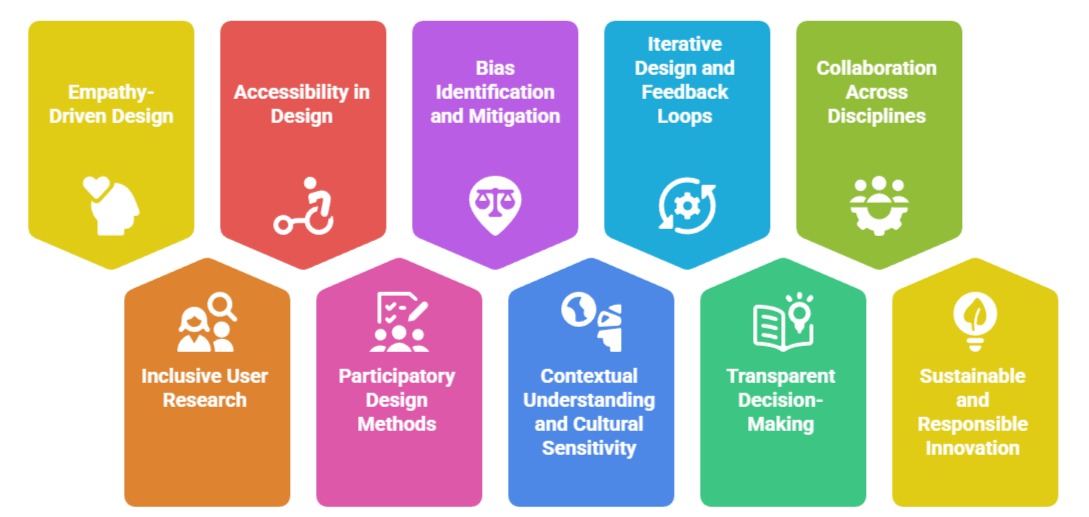 1. Empathy-Driven Design
Human-centered design begins with empathy, understanding user experiences, needs, and frustrations.
Conducting interviews, surveys, and observations ensures designers consider diverse perspectives.
Empathy prevents the creation of systems that overlook critical user requirements or inadvertently harm vulnerable groups.
Ethical data science involves incorporating human feedback into system design, refining models, interfaces, and workflows based on real-world needs.
This approach fosters trust, relevance, and usability, ensuring technology serves people rather than forcing humans to adapt to technology.
2. Inclusive User Research
Inclusive design requires research that actively includes marginalized populations, ensuring underrepresented voices shape product development.
Neglecting diversity can lead to systemic biases or inequitable access. Inclusive research methods identify barriers such as language, culture, ability, or economic constraints.
By integrating diverse inputs, data scientists design products that serve a broader audience fairly.
Ethical inclusivity reduces the risk of discrimination, improves adoption, and ensures equitable distribution of technological benefits.
3. Accessibility in Design
Accessibility ensures that users with disabilities can interact with AI systems effectively.
This includes visual, auditory, cognitive, and motor accessibility considerations.
Tools like screen readers, voice commands, and high-contrast interfaces are practical solutions. Ethical design incorporates accessibility from the outset rather than as an afterthought.
Accessible systems enable participation, equity, and independence for all users, reinforcing social responsibility and regulatory compliance.
4. Participatory Design Methods
Human-centered design incorporates participatory methods, inviting users to co-create solutions.
This collaboration empowers stakeholders, ensures relevance, and mitigates unintended harms.
Participatory design fosters trust and ensures that ethical concerns are considered from multiple perspectives. By including community representatives, organizations can identify potential social impacts before deployment.
5. Bias Identification and Mitigation
Inclusive design proactively addresses biases in data, models, and interfaces.
This involves analyzing historical data for skewed representation, auditing algorithms, and testing outputs across demographic groups. Bias mitigation ensures fair outcomes and prevents reinforcing systemic inequalities.
Transparent reporting of identified biases further promotes accountability and ethical integrity.
6. Contextual Understanding and Cultural Sensitivity
Designers must consider cultural, social, and environmental contexts where systems operate.
Solutions suitable in one region may not be appropriate in another due to local norms or practices.
Human-centered design involves understanding these contexts, ensuring technology aligns ethically with societal values.
Context awareness improves user satisfaction, adoption, and ethical alignment.
7. Iterative Design and Feedback Loops
Continuous testing, iteration, and feedback are central to human-centered design. Incorporating feedback from diverse users ensures that systems evolve to meet ethical and functional requirements.
Iterative processes help identify unforeseen issues, minimize harm, and enhance usability.
This approach embeds accountability and responsiveness into AI deployment.
8. Transparent Decision-Making
Human-centered systems should provide users with clear explanations for automated decisions.
Transparency fosters trust, reduces fear, and allows users to contest or understand outcomes.
Ethical design ensures that decision-making processes are interpretable, fair, and aligned with user expectations.
9. Collaboration Across Disciplines
Inclusive design requires cross-functional collaboration among data scientists, designers, ethicists, and social scientists.
Diverse perspectives help anticipate ethical challenges, improve usability, and foster equitable solutions.
Collaboration ensures that design decisions are holistic and socially responsible.
10. Sustainable and Responsible Innovation
Human-centered design promotes sustainability by considering long-term social and environmental impacts.
Ethical innovation balances technical advancement with societal benefits, ensuring that AI systems remain responsible, equitable, and aligned with human values.
Importance of Human-Centered & Inclusive Design
1. Ensures Ethical and Responsible Technology Development
Human-centered and inclusive design ensures that AI systems and data-driven products are developed with consideration for ethical implications.
By prioritizing human needs and values, organizations reduce the risk of harm, bias, and exclusion.
This approach encourages the anticipation of potential negative impacts and ensures that technology aligns with societal norms.
Ethical design embeds fairness and accountability at every stage, creating systems that are socially responsible.
It also helps prevent costly mistakes or public backlash caused by unethical deployment.
Organizations adopting this approach demonstrate moral leadership and commitment to societal well-being.
2. Promotes Equity and Reduces Bias
Inclusive design actively addresses systemic biases in data, algorithms, and user interfaces.
By considering the perspectives of marginalized or underrepresented groups, technology can provide fairer outcomes.
It ensures that all populations, regardless of race, gender, ability, or socioeconomic status, are accounted for in design decisions.
Reducing bias helps prevent discrimination, improves fairness in automated decision-making, and supports social justice.
Ethical inclusivity also builds credibility and trust with stakeholders who may be affected by AI systems.
Ultimately, it aligns technological innovation with equity and societal values.
3. Improves Accessibility and Usability
Human-centered design emphasizes creating systems that are usable by all individuals, including those with disabilities or differing levels of technical literacy.
Accessible design ensures equal opportunity for participation and interaction with AI systems.
By considering visual, auditory, cognitive, and motor accessibility, organizations enhance user experience and satisfaction.
Inclusive usability improves adoption rates and reduces frustration or misuse.
It also complies with legal accessibility standards and promotes a culture of empathy. Accessible AI products demonstrate ethical responsibility toward diverse user groups.
4. Builds Trust Among Users and Stakeholders
Transparency, empathy, and inclusivity in design foster trust between organizations and users.
When people see that their needs, concerns, and rights are considered, they are more likely to adopt and rely on AI systems.
Trust also reduces resistance to new technologies and encourages user engagement.
Organizations that prioritize human-centered practices strengthen relationships with regulators, clients, and communities.
Trusted systems are less likely to face public backlash or legal challenges. Ethical trust-building is key for long-term sustainability of AI initiatives.
5. Encourages Participatory and Collaborative Decision-Making
Human-centered design promotes stakeholder involvement and co-creation of solutions.
By including users, ethicists, and diverse experts in the design process, organizations can identify potential risks early.
Participatory approaches empower communities and ensure that AI solutions reflect real-world needs.
Collaborative decision-making reduces the likelihood of harmful outcomes or unanticipated biases.
It also fosters a culture of transparency, accountability, and inclusivity. Engaging multiple perspectives strengthens both ethical and functional quality of AI systems.
6. Supports Compliance with Legal and Ethical Standards
Inclusive and human-centered design aligns AI systems with accessibility laws, data protection regulations, and emerging ethical AI guidelines.
Following these standards minimizes legal risks, financial penalties, and reputational damage.
Compliance ensures organizations respect user rights, privacy, and equity.
Ethical frameworks like GDPR, AI Acts, and accessibility legislation require transparent and inclusive practices.
Adopting these principles proactively allows organizations to avoid reactive measures.
Human-centered design ensures that systems meet both societal expectations and legal obligations.
7. Enhances System Reliability and Accuracy
Designing for diverse users ensures AI systems perform effectively across contexts and populations.
Accounting for different abilities, languages, and cultural norms reduces errors and misinterpretation.
Inclusive testing and iterative design improve model accuracy and robustness.
Ethical consideration during design increases trustworthiness of outputs.
Reliable systems lead to better decision-making and fewer unintended consequences. By prioritizing user-centered principles, organizations create durable and dependable AI products.
8. Drives Social Impact and Equity
Human-centered and inclusive design empowers marginalized communities and promotes social inclusion.
AI products designed ethically can provide services to populations previously excluded from technological benefits.
Reducing barriers increases access to healthcare, education, finance, and digital services.
This approach contributes to social equity and responsible innovation.
Ethical design fosters societal well-being while reinforcing the organization’s commitment to positive impact.
Inclusive solutions help bridge technological gaps and promote fairness on a broad scale.
9. Facilitates Continuous Improvement
Iterative feedback loops and human-centered testing allow AI systems to evolve ethically and functionally.
Continuous evaluation ensures that changes in societal norms, user needs, or technological capabilities are incorporated.
This adaptability reduces risks associated with outdated or biased systems.
Feedback from diverse stakeholders highlights unforeseen challenges, allowing proactive interventions.
Organizations can refine models, interfaces, and workflows responsibly over time.
Continuous improvement enhances both ethical alignment and technical performance of AI systems.
10. Strengthens Organizational Reputation and Leadership
Organizations committed to human-centered and inclusive design demonstrate ethical leadership and social responsibility.
Ethical practices attract conscientious customers, partners, and employees.
Transparent and inclusive AI initiatives enhance public perception and stakeholder trust.
Leaders in ethical design gain a competitive advantage in markets increasingly concerned with fairness and social impact.
This reputation fosters loyalty, long-term partnerships, and credibility in policy discussions.
Ethical leadership through inclusive design positions organizations as pioneers in responsible AI innovation.
Real-World Case Studies
1. Google Duplex – Voice AI for Booking Services
Google Duplex is an AI system designed to conduct natural conversations for making reservations and appointments on behalf of users.
The design prioritized human-like interaction, understanding nuances in speech, pauses, and context.
Google conducted extensive usability testing to ensure that the AI’s voice, tone, and conversational style were approachable and intuitive for diverse user demographics.
Outcome: Users could interact naturally with AI without confusion or frustration, increasing adoption.
Lesson: Designing AI that mirrors human communication patterns enhances accessibility and reduces cognitive load, demonstrating the power of human-centered design in making AI feel natural and inclusive.
2. Microsoft Seeing AI – Accessibility for Visually Impaired Users
Microsoft developed the Seeing AI app to help visually impaired individuals interpret the world through image recognition.
The team conducted immersive user research, collaborating with blind and low-vision communities to understand specific needs, including text reading, object recognition, and facial expression analysis.
Outcome: The app provides real-time audio descriptions, making everyday activities more accessible.
Lesson: Direct engagement with end-users and understanding lived experiences ensures that technology addresses real challenges and empowers marginalized populations.
3. Facebook’s Inclusive Design for Alt Text Generation
Facebook implemented AI-driven automatic alt text to improve accessibility for visually impaired users.
The development team studied how people with disabilities navigate social media and iteratively refined models to describe images accurately.
Considerations included culturally sensitive descriptions and clarity for different levels of visual impairment.
Outcome: Improved social media inclusivity and greater participation of visually impaired users.
Lesson: Inclusive design must consider diverse abilities and experiences, ensuring technology does not unintentionally exclude users.
4. IBM Watson for Oncology – Collaborative Medical Decision Support
IBM Watson for Oncology was designed to assist doctors in cancer treatment planning.
Developers worked with oncologists and patient advocacy groups to ensure recommendations were clinically relevant and understandable.
Transparency in model outputs and reasoning helped clinicians interpret suggestions effectively.
Outcome: Improved trust and adoption in medical workflows, though challenges persisted in localizing recommendations to diverse healthcare settings.
Lesson: Human-centered design in high-stakes domains requires close collaboration with domain experts and careful consideration of the social context in which AI is applied.
5. Project Euphonia – Speech Recognition for Impaired Speech
Google’s Project Euphonia focused on improving speech recognition systems for individuals with speech impairments.
Engineers worked directly with affected users to collect voice samples and iteratively trained models to understand diverse speech patterns.
Outcome: Users gained better access to digital assistants, communication tools, and devices, enhancing independence.
Lesson: Inclusive design demands iterative co-creation and extensive engagement with marginalized communities to address real-world needs.
6. Lyft Accessibility Features – Inclusive Ride-Hailing
Lyft implemented design features to accommodate riders with disabilities, including wheelchair-accessible ride options and visually guided apps.
The team incorporated feedback from riders with mobility and sensory challenges to refine app interfaces, booking workflows, and driver instructions.
Outcome: Improved accessibility for users with diverse abilities and enhanced safety.
Lesson: Inclusive design extends beyond software to services and operational workflows, requiring systemic consideration of user needs.
7. Spotify – Personalized Playlists for Diverse Audiences
Spotify leveraged human-centered design to create music recommendations that reflect cultural diversity and individual listening preferences.
The design team conducted ethnographic studies and surveys across global markets to ensure that recommendations were culturally relevant and inclusive.
Outcome: Increased user engagement and satisfaction across diverse demographics.
Lesson: Human-centered design in AI products requires understanding cultural context and audience diversity to avoid exclusion and enhance relevance.
8. Duolingo Accessibility and Inclusivity
Duolingo, the language-learning app, incorporated accessibility features for users with hearing, vision, and motor impairments.
Human-centered research guided interface design, voice recordings, and gamification elements, making the app usable for learners from different backgrounds and abilities.
Outcome: Greater adoption among users with disabilities and improved inclusivity in language education.
Lesson: Inclusive AI and digital learning platforms must account for varying user abilities and contexts to ensure equitable access.

Class Sessions
Sales Campaign

We have a sales campaign on our promoted courses and products. You can purchase 1 products at a discounted price up to 15% discount.