Data ownership and informed consent are two core pillars of ethical data governance, defining who controls data, how it can be used, and what rights individuals maintain over their digital identity.
As organizations collect vast amounts of information through apps, sensors, websites, and enterprise systems, questions of “Who owns the data?” and “Do users genuinely understand how their data is used?” have become central ethical debates.
Data ownership establishes the legal and moral rights an individual has over their personal information such as the ability to access, correct, delete, or transfer it.
Informed consent ensures that individuals clearly understand what data is collected, why it is collected, how it will be used, and the risks involved before granting permission.
However, modern data ecosystems make these concepts complicated. Data is frequently shared with third parties, combined with external datasets, or used for secondary purposes like AI training, often in ways not explicitly communicated to the user.
Platforms rely on lengthy privacy policies that users rarely read, and dark patterns sometimes push individuals into granting permissions unknowingly.
Ethical data science therefore requires transparent communication, respect for user autonomy, and mechanisms that ensure individuals remain in control of their data throughout its life cycle.
Organizations must adopt user-centric designs, streamlined consent flows, and robust governance frameworks that honor the rights associated with true data ownership.
Consent Management and Ethical Data Practices in Data Science
Consent management and ethical data practices ensure that personal data is collected and used with respect, transparency, and user control. By prioritizing informed consent and data ownership, data science can balance innovation with trust, legal compliance, and individual rights.
1. Understanding Data Ownership and Why It Is Crucial
Data ownership places control of personal information in the hands of the individual rather than the organization.
When users retain ownership, they gain the right to decide how their data is used and whether it can be shared or monetized.
This protects individuals from unauthorized access, profiling, and exploitation.
Organizations must adopt transparent policies that acknowledge users’ rights and outline how data will be managed.
Data scientists should ensure that collected data is always linked to a legitimate purpose and never repurposed without consent.
Clear ownership boundaries build trust and reduce legal risk.
2. Principles and Requirements of Informed Consent
Informed consent must be clear, specific, voluntary, and easy to withdraw at any time.
Users should be told what data is being collected, why it is needed, who will access it, and how long it will be stored.
Consent cannot be hidden in complex legal text or obtained through dark patterns.
It should also be granular, meaning users can choose which aspects they agree to rather than accepting everything.
Data scientists must design systems where consent is logged, trackable, and automatically applied throughout the data pipeline to ensure ethical compliance.
3. Transparency and User Empowerment through Clear Communication
Transparent communication helps users make informed choices about their data.
This involves simple, accessible explanations of data practices rather than technical or legal jargon.
Transparency increases user trust and reduces regulatory risk. It also ensures users understand their rights, such as access, correction, deletion, and data portability.
For data scientists, creating documentation, dashboards, or interfaces that clarify how data flows through the system is essential.
This empowers users while ensuring models are built on ethically obtained data.
4. The Role of Consent in Data Processing, Sharing, and Model Training
Consent governs everything from data collection to model training and third-party sharing.
Without valid consent, any processing activity becomes legally and ethically questionable.
When datasets are shared across teams or used for new purposes such as machine learning experiments, consent must be reassessed to ensure it still applies.
Data scientists must implement checks to ensure the data used in training aligns with user permissions.
This prevents misuse that could harm individuals or expose organizations to penalties.
5. Handling Consent Withdrawal and Data Deletion Requests
Modern privacy laws require that users have the right to withdraw consent at any time.
Organizations must process these requests quickly and delete or anonymize the associated data.
For data scientists, this creates the need for traceable data pipelines where individual data points can be located and removed from databases, logs, or trained models if necessary.
Systems must be designed with reversibility in mind to respect user autonomy. Failure to manage withdrawal requests can lead to significant legal consequences.
6. Ethical Risks of Ignoring Data Ownership and Consent Requirements
Failure to respect data ownership or obtain informed consent can lead to ethical violations such as unauthorized tracking, behavioral profiling, or discrimination.
Scandals like Cambridge Analytica reveal how misuse of data without proper consent can manipulate public opinion and damage democratic systems.
Poor consent practices lead to widespread distrust, reputational harm, and financial penalties.
Data scientists must remain vigilant to ensure that data-driven innovation does not compromise user rights or societal values.
7. Modern Challenges: Dark Patterns, AI Automation & Implicit Data Collection
Today’s digital platforms often use dark patterns design tricks that manipulate users into giving consent.
Additionally, AI systems collect data implicitly through sensors, cookies, or background tracking, making true consent difficult.
These issues challenge traditional consent models and raise questions about fairness.
Data scientists must design systems that avoid manipulative interfaces, ensure AI does not collect hidden data, and advocate for ethical defaults.
As AI becomes more automated, respecting user ownership becomes both more difficult and more essential.
Practical Challenges in Data Ownership & Consent
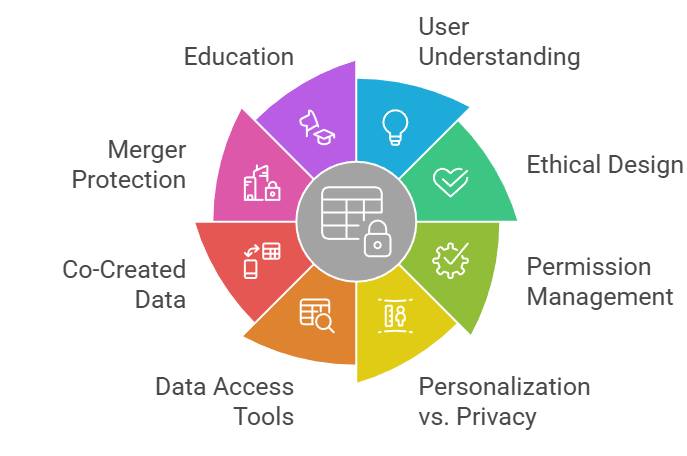
1. Ensuring Users Truly Understand Consent
Many users click “agree” without reading or understanding long consent documents.
Ethical data practices require presenting information in simple, clear language so users know how their data will be used.
This also includes avoiding misleading wording or hidden clauses. The goal is to make consent meaningful, not just a legal formality.
2. Designing Ethical and Compliant Consent Flows
Consent flows must balance user rights with business goals such as personalization or analytics.
Ethical design ensures that users are not pressured or manipulated into giving consent.
Businesses need to provide transparent options without dark patterns. A well-designed flow supports trust while meeting legal requirements.
3. Managing Changing User Permissions Over Time
As new features, products, or data uses arise, user permissions may need updating.
Ethical data systems track these changes and allow users to easily modify their choices.
This ensures continued respect for users’ preferences rather than assuming permanent consent. It also prevents unauthorized or outdated uses of personal data.
4. Balancing Personalization and Privacy
Personalization requires access to user data, but too much data collection can compromise privacy.
Organizations must determine the minimum data needed to deliver value without excessive tracking.
Striking this balance builds trust and avoids intrusive user profiling. Ethical systems prioritize user benefit rather than data hoarding.
5. Providing Easy Tools for Data Access and Control
Users should be able to download, delete, or transfer their data without needing technical expertise.
Clear dashboards or interfaces empower users to manage their digital identities.
This aligns with global privacy laws and strengthens user autonomy. Reducing friction in these processes encourages responsible data ecosystems.
6. Handling Co-Created Data Responsibly
Some data involves multiple people, such as shared photos, group chats, or collaborative documents.
Ethical challenges arise when one person wants deletion but others rely on the content.
Organizations must design fair policies that respect everyone’s data rights. This requires careful handling of shared ownership and consent.
7. Protecting Data Rights During Mergers or Restructuring
When companies merge or get acquired, user data often transfers to new entities.
Ensuring that original data rights, consent preferences, and privacy agreements remain valid is essential.
Ethical governance prevents misuse of data under new ownership. Transparency about changes helps maintain user trust.
8. Educating Employees and Users About Data Rights
Ethical data use requires awareness at every level of an organization.
Employees must understand rules, responsibilities, and the consequences of mishandling data.
Users also benefit from guidance on how their rights work and how to protect their information. This shared understanding supports a culture of responsible data management.