Transparency in AI and data workflows is a cornerstone of ethical data science, ensuring that data collection, processing, modeling, and decision-making processes are visible, interpretable, and accountable.
As AI systems become more complex, opaque “black-box” models make it challenging for users, regulators, and stakeholders to understand how decisions are made.
Lack of transparency can lead to mistrust, misuse, and ethical violations, especially in sensitive domains like healthcare, finance, or criminal justice.
Transparent and Explainable Data Science Practices
1. Documenting Data Sources and Provenance
Transparency begins with clear documentation of data sources, collection methods, and ownership.
Knowing the origin of data ensures accountability and helps stakeholders assess reliability and ethical considerations.
Proper documentation allows auditing for bias, consent compliance, and data quality. It also prevents misuse of unauthorized or sensitive data and ensures reproducibility.
In complex workflows, provenance records are critical to trace errors, validate results, and build trust among users and regulators.
2. Explaining Preprocessing and Feature Engineering
Data preprocessing—like cleaning, normalization, or transformation—can significantly impact model outcomes.
Transparent workflows document all preprocessing steps and decisions to make the process understandable.
Feature selection and engineering should also be justified with clear reasoning.
Transparency here allows evaluators to detect biases introduced during preprocessing and ensures that the model reflects ethical and fair treatment of all groups.
Documentation helps both technical and non-technical stakeholders understand how raw data evolves into model-ready inputs.
3. Using Explainable AI Techniques
Explainable AI (XAI) methods help interpret complex models, including deep learning and ensemble methods.
Techniques like SHAP, LIME, or counterfactual explanations reveal the contribution of features to predictions.
This transparency ensures users can understand decisions, challenge errors, and identify potential biases.
Explainability also facilitates regulatory compliance, especially when AI decisions affect individuals’ rights.
Transparent interpretation strengthens stakeholder confidence and supports ethical accountability.
4. Communicating Model Assumptions and Limitations
Every AI model has assumptions, constraints, and limitations.
Ethical transparency requires that these are clearly communicated to stakeholders.
Users need to understand when and where a model may fail or produce uncertain results.
Misrepresentation of capabilities can lead to misuse, over-reliance, or harm.
Documenting and communicating limitations ensures responsible use and encourages human oversight where automated systems may not perform reliably.
5. Reporting Evaluation Metrics and Performance
Transparency involves sharing model performance metrics, such as accuracy, precision, recall, fairness measures, and error rates.
Transparent reporting helps stakeholders evaluate model suitability for specific contexts.
It also enables identification of biases or disparities in outcomes across groups.
Providing detailed metrics supports informed decision-making and builds trust with regulators, clients, and the public.
6. Tracking Workflow Decisions and Changes
Ethical transparency includes version control and logging of decisions throughout the data and AI workflow.
Recording changes to datasets, models, and algorithms ensures reproducibility and accountability.
Tracking allows organizations to investigate errors, monitor drift, and provide audit trails for regulatory compliance.
A detailed record of decisions helps maintain ethical standards over the lifecycle of the AI system.
7. Providing Accessible Documentation for Stakeholders
Documentation should be understandable by both technical and non-technical stakeholders.
User-friendly guides, dashboards, and visual explanations make complex workflows accessible.
This ensures that decision-makers, auditors, and affected communities can interpret AI outcomes and participate in ethical oversight.
Accessibility strengthens trust and encourages responsible usage.
8. Communicating Biases and Ethical Considerations
Transparency requires openly disclosing potential biases in data and model outcomes.
Ethical considerations, such as fairness, discrimination risks, and privacy implications, should be clearly stated.
Stakeholders must be aware of these risks to make informed decisions, intervene when necessary, and ensure equitable outcomes.
9. Aligning Transparency with Regulatory Requirements
Transparent workflows help meet legal and ethical standards like GDPR, AI Acts, and sector-specific guidelines.
Demonstrating transparency is essential for compliance audits, liability mitigation, and public accountability.
Proper alignment ensures that organizations are proactive in governance and ethical responsibilities.
10. Encouraging a Culture of Ethical Responsibility
Transparency fosters a culture where ethical responsibility is prioritized.
Teams are encouraged to question assumptions, document decisions, and communicate openly about risks and limitations.
This cultural shift ensures that transparency is embedded across organizational processes, supporting long-term trust and ethical integrity.
Importance of Transparency in AI and Data Workflows
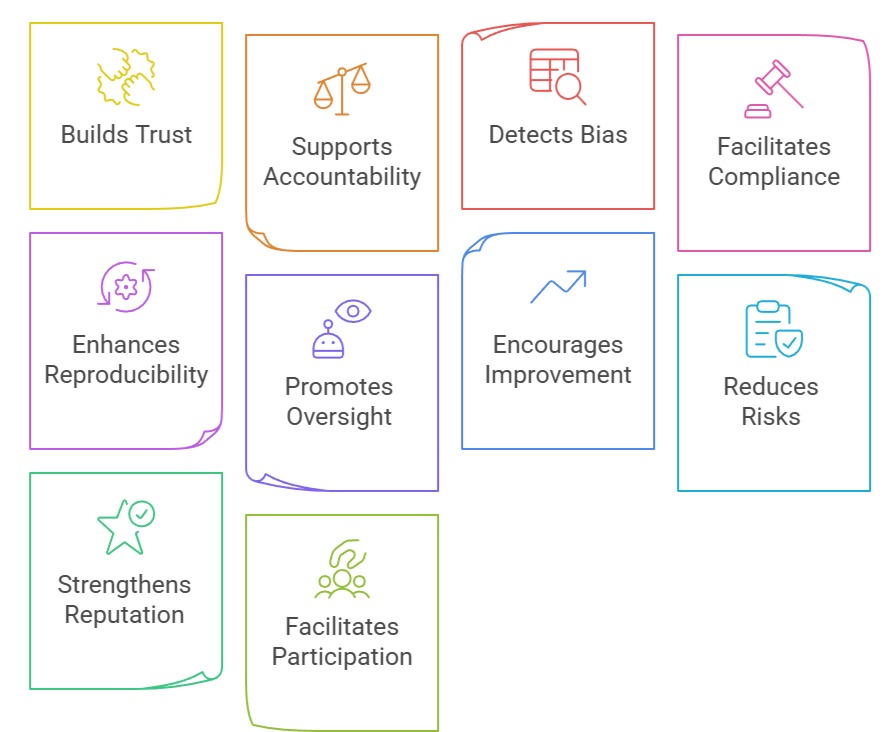
1. Builds Trust Among Users and Stakeholders
Transparency allows stakeholders to understand AI decisions, improving confidence in system outputs.
Users are more likely to accept and rely on AI when processes are interpretable, reducing resistance and fear of misuse.
2. Supports Accountability and Ethical Oversight
Transparent workflows provide audit trails and clear documentation, holding teams accountable for errors, biases, or unintended harms.
Accountability ensures corrective action and ethical responsibility.
3. Enables Detection of Bias and Unfair Practices
Transparency exposes potential bias in data or algorithms. Ethical interventions can be made before models cause harm, promoting fairness and inclusivity in AI-driven decisions.
4. Facilitates Regulatory Compliance
Clear documentation and workflow visibility support adherence to legal frameworks like GDPR, AI Acts, and sector-specific regulations, minimizing the risk of penalties or reputational damage.
5. Enhances Reproducibility and Reliability
Transparent data workflows allow independent verification of results, ensuring that analyses and predictions are reproducible, reliable, and trustworthy for critical decision-making.
6. Promotes Human Oversight in Automation
By making AI workflows interpretable, humans can oversee automated processes, correct errors, and intervene in high-risk situations, preventing over-reliance on opaque systems.
7. Encourages Continuous Improvement
Documented workflows allow teams to evaluate model performance over time, identify weaknesses, and make iterative improvements, fostering ethical and effective AI evolution.
8. Reduces Legal and Ethical Risks
Transparency protects organizations from litigation, regulatory scrutiny, and ethical violations by ensuring that decision-making processes are clearly documented and defensible.
9. Strengthens Public and Organizational Reputation
Ethical transparency demonstrates commitment to responsible AI, enhancing credibility with clients, regulators, and the public, and positioning the organization as trustworthy and socially responsible.
10. Facilitates Stakeholder Participation
Clear communication of AI workflows enables affected communities to provide feedback, raise concerns, or suggest improvements, supporting human-centered design and participatory governance.
Challenges of Transparency in AI and Data Workflows
1. Complexity of AI Models
Modern AI systems like deep learning are inherently complex and difficult to interpret.
Providing meaningful transparency without oversimplifying decisions remains a significant challenge.
2. Balancing Proprietary Knowledge and Openness
Organizations may hesitate to fully disclose workflows due to intellectual property concerns.
Striking a balance between transparency and protecting proprietary algorithms is difficult.
3. Handling Large-Scale and Dynamic Data
AI systems often use vast, constantly changing datasets, making it hard to track provenance, preprocessing, and changes effectively, complicating transparent reporting.
4. Communication to Non-Technical Stakeholders
Explaining technical workflows and model decisions to non-experts requires clear visualization, accessible language, and contextual explanations, which can be challenging to implement consistently.
5. Detecting and Reporting Bias Accurately
Transparency alone is not enough; identifying, quantifying, and communicating bias requires rigorous analysis, which can be resource-intensive and technically demanding.
6. Ensuring Compliance Across Jurisdictions
Different countries have varying legal requirements. Maintaining workflow transparency that meets diverse regulations simultaneously is a complex governance challenge.
7. Resource and Cultural Constraints
Embedding transparency requires time, skilled personnel, and organizational commitment. Cultural resistance or lack of resources can hinder adoption of transparent practices.

Class Sessions
Sales Campaign

We have a sales campaign on our promoted courses and products. You can purchase 1 products at a discounted price up to 15% discount.