A Code of Conduct in data science is a formal set of ethical guidelines, principles, and professional standards that data scientists are expected to follow while collecting, analyzing, interpreting, and deploying data-driven solutions.
It governs acceptable behaviors, protects user rights, ensures fairness, and helps professionals make responsible decisions when handling data, building models, or influencing public outcomes.
A well-defined Code of Conduct minimizes harm, prevents misuse of data systems, and promotes transparency, accountability, and trust in data-driven work.
Responsible Conduct in Data Science Practice
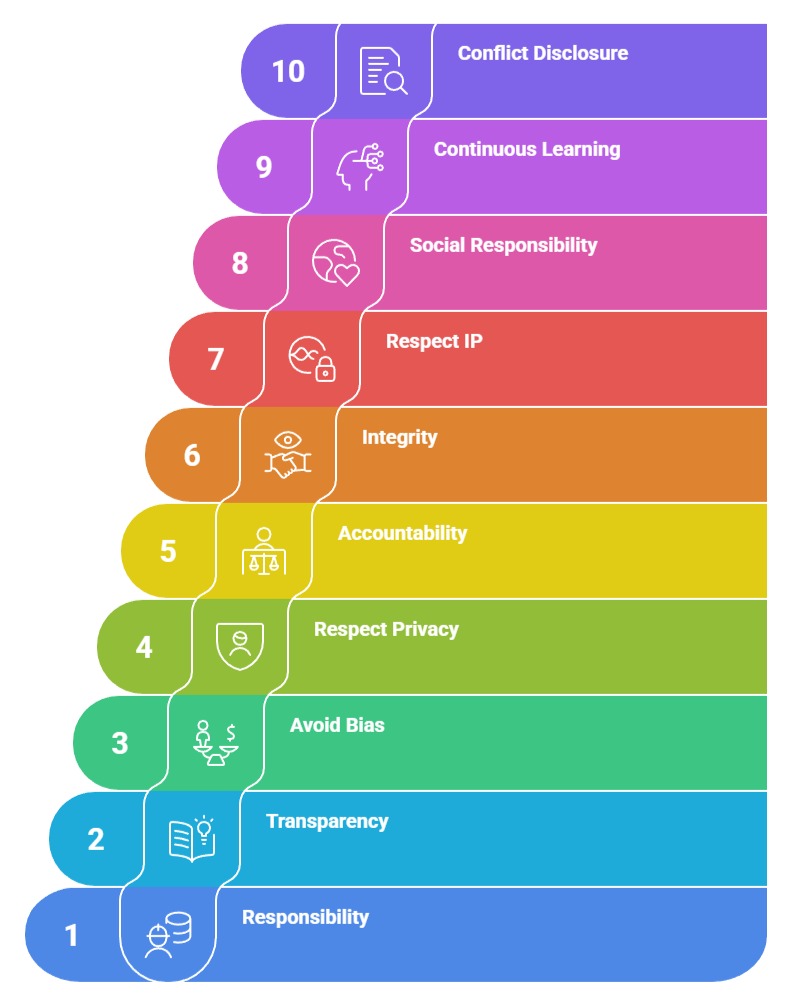
1. Responsibility in Data Handling
Data scientists must treat all forms of data—personal, financial, behavioral, or sensitive—with strict responsibility to avoid misuse or harm.
They should ensure every dataset is collected legally, stored securely, and accessed only by authorized individuals.
Proper encryption, access controls, and monitoring systems must be in place to prevent breaches.
Data must be used only for the intended purpose stated at the time of collection. Professionals must also respect retention policies by deleting or anonymizing data when it is no longer needed.
They should maintain documentation for all steps in the data pipeline to ensure traceability. Overall, responsible data handling builds trust and avoids legal or ethical violations.
2. Transparency in Methods and Decisions
Transparency means clearly explaining how data is processed, what algorithms are used, and what assumptions guide the model.
Data scientists must document preprocessing steps, feature engineering, model selection, and evaluation metrics so stakeholders understand the full workflow.
This openness prevents misunderstandings and helps non-technical teams make informed decisions.
Transparency also includes communicating model limitations, accuracy trade-offs, and potential risks associated with automated decisions.
When decisions affect individuals—such as loan approvals or hiring—clear explanations are essential for fairness.
Transparent reporting allows audits and external reviews. Ultimately, transparency increases accountability and public trust.
3. Avoidance of Bias and Discrimination
Data scientists must proactively identify biases in data sources, sampling processes, and historical patterns that may distort model behavior.
They should use fairness metrics and bias-detection tools to ensure the model does not discriminate against protected groups like women, minorities, or low-income individuals.
If bias is detected, corrective measures such as reweighting, resampling, or fairness-aware algorithms must be applied.
Avoiding bias also requires understanding social contexts and systemic inequalities that could influence model outcomes.
Teams must regularly re-evaluate deployed models, as bias can emerge over time due to shifting populations.
Failure to address bias leads to unfair predictions and ethical breaches. A fair model strengthens credibility and aligns with legal standards.
4. Respect for User Privacy and Informed Consent
Respecting privacy requires collecting only the data that is truly necessary for analysis, minimizing exposure risk.
Users should clearly understand what data is being collected, why it is being collected, and how it will be used—a principle known as informed consent.
Consent must be freely given, specific, and easy to withdraw.
Data scientists must apply anonymization or pseudonymization techniques to protect identities before analysis.
They must not share or sell data without explicit permission, especially when dealing with sensitive categories.
Privacy also includes being transparent about potential risks and data-sharing agreements. Respect for privacy strengthens accountability and aligns with global regulations like GDPR and HIPAA.
5. Accountability for Model Outcomes
Data scientists must take responsibility for the outcomes and consequences of the models they build, whether positive or negative.
Accountability requires continuous monitoring after deployment to catch failures, drifts, or harmful impacts early. When a model generates unfair or incorrect outputs, teams must be ready to pause, update, or replace it.
Ethical accountability also includes documenting decisions so that they can be audited or reviewed later.
Data scientists must communicate risks to stakeholders before deployment to avoid misuse.
Accountability encourages responsible innovation rather than blindly trusting automation. Ultimately, it ensures that human oversight remains central in critical decision-making systems.
6. Integrity and Honesty in Reporting
Integrity requires presenting results truthfully without exaggeration, manipulation, or omission of undesirable findings.
Data scientists should avoid cherry-picking metrics or visualizations that create a misleading narrative.
Reporting must reflect all outcomes—positive, negative, and inconclusive—so stakeholders gain accurate insights.
They must clarify when results are uncertain or incomplete, preventing misguided decisions.
Integrity also includes acknowledging limitations such as small samples, noisy data, or potential errors.
When mistakes occur, professionals must correct them promptly rather than hiding them. Honest reporting builds long-term trust and protects organizations from reputational damage.
7. Respect for Intellectual Property and Confidentiality
Data scientists work with proprietary datasets, confidential business insights, and sensitive algorithms that must not be leaked or used without authorization.
They must comply with copyright laws, licensing agreements, and terms of use when using open-source tools or external datasets.
Sharing internal work outside the organization can lead to legal and ethical violations.
Confidentiality also extends to client data and trade secrets, which must be protected at all times.
A code of conduct requires secure handling of all sensitive materials, whether stored locally or in cloud environments.
Proper attribution must be given to external research or code. Respect for IP helps maintain professional credibility.
8. Social Responsibility and Harm Prevention
Data scientists must consider how their work impacts society, especially when models influence public services such as healthcare, policing, finance, and employment.
They should avoid developing systems that encourage harm, discrimination, surveillance abuse, or misinformation.
Before deploying a model, potential social risks both short-term and long-term must be evaluated carefully.
If a project carries unacceptable risks, data scientists should voice concerns or refuse participation.
Social responsibility also includes advocating for ethical AI within teams and organizations.
Ensuring that technology benefits communities rather than exploiting them is central to ethical practice.
Harm prevention safeguards human rights and public safety.
9. Continuous Learning and Ethical Awareness
Technology evolves quickly, and ethical risks become more complex with advancements like generative AI, biometrics, and autonomous systems.
Data scientists must regularly update their knowledge of privacy laws, fairness techniques, and new security threats.
Continuous learning includes participating in training, reading updated ethical guidelines, and staying aware of societal concerns around AI.
Ethical awareness helps professionals identify risks earlier and design safer systems.
It also enables better collaboration with legal, compliance, and policy teams. A learning mindset ensures that ethical responsibilities grow alongside technical capabilities.
10. Conflict of Interest Disclosure
Conflicts of interest occur when personal or financial incentives could influence professional decisions.
Data scientists must be transparent about such situations to avoid compromising fairness.
If working on a project where personal bias may interfere—such as analyzing data about a competitor—disclosure is essential.
Ethical practice requires stepping back from decisions where objectivity is at risk.
Transparent disclosure protects both the individual and the organization from ethical misconduct. It also promotes trust and maintains the integrity of analytical outcomes. Avoiding conflicts ensures unbiased and socially responsible decision-making.

Class Sessions
Sales Campaign

We have a sales campaign on our promoted courses and products. You can purchase 1 products at a discounted price up to 15% discount.