Responsible communication involves more than making charts or dashboards; it includes understanding the target audience, choosing appropriate levels of complexity, avoiding manipulative visualizations, clarifying uncertainty, and openly acknowledging model limitations.
Ethical communication also requires preventing bias amplification, contextualizing insights properly, and ensuring that non-technical stakeholders can interpret results without confusion.
As AI models grow in complexity, communicating their inner workings, risks, and fairness implications becomes even more essential.
Organizations today expect data scientists to be proactive truth-tellers not just analysts who ensure that insights are conveyed with integrity, empathy, and accountability.
Responsible data communication is therefore a fundamental competency for any modern data professional.
Ethical Communication in Data Science
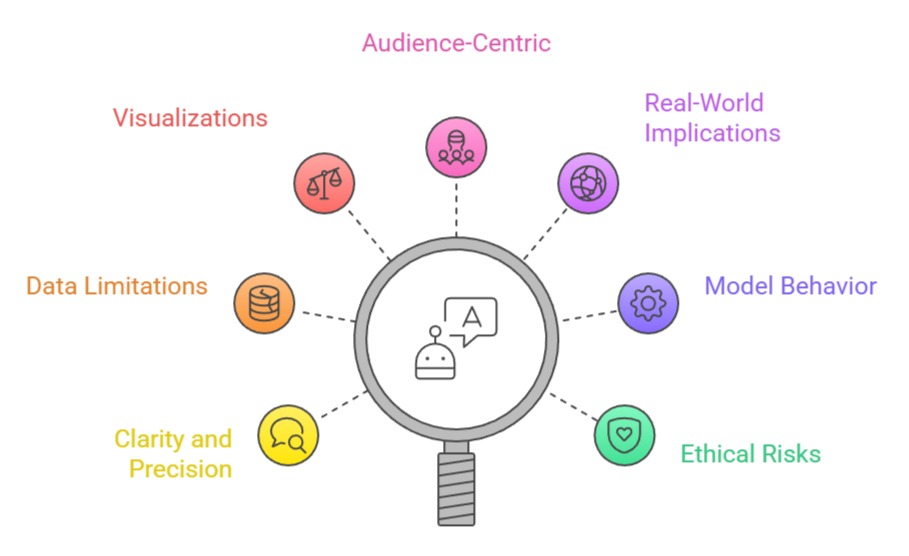
1. Communicating With Clarity and Precision
Responsible communication requires translating complex technical information into plain, accessible language that stakeholders can understand without misinterpretation.
Data scientists must avoid jargon, simplify explanations, and use intuitive examples to help non-technical users grasp insights.
Clarity also involves specifying what the model can and cannot do, including any assumptions made during analysis.
Presenting results without ambiguity reduces the risk of flawed or unethical decisions.
Precision in communication ensures that the audience accurately interprets trends, patterns, and recommendations without exaggeration or distortion.
Ultimately, clarity bridges the gap between analytical output and ethical decision-making.
2. Transparently Presenting Data Limitations and Uncertainties
Every dataset contains imperfections such as missing values, sampling biases, or measurement errors; responsible communicators highlight these limitations rather than hiding them.
Explaining the uncertainty levels, confidence intervals, and margins of error helps stakeholders understand how much trust to place in results.
Transparency prevents overconfidence in predictions, especially in high-stake areas like medical diagnosis or fraud detection.
Acknowledging uncertainty also signals professional integrity and fosters healthier data-driven cultures.
This approach aligns with ethical principles of honesty and reduces the likelihood of misuse or overgeneralization of insights.
3. Avoiding Misleading Visualizations and Presentations
Charts, dashboards, and graphs can unintentionally manipulate perceptions if improperly designed, such as by altering axis scales or using visually exaggerated elements.
Ethical communication requires designing visuals that accurately represent the underlying data without creating illusions of extreme trends.
This includes maintaining proportionality, using neutral color schemes, and sharing raw numbers where relevant.
Ensuring visual honesty prevents stakeholders from drawing false conclusions that might influence harmful business or policy decisions.
Responsible data visualization enhances trust and reinforces the credibility of analytical work.
4. Ensuring Audience-Centric Communication
Ethical communication requires tailoring insights to the needs, literacy levels, and cultural contexts of the audience consuming the information.
Technical audiences might expect deeper statistical details, while executives may require concise strategic summaries.
Understanding who will use the information helps determine the level of simplification, technical depth, and visual presentation required.
By designing communication that aligns with the users’ goals and constraints, data scientists enhance comprehension, reduce misinterpretation, and foster equitable access to information.
This user-centric mindset is a pillar of human-centered design in ethical data science.
5. Contextualizing Insights With Real-World Implications
Raw analysis without context can lead to flawed interpretations, especially when stakeholders lack domain expertise.
Responsible communication connects insights to practical considerations, such as economic constraints, regulatory factors, or ethical implications.
Contextualization helps avoid misapplying results or implementing harmful actions based on incomplete understanding.
It also ensures stakeholders appreciate the broader significance of findings, rather than focusing solely on statistical outputs.
By offering context, data scientists promote responsible decision-making grounded in both data and real-world complexities.
6. Communicating Model Behavior, Biases, and Fairness Impacts
Modern AI systems can unintentionally reinforce biases, making it essential to communicate fairness-related insights with clarity.
This includes explaining how the model was trained, what biases might exist in the data, and how predictions may differ across demographic groups.
Responsible communication involves sharing fairness metrics, mitigation steps, and ethical considerations to help stakeholders assess risk.
Transparently addressing bias encourages organizations to adopt safer and more equitable technologies.
This practice strengthens accountability and builds public trust in AI-driven systems.
7. Disclosing Ethical Risks and Potential Misuse
Data insights sometimes carry ethical implications that must be communicated upfront, such as privacy risks, discrimination concerns, or unintended consequences.
Responsible communication includes warning stakeholders about possible misuse of results or misinterpretation of trends.
This protects organizations, individuals, and communities from harmful impacts caused by inappropriate applications of data insights.
Disclosing risks demonstrates ethical foresight and establishes the data scientist’s role as a guardian of responsible innovation.
It also encourages ethical culture within teams and institutions.
Importance of Communicating Data Insights Responsibly
1. Prevents Misinterpretation and Harmful Decisions
Clear and ethical communication ensures that decision-makers do not misread or misapply findings.
Misinterpretation can lead to wrong policy decisions, flawed business strategies, or discriminatory outcomes.
Responsible communication minimizes such risks and safeguards against real-world harm.
2. Builds Trust With Stakeholders and the Public
Transparent communication creates confidence among users who rely on data outputs.
Trust is essential for adopting AI systems, sharing sensitive information, and maintaining long-term organizational credibility.
Without responsible communication, trust erodes quickly.
3. Supports Ethical and Fair Decision-Making
When biases, limitations, and risks are clearly communicated, stakeholders make more equitable decisions.
This is especially important in sensitive domains like hiring, lending, and healthcare.
Ethical communication ensures data-driven decisions align with fairness principles.
4. Ensures Compliance With Legal and Regulatory Standards
Regulations such as GDPR require transparency in automated decision-making.
Responsible communication helps organizations meet legal obligations and avoid penalties.
Explaining data flows, model logic, and risk factors supports compliance audits.
5. Encourages Accountability and Responsible Innovation
Open communication about uncertainties and risks encourages teams to take responsibility for model outcomes.
It also fosters a culture of ethical innovation, where transparency and accountability guide the development of new technologies.
6. Improves Collaboration Across Multidisciplinary Teams
Ethical communication makes it easier for teams—marketing, engineering, compliance, legal, and operations—to collaborate effectively.
This alignment leads to better decisions, fewer mistakes, and more integrated ethical thinking in organizational processes.
7. Protects Vulnerable Populations From Negative Impacts
By responsibly communicating potential risks, data scientists help ensure that automated systems do not disproportionately harm marginalized groups.
Highlighting fairness issues enables early interventions and reinforces social responsibility.
Challenges
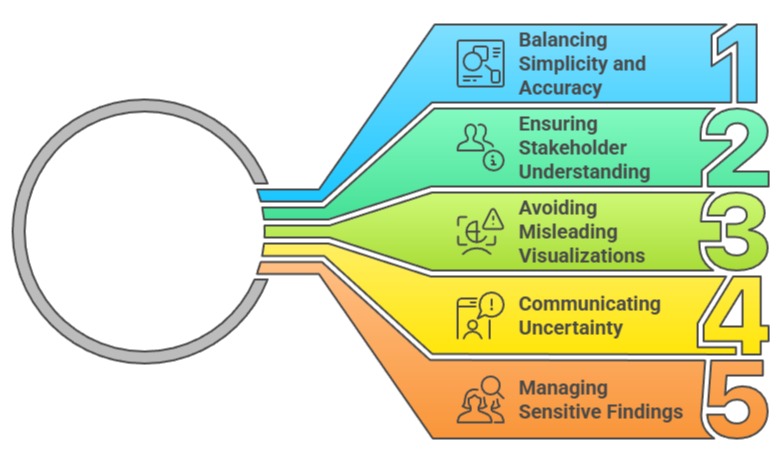
1. Balancing Simplicity and Accuracy
Communicators often struggle to simplify insights without oversimplifying or distorting facts.
Striking the right balance requires strong domain knowledge and communication skills.
Oversimplification may hide critical assumptions, whereas too much complexity confuses stakeholders.
This tension is particularly challenging when discussing advanced models like deep learning.
2. Ensuring Stakeholder Understanding Across Varied Literacy Levels
Different stakeholders possess different levels of statistical, technical, or domain knowledge.
Communicating effectively across these variations requires customized messaging, which is time-intensive and difficult to maintain.
Misalignment often leads to misinterpretation or misuse of insights.
3. Avoiding Misleading Visualizations Under Time or Business Pressure
Organizational pressures may push data teams to present results more persuasively rather than more ethically.
This can lead to using exaggerated charts, selective reporting, or intentional omission of limitations.
Maintaining ethical visualization practices becomes difficult under performance expectations.
4. Communicating Uncertainty Without Creating Confusion or Distrust
Stakeholders often expect definite answers, but ethical communication requires explaining uncertainty.
However, too much discussion about uncertainty can create confusion or reduce confidence in the analysis.
Finding the right tone and level of detail is a delicate challenge.
5. Managing Sensitive or Controversial Findings
Some insights—such as results related to bias, discrimination, or public behavior—can be politically or socially sensitive.
Communicating them responsibly requires careful framing, empathy, and ethical foresight. Mishandling such results may escalate conflicts or damage organizational reputation.