The rapid expansion of Automation and the Internet of Things (IoT) has created a highly interconnected ecosystem where devices, sensors, and intelligent algorithms collaborate to streamline daily life and industrial operations.
From smart homes and autonomous vehicles to connected healthcare devices and predictive maintenance systems, IoT-driven automation has become a fundamental part of modern digital infrastructure.
However, this growth also introduces significant ethical considerations related to privacy, data ownership, surveillance, cybersecurity, algorithmic autonomy, and unintended system behaviors.
As IoT devices collect continuous streams of real-time data, the potential for misuse, over-reliance, or biased decision-making increases.
Similarly, automated systems—especially those that operate independently—can act without adequate human oversight, leading to safety risks, discrimination, or loss of accountability.
Ethics of IoT-Based Automation Systems
1. Ethical Data Collection & Consent in IoT
IoT devices continuously collect large volumes of personal and behavioral data—often passively and without explicit awareness from users, making transparent consent essential.
Responsible use demands clear communication about what data is collected, how long it is stored, and how it is processed.
Ethical systems must allow users to opt in or out easily rather than hiding consent behind complex settings. In many IoT ecosystems, multiple stakeholders (manufacturers, service providers, third parties) access the same data, increasing the risk of misuse, unauthorized sharing, or commodification.
Ethical frameworks emphasize data minimization, ensuring that devices collect only what is necessary to function rather than harvesting excessive personal information.
Without such safeguards, IoT systems may unintentionally contribute to surveillance culture or intrusive profiling.
2. Security & Vulnerability Management
IoT devices often operate with minimal security, making them vulnerable to hacking, data breaches, identity theft, or remote control attacks.
Ethical IoT development includes implementing strong encryption, secure firmware updates, and continuous vulnerability assessments.
Poorly protected devices in homes, cities, or industries can become entry points into larger networks, creating systemic risks.
Automated systems connected to IoT like smart door locks or industrial robots—pose physical safety risks when compromised.
Ethical responsibility requires manufacturers and data scientists to design with “security by default,” ensuring that safety features are not optional but integral.
Addressing cybersecurity gaps proactively prevents misuse, financial loss, societal disruption, and erosion of public trust in automation systems.
3. Human Oversight and Control
Automation and IoT devices often act autonomously, making independent decisions based on sensor data or algorithmic rules.
It is ethically essential to maintain meaningful human oversight, especially in high-stakes environments like healthcare, transportation, and industrial control.
Systems must provide override mechanisms so users can intervene during abnormal behavior or malfunction.
Without human supervision, automated IoT systems may perpetuate biases, make unsafe choices, or misinterpret contextual cues.
Ethical governance stresses that IoT automation should support human capabilities, not replace decision-making where safety or fairness is critical.
Maintaining human control ensures accountability and prevents over-reliance on fully autonomous systems.
4. Fairness, Bias, and Inclusivity
Automation systems relying on IoT-generated data may inadvertently reinforce biases if the collected data is incomplete, skewed, or poorly representative.
Ethical frameworks emphasize inclusive data collection to avoid discriminatory actions—such as biased smart home sensors that fail to detect certain skin tones or accessibility issues affecting the elderly or disabled.
Automated decisions based on biased IoT inputs can lead to unequal treatment, resource allocation errors, or service denial.
Developers must ensure that models trained on IoT data undergo fairness testing and bias mitigation. Inclusivity also means designing IoT systems usable and safe for all populations, regardless of socio-economic differences.
Ethical automation ensures that technology benefits are distributed equitably across society.
5. Environmental and Sustainability Considerations
IoT and automation technologies contribute to energy consumption, e-waste, and resource depletion due to millions of interconnected devices.
Ethical use involves designing low-energy systems, promoting durable materials, and reducing unnecessary data processing.
Automation can create sustainability benefits—like energy-efficient smart grids and optimized waste management—but only when implemented responsibly.
The lifecycle of IoT from manufacturing to disposal must be considered to minimize harmful environmental impact. Responsible system development encourages recycling programs, modular designs
Importance of Responsible Automation & IoT
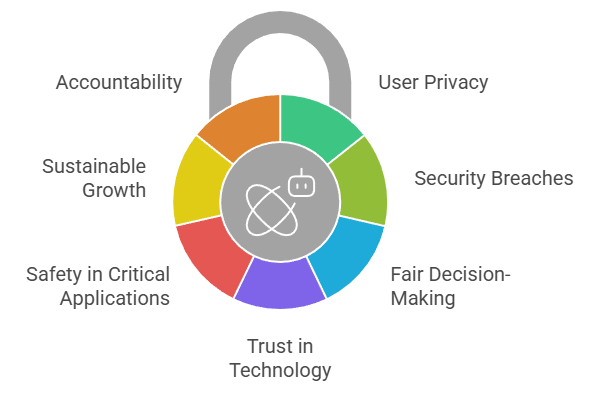
1. Protects User Privacy
Responsible use of IoT is crucial because these devices collect intimate, continuous data about people’s homes, daily habits, health patterns, and even emotional states.
Without strict privacy standards, this data can be misused by companies, sold to advertisers, or accessed by unauthorized parties.
Ethical privacy safeguards ensure users understand what is being collected and why, preventing hidden surveillance and data exploitation.
Responsible practices create transparent systems that respect user autonomy and consent.
They also reduce the risk of sensitive information leaking through poorly secured sensors.
Ultimately, protecting privacy builds long-term trust in IoT ecosystems and prevents harmful social and psychological consequences of over-monitoring.
2. Prevents Security Breaches and Cyber Risks
IoT devices can become major cybersecurity threats if not designed responsibly, because many operate with weak security settings or outdated firmware.
A compromised IoT system can allow hackers to take control of home appliances, connected vehicles, industrial robots, or medical devices.
Ethical responsibility involves implementing strong encryption, enforcing secure updates, and conducting regular vulnerability assessments to prevent such attacks.
When security is neglected, a single device can expose entire networks, causing financial losses, service disruption, and even physical danger.
Responsible security practices ensure systems remain resilient against evolving cyber threats.
This protects individuals, organizations, and national infrastructure from exploitation and sabotage.
3. Ensures Fair and Bias-Free Decision-Making
Automation systems often rely on sensor data that may not represent all users equally, leading to biased outcomes.
For Example, facial recognition doorbells may misidentify darker-skinned individuals, or smart health systems may misinterpret non-standard physiological patterns.
Responsible use emphasizes inclusive data collection, fairness evaluation, and bias mitigation to prevent discrimination.
Ensuring fairness is crucial in environments like workplaces, smart cities, and healthcare, where automated decisions affect opportunities and well-being.
Ethical design avoids reinforcing existing social inequalities through algorithmic decisions.
By prioritizing fairness, IoT systems become more reliable, inclusive, and socially responsible for diverse user groups.
4. Maintains Trust in Technology
Trust is fundamental for public acceptance of automation and IoT systems, especially when these devices operate in private spaces or make autonomous decisions.
If users feel monitored, unsafe, or misinformed, they will resist adoption, slowing innovation and limiting societal benefits.
Responsible practices ensure transparent communication about how devices function, what data they store, and how decisions are made.
This openness reduces fear around hidden surveillance, manipulation, or malicious use of automation.
As trust strengthens, people become more willing to engage with smart homes, autonomous vehicles, and connected services.
Long-term trust also helps companies build strong reputations and avoid legal or ethical backlash.
5. Supports Safety in Critical Applications
In high-risk environments—like autonomous vehicles, robotic surgery, industrial automation, or smart energy systems—ethical responsibility ensures the system behaves safely.
Failure in these scenarios can lead to injuries, fatalities, or large-scale operational breakdowns.
Responsible automation includes human-override mechanisms, clear failure protocols, and rigorous safety testing to avoid unpredictable behavior.
Ethical systems ensure algorithms do not make high-risk decisions without supervision.
This is especially important where real-time IoT data may be noisy, incorrect, or incomplete. Ensuring safety protects users, prevents accidents, and helps regulatory bodies validate new technologies before widespread deployment.
6. Encourages Sustainable Technology Growth
Billions of IoT devices generate huge energy demands, electronic waste, and data-processing emissions.
Responsible use ensures the development of energy-efficient devices, eco-friendly materials, and minimalistic data collection to reduce processing loads.
Ethical sustainability practices also encourage manufacturers to design repairable, upgradeable devices instead of disposable ones.
Automation can contribute to climate-positive outcomes—like smart agriculture, green logistics, or energy-efficient buildings—only when sustainability is part of its ethical design.
Prioritizing sustainability helps align technology growth with environmental goals and long-term ecological preservation.
This ensures IoT deployment remains beneficial instead of environmentally harmful.
7. Ensures Accountability and Prevents Misuse
IoT and automation systems involve many stakeholders—manufacturers, software engineers, data scientists, enterprises—and without clear accountability, failures or abuses can go unanswered.
Ethical frameworks define responsibility for system behavior, security upkeep, data handling, and user safety.
This prevents companies from shifting blame when harm occurs due to poor design or negligence.
Accountability is also essential to prevent intentional misuse, such as unauthorized surveillance, discriminatory automation, or using IoT devices to manipulate consumer behavior.
When accountability is in place, organizations adopt safer practices, maintain compliance with laws, and protect users from harm. It also ensures quick corrections when systems behave unexpectedly or unethically.