Data anonymization and security form the backbone of responsible data handling, ensuring that personal information is protected from unauthorized access, re-identification, and misuse.
In a world where data breaches, tracking technologies, and AI-driven analytics are rapidly expanding, anonymization helps organizations use data ethically while preserving privacy.
Anonymization removes or masks personally identifiable information (PII) so individuals cannot be easily traced, even when datasets are shared, combined, or analyzed.
However, modern re-identification techniques—such as linkage attacks or machine learning inference—make it challenging to guarantee complete anonymity, especially with large-scale data.
Security complements anonymization by safeguarding data against unauthorized access, internal threats, cyberattacks, and accidental leaks. Ethical data science requires implementing strong encryption, access controls, secure storage, and consistent monitoring to maintain data confidentiality and integrity.
As datasets grow and AI models become more powerful, organizations must adopt advanced security frameworks such as zero-trust architectures, differential privacy, secure multi-party computation, and federated learning to minimize exposure.
Overall, data anonymization and security ensure that sensitive information remains protected throughout its lifecycle—from collection to storage, processing, sharing, and deletion.
These practices enhance trust, support legal compliance, and allow data analysts to extract insights without compromising individual rights.
Privacy-Preserving Data Security and Anonymization in AI Systems
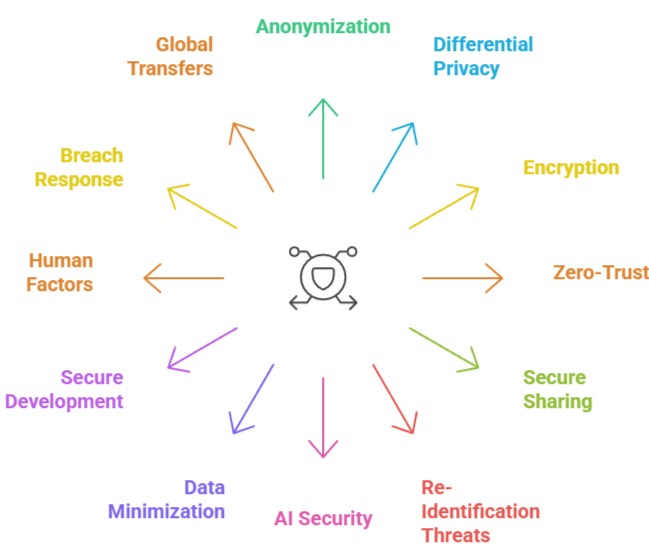
1. Importance of Strong Anonymization Techniques
Data anonymization reduces the risk of exposing individuals by removing, masking, or transforming identifiers such as names, phone numbers, IP addresses, and location trails.
Modern techniques like k-anonymity, l-diversity, and t-closeness help ensure that no single individual can be isolated or uniquely identified within a dataset.
However, anonymization is often challenged by the availability of external datasets, which can be combined to re-identify users.
Ethical practice requires ongoing evaluation of anonymization strength, regular audits, and updating methods as threats evolve.
Organizations must also consider that truly anonymous data should maintain utility while preventing misuse or unintended inference by AI models.
2. Differential Privacy and Its Role in Ethical Data Use
Differential privacy provides mathematically proven privacy guarantees by adding controlled noise to data or query outputs.
This prevents attackers from determining whether a specific individual’s data is included in a dataset.
Tech giants like Apple and Google now use differential privacy to collect usage statistics safely.
Ethical data science requires balancing noise levels to ensure privacy without damaging analytical value.
Differential privacy protects against re-identification attacks, supports safe data sharing, and is rapidly becoming a regulatory expectation for sensitive datasets such as health records, financial activity, or genomic data.
3. Encryption and Secure Data Storage Practices
Data security relies heavily on encryption—both in transit and at rest—to prevent unauthorized individuals from reading sensitive information.
Strong encryption protocols (e.g., TLS 1.3, AES-256) ensure that even if data is intercepted, it remains unreadable.
Ethical data protection also includes secure key management, controlled access, multi-factor authentication, and strict storage policies.
Cloud platforms require additional safeguards, such as role-based access controls, storage bucket audits, and continuous monitoring.
Without proper encryption, even anonymized data can be vulnerable to theft or manipulation, increasing risks for individuals and organizations.
4. Zero-Trust Security Architecture
A zero-trust framework assumes that no user, device, or system should be trusted by default—even inside an organization’s network.
Access is granted only after continuous verification, reducing the likelihood of insider threats or lateral movement by attackers.
Ethical data governance adopts zero-trust to ensure that sensitive data is only accessible to authorized personnel with legitimate need.
This method minimizes attack surfaces, enforces least-privilege access, and strengthens defenses against modern cyber threats such as ransomware, phishing, or credential theft.
As data volumes increase, zero-trust becomes essential for protecting distributed systems and remote work environments.
5. Secure Data Sharing, Collaboration, and Governance
Organizations frequently share datasets across teams, partner companies, research labs, or external vendors.
Ethical data science mandates secure sharing frameworks that include data masking, secure APIs, access logs, and expiration-based permissions.
Techniques like federated learning allow multiple organizations to train models without exposing raw data.
Governance tools help track who accessed what data, when, and for what purpose.
Without strong sharing controls, even anonymized data can leak into unregulated ecosystems, leading to re-identification risks or unauthorized exploitation by third parties.
6. Threats of Re-Identification and Inference Attacks
One of the biggest ethical challenges today is the rising power of inference attacks where attackers use machine learning to re-identify individuals from anonymized datasets.
Combining demographic data with external information social media, public records, or dark-web databases can uncover identities with high accuracy.
Even seemingly harmless attributes, like ZIP code or purchase history, can uniquely identify a person.
Ethical anonymization must consider these threats by reducing granularity, applying noise, and evaluating datasets for re-identification risk before release.
Organizations must stay updated on attack techniques and adjust protection strategies continuously.
7. Security in the Age of AI and Large Models
AI models often store patterns from training data, raising concerns about data leakage or membership inference attacks.
Ethical data practices require model-level security, including regular audits, privacy-preserving training, and access controls for model outputs.
Techniques like secure multi-party computation (SMPC) and homomorphic encryption (HE) allow computations on encrypted data without exposing sensitive information.
As models become more powerful, ethical risks grow, making advanced security essential to prevent AI systems from leaking personal or sensitive information unintentionally.
8. Data Minimization and Ethical Retention Policies
Data minimization is a critical ethical principle that focuses on collecting only the information absolutely necessary for the intended purpose.
The more data an organization collects, the higher the risk of exposure, misuse, or unauthorized access making minimization a strong complementary strategy to anonymization and security.
Ethical retention policies ensure that data is stored only for the required duration and automatically deleted afterward.
Many privacy breaches occur because outdated, unnecessary data remains accessible long after it has lost business value.
Clear, automated deletion workflows reduce risk, ensure compliance, and prevent large-scale exposure of forgotten data.
9. Secure Development Lifecycle (SDL) for Data Systems
Ethical data protection is not a one-time process but must be embedded throughout the development lifecycle of software and analytics systems.
A Secure Development Lifecycle ensures that privacy and security controls are considered from the design phase—long before deployment.
This includes threat modeling, secure coding practices, vulnerability scanning, and privacy impact assessments.
SDL helps identify potential risks early, reducing the chances of security flaws that could expose anonymized datasets.
As data platforms evolve with new features, continuous updates and patching remain essential to maintain strong defenses.
10. Role of Human Factors and Insider Threats
Human error remains one of the biggest risks in data protection—ranging from accidental file sharing to misconfigured cloud storage buckets.
Ethical data governance acknowledges that even strong technical controls can be undermined by weak training or poor awareness.
Insider threats intentional or unintentional pose significant challenges when employees access anonymized datasets that still contain sensitive patterns.
Organizations must provide regular security training, enforce role-based permissions, monitor access logs, and apply behavioral detection tools to reduce human-related vulnerabilities.
11. Ethical Data Breach Response and Transparency
Even with strong anonymization and security measures, breaches can occur. Ethical organizations prioritize transparency by informing affected individuals promptly and explaining the extent of exposure.
A robust incident response plan includes immediate containment, forensic investigation, legal compliance, and communication protocols.
Quick action helps reduce harm, prevent re-identification attempts, and rebuild public trust.
Ethical breach response also includes learning from the incident—fixing underlying vulnerabilities and updating security strategies to prevent future failures.
12. Cross-Border Data Transfers and Global Security Challenges
With organizations operating globally, data often crosses national borders where privacy laws differ significantly.
Ethical data handling requires ensuring that anonymization and security protections travel with the data, regardless of where servers, vendors, or analytics teams are located.
Challenges arise when data is transferred to regions with weaker privacy regulations or surveillance-heavy environments.
Secure transfer mechanisms, encryption tunnels, and strict contractual controls help mitigate these risks. Ethical compliance ensures that global data movement does not compromise individual privacy.
Real-World Case Studies
Case Study 1: Netflix Prize Dataset Re-Identification (Failure)
Netflix released an anonymized dataset of user viewing histories for a machine learning competition.
Although names and IDs were removed, researchers cross-referenced viewing patterns with IMDb ratings and successfully re-identified many users.
This exposed sensitive preferences and personal habits.
Lesson: Even well-anonymized data can be re-identified when combined with external datasets. Stronger techniques like differential privacy are necessary.
Case Study 2: UK National Health Service (NHS) Data Sharing Controversy (Failure)
The NHS partnered with DeepMind (Google) for a healthcare AI project but transferred millions of patient records without explicit consent.
Although the data was partially anonymized, the public criticized the lack of transparency and oversight.
Lesson: Data sharing—even for beneficial purposes—requires clear consent, governance, and strong anonymization standards.
Case Study 3: Apple’s Differential Privacy for User Data (Success)
Apple implemented differential privacy to collect usage statistics without exposing individual user behavior.
Noise is added to data like emoji usage, Safari browsing patterns, and app crashes, making it mathematically impossible to identify unique users.
Lesson: Differential privacy shows how organizations can gain insights ethically while protecting personal identity.
Case Study 4: Aadhaar Data Security Challenges in India (Mixed Outcome)
India’s Aadhaar biometric system introduced one of the world’s largest digital identity databases. Although encrypted and safeguarded, several cases of unauthorized access and database leaks raised concerns about privacy and security.
The government responded with stronger regulations, monitoring systems, and penalties.
Lesson: Large-scale identity systems require continuous security upgrades, strong encryption, and strict access controls.