Accountability in data-driven decision making refers to the obligation of data practitioners, organizations, and automated systems to justify the outcomes they produce and take responsibility for the consequences of those outcomes.
As organizations increasingly rely on machine learning models and AI systems to make decisions ranging from healthcare diagnosis to loan approvals and hiring—the need for clear accountability structures has become critical.
Without defined accountability, errors can go unresolved, biases may propagate, and users may lose trust in data systems.
Ethical accountability requires transparency in how decisions are made, clarity about who is responsible for validating model outputs, and mechanisms to address harms when they occur.
It promotes practices such as documenting datasets, validating algorithms, monitoring model drifts, evaluating fairness, and ensuring human oversight.
It also ensures compliance with global regulations like GDPR, which mandates explainability and the right to contest automated decisions.
In modern data ecosystems, accountability is not limited to model developers but extends to data collectors, business stakeholders, and decision-makers using model outputs.
By embedding accountability into workflows, organizations can maintain trust, reduce legal risks, and ensure that AI systems operate consistently with societal values and ethical standards.
Governance, Explainability, and Accountability in Data Science
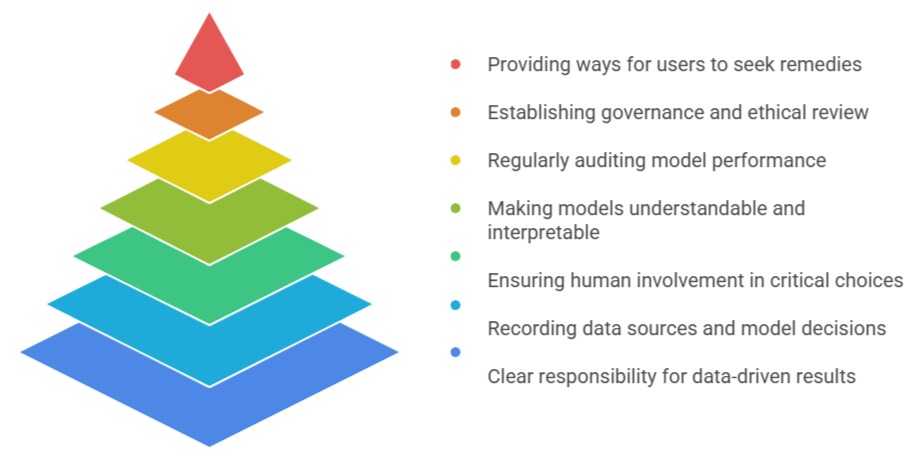 1. Clear Ownership of Data-Driven Outcomes
Assigning clear responsibility for model outcomes ensures that every stage of the data lifecycle has accountable stakeholders.
This prevents situations where errors are ignored because everyone assumes someone else is responsible. Teams must define who validates datasets, who approves model deployment, and who monitors real-world performance.
Clear ownership also helps escalate issues quickly when biases or inaccuracies appear in predictions.
It encourages proactive detection of risks rather than reactive crisis management. Ultimately, well-defined ownership creates a safety net that ensures transparency and prevents ethical negligence.
2. Documenting Data Sources, Assumptions, and Model Decisions
Accountability requires thorough documentation of how data was collected, processed, and used.
This includes recording model assumptions, biases in training data, preprocessing steps, and evaluation metrics.
Proper documentation prevents opacity and allows auditors, regulators, and developers to trace decisions back to their origins.
It also helps future team members understand design choices and update models responsibly.
Without documentation, accountability becomes impossible because harmful outcomes cannot be traced to their root cause, limiting both learning and corrective action.
3. Ensuring Human Oversight in Critical Decisions
Even the most accurate models require human judgement for ethical decision-making.
Accountability demands that humans review automated decisions, especially in sensitive sectors like healthcare, finance, and law enforcement.
Human oversight reduces automated errors, prevents over-reliance on AI, and allows nuanced evaluation of edge cases.
It also establishes a safety protocol so that harmful predictions can be corrected before they affect real individuals.
This balance between automation and human governance ensures responsible and safe system operation.
4. Building Explainability and Interpretability into Models
Transparent models allow stakeholders to understand why decisions are made, reducing the risk of hidden biases.
Explainability tools like SHAP, LIME, and model cards help reveal the logic behind predictions.
When stakeholders can interpret outputs, they can challenge incorrect or unfair decisions. Building interpretability also supports regulatory compliance in industries where explanations are legally required.
Most importantly, it empowers users to trust systems because they can evaluate their fairness and accuracy.
5. Monitoring and Auditing Model Performance Continuously
Accountability requires ongoing evaluation of whether models behave as expected over time.
Monitoring helps detect performance degradation, shifts in data distributions, or emerging bias patterns.
Audits both internal and external ensure transparency and identify ethical risks before they escalate.
Regular reviews also help teams update outdated models and improve reliability.
Continuous monitoring ensures that systems remain safe and fair under changing conditions, protecting users from unintended harm.
6. Establishing Ethical Review Frameworks and Governance Committees
Organizations must form ethics boards or review committees to evaluate the societal impact of AI systems.
These groups examine risks, fairness issues, and potential harms before a system is deployed.
Ethical frameworks ensure that decision-making aligns with organizational values, laws, and public expectations.
They create a structured approach to handling ethical dilemmas and provide oversight beyond technical development teams.
Governance committees also hold teams accountable for implementing responsible AI practices.
7. Providing Redress Mechanisms for Affected Users
True accountability means giving individuals the ability to challenge, contest, or appeal automated decisions.
Organizations must implement channels where users can request explanations, corrections, or reconsiderations.
Redress mechanisms create fairness and help repair trust when mistakes occur.
They also highlight areas where models can be improved. Ensuring redress shows that organizations accept responsibility for consequences and prioritize user rights.
Real-World Case Studies
1. COMPAS Criminal Justice Algorithm (USA) – Accountability Failure
The COMPAS algorithm, used to predict recidivism, was found to disproportionately score Black defendants as higher risk compared to white defendants.
Initially, authorities claimed “the algorithm is proprietary,” refusing to explain its logic.
This lack of accountability created large-scale ethical controversy. Courts, researchers, and civil rights groups demanded transparency and fairness audits.
The lack of explainability and accountability led to widespread public distrust and fueled global debates on responsible AI governance.
2. Amazon’s AI Hiring Tool – Bias and Lack of Oversight
Amazon built an automated hiring algorithm trained on historical resumes, which unintentionally favored male candidates for technical roles.
The system penalized resumes containing words linked to women’s colleges or associations.
Poor accountability practices allowed biased patterns to remain unnoticed for years.
When discovered, the model could not be corrected reliably and was eventually scrapped.
The case highlights how lack of responsibility ownership leads to systemic discrimination and reputational harm.
3. Apple Card Credit Limit Controversy – Accountability Demanded by Public
Customers reported that Apple’s credit card algorithm offered significantly lower limits to women compared to men—even when financial profiles were similar.
Public outrage forced regulators to investigate and demand explanations from Apple and Goldman Sachs.
Because no clear accountability structure existed internally, neither company could provide immediate clarity on model logic.
The incident demonstrated how essential explainability and responsible governance are in financial risk models.
4. Netflix Content Recommendation Bias – Successful Accountability Example
Netflix discovered that recommendation models were reinforcing cultural and demographic bubbles, limiting content diversity exposure.
The team implemented an accountability framework: fairness-aware recommendations, transparency reports, and continuous audits.
By improving accountability, Netflix reduced stereotype reinforcement and made their platform more inclusive.
This case shows how proactive accountability improves user experience and prevents algorithmic harm.

Class Sessions
Sales Campaign

We have a sales campaign on our promoted courses and products. You can purchase 1 products at a discounted price up to 15% discount.