Foundations of Data Governance establish the strategic, ethical, and operational framework for how data is collected, stored, processed, accessed, and used within an organization.
It ensures that data practices remain reliable, transparent, and aligned with legal as well as ethical expectations.
In the modern data-driven world, organizations generate enormous volumes of information, making governance essential to prevent misuse, inaccuracies, or unethical exploitation.
Proper governance structures help define ownership, accountability, and standardized procedures that guide employees, data scientists, and decision-makers.
Foundations of Data Governance and Stewardship
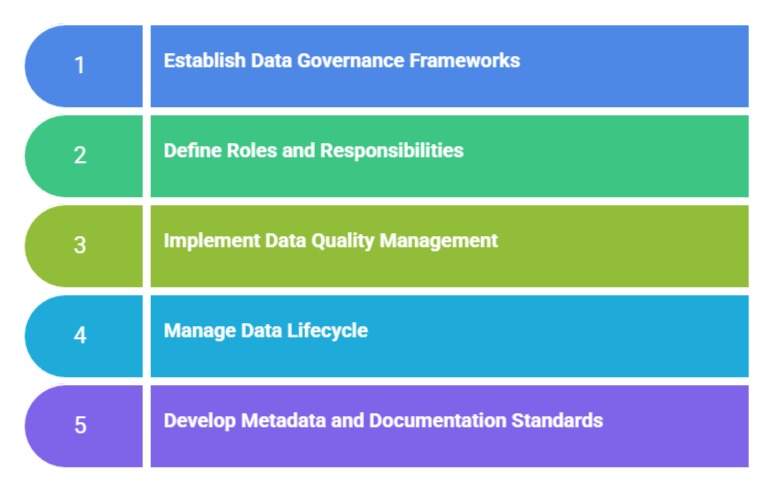
1. Data Governance Frameworks and Policies
A governance framework defines the overarching structure that guides how data is managed across the organization.
It outlines standard policies, operational procedures, and ethical obligations for handling information responsibly.
A well-designed framework helps reduce ambiguity by clearly defining what can and cannot be done with data.
It ensures consistency in data handling, regardless of department or use case, minimizing risks related to bias, privacy, or unauthorized usage.
The framework also establishes escalation mechanisms for violations and outlines accountability structures.
As organizations grow, these frameworks help maintain order and ethical discipline across data operations.
2. Roles and Responsibilities in Data Governance
Clearly defined roles—such as data owners, stewards, custodians, and users—create accountability and reduce governance gaps.
Each role has specific duties, such as maintaining data accuracy, ensuring secure access, or monitoring compliance.
These responsibilities ensure that no single stakeholder has unchecked control, thus reducing the chances of unethical data use.
This role distribution encourages collaboration between technical teams, compliance officers, and business units.
It also ensures that governance tasks are proactively managed instead of becoming reactionary.
The clarity helps organizations track performance, manage risks, and uphold ethical standards efficiently.
3. Data Quality Management
Data quality is central to ethical decision-making, as poor-quality data leads to unfair outcomes, biased algorithms, and unreliable insights.
Quality management involves maintaining accuracy, completeness, timeliness, and consistency throughout the data lifecycle.
Organizations adopt validation techniques, automated checks, and audits to ensure that the data remains reliable.
When data meets high-quality standards, it reduces errors and ensures fair, transparent analytics.
Proper quality management also ensures that downstream applications—machine learning models, dashboards, or automated systems—operate ethically and effectively. It reinforces trust among internal teams and external stakeholders.
4. Data Lifecycle Management
The data lifecycle includes creation, collection, storage, processing, sharing, retention, and eventual deletion.
Managing each stage carefully prevents ethical and legal risks such as unauthorized access, outdated data usage, or unnecessary retention.
It ensures data is handled responsibly from the moment it enters the system to the moment it is securely archived or destroyed.
Lifecycle policies help organizations avoid security vulnerabilities and regulatory violations.
They guide teams on when data should be updated, archived, or removed to maintain compliance.
Effective lifecycle management reflects an organization’s commitment to ethical stewardship.
5. Metadata and Documentation Standards
Metadata provides descriptive information about data, helping teams understand its origin, structure, meaning, and limitations.
Strong documentation prevents misuse caused by misunderstanding or misinterpretation.
Metadata standards support transparency by detailing how the data was collected and what biases or constraints it might carry.
Proper documentation enables reproducibility and reduces errors during data integration or model-building tasks.
It also supports audits, compliance checks, and long-term governance stability.
Clear metadata ensures ethical data usage by providing context, accountability, and informed decision-making.
Importance of Foundations of Data Governance
1. Ensures Ethical and Responsible Data Use
Foundational governance ensures that every data activity—from collection to processing—is performed with strict respect for ethical norms.
It helps organizations prevent harmful uses, discriminatory outcomes, or manipulative practices by placing ethical constraints around data workflows.
Clear ethical guidelines also act as guardrails when teams face ambiguity in fast-moving data projects.
This reduces the likelihood of ethical violations caused by accidental oversight.
It also promotes an organizational culture grounded in responsibility. Ultimately, it ensures that data is used in ways that respect human dignity and societal values.
2. Protects Privacy and Personal Rights
Strong data governance frameworks enforce controls such as consent management, purpose limitation, and privacy-by-design.
These controls protect individuals from unauthorized use of their personal data and reduce the risk of harmful intrusions.
Governance ensures that sensitive information—like health or financial data receives the highest protection.
It establishes mechanisms to handle data requests, opt-outs, deletions, and anonymization responsibly.
As privacy regulations tighten globally, governance becomes essential for long-term compliance and trust.
It ensures organizations treat personal data as a right, not a commodity.
3. Improves Data Quality and Reduces Errors
Governance defines standards for accuracy, consistency, completeness, and timeliness of data.
High-quality data results in better analytics outcomes, fewer model errors, and more reliable decision-making.
Without governance, datasets often contain duplicates, missing values, or incorrect entries that distort models.
Data quality frameworks also formalize error correction procedures, validation checks, and stewardship responsibilities.
In ethical terms, poor data quality can lead to unfair or biased outcomes. Therefore, governance improves both technical reliability and ethical fairness.
4. Supports Fair and Unbiased Model Development
Foundational governance ensures that systems include fairness checks, bias detection procedures, and equitable data sourcing.
It enforces review mechanisms before algorithms are deployed, preventing harmful discrimination, especially in high-stake domains like hiring, lending, policing, or healthcare.
Governance standards require transparency in feature engineering, sampling techniques, and model evaluations.
By controlling data lineage and access, governance minimizes hidden sources of algorithmic bias.
Ultimately, it ensures that the organization does not unintentionally amplify social inequalities.
5. Enhances Transparency and Traceability
Governance requires documenting data sources, transformations, decision rules, and analytical steps.
This creates a chain of traceability that builds trust with regulators, customers, and internal teams.
Transparent systems allow audits, root-cause tracing, and accountability in cases of errors or ethical concerns.
When data scientists can clearly see how data evolved, they make more responsible and explainable decisions.
Transparency also supports communication with non-technical stakeholders, improving understanding of risks.
Ultimately, it reduces opacity and enables ethical oversight.
6. Enables Compliance with Laws and Regulations
Modern regulations like GDPR, CCPA, HIPAA, and India’s DPDP Act impose strict rules on consent, retention, cross-border transfers, and security.
Governance frameworks embed these rules into organizational processes so compliance becomes systematic, not reactive.
Non-compliance can lead to heavy fines, lawsuits, and reputational damage.
Governance also ensures timely reporting of breaches and handling of user data rights.
It enables organizations to stay aligned with evolving global laws. Thus, governance reduces legal risks while strengthening ethical credibility.
7. Strengthens Data Security and Risk Management
Governance sets protocols for encryption, access control, threat monitoring, and breach response.
These controls reduce the risk of unauthorized access, data leaks, or cyberattacks.
Governance also defines incident-handling responsibilities so teams can respond swiftly and avoid escalation.
By continuously monitoring vulnerabilities, organizations protect both sensitive data and public trust.
Security failures today extend far beyond financial losses—they destroy user confidence. Therefore, governance acts as a proactive defense layer in ethical data operations.
8. Establishes Clear Roles and Accountability
A governance foundation defines who owns data, who stewards it, who can access it, and who makes ethical decisions.
Clear role assignments reduce confusion, prevent misuse, and ensure proper escalation when issues arise.
Ethical accountability becomes distributed rather than isolated to individuals.
This structure prevents the “no one is responsible” scenario during failures.
It aligns teams towards shared ethical goals and ensures responsibilities are measurable.
Ultimately, it creates a culture where data decisions are owned, not left to chance.
9. Reduces Operational Inefficiencies and Conflicts
Without governance, teams often build inconsistent workflows, leading to duplicated efforts, incompatible datasets, and communication breakdowns.
Governance provides standardization that streamlines operations and reduces friction between departments like IT, analytics, and compliance.
Clear policies resolve debates on data ownership, permissible use, and ethical boundaries.
This improves productivity and collaboration. In ethical terms, consistency prevents ad-hoc shortcuts that may risk privacy or fairness. Governance converts disorder into systematic control.
10. Builds Public Trust and Organizational Reputation
Consumers increasingly judge organizations based on how responsibly they handle data.
Strong governance demonstrates transparency, ethical concern, and commitment to user rights.
This builds trust and strengthens relationships with customers, partners, and regulators.
Trust becomes a strategic advantage, especially in AI-driven products.
Governance also prevents scandals that could damage reputation for years. In an era of data-driven services, ethical governance becomes one of the biggest differentiators.
11. Facilitates Ethical Innovation and Experimentation
Governance enables innovation by creating structured frameworks for safe experimentation.
Teams can explore new models, technologies, or datasets without crossing ethical boundaries.
Governance ensures that early-stage experiments do not harm users or violate privacy.
It builds an environment where creativity and responsibility coexist.
This is especially important for AI, where unregulated experimentation can lead to unintended societal impacts.
Thus, governance supports ethical innovation rather than restricting it.
12. Controls Data Access and Minimizes Insider Risks
Unauthorized internal access to sensitive data is a major risk. Governance policies restrict access based on necessity, role, and sensitivity levels. This ensures that employees only access what is essential for their tasks.
It also enforces monitoring and auditing of access logs. Insider misuse—intentional or accidental is reduced significantly.
Strong access controls also prevent unethical data leaks, model manipulation, or unauthorized sharing.
Governance protects the organization from internal vulnerabilities.
13. Supports Cross-Functional Collaboration and Shared Understanding
Governance frameworks act as common ground for technical, legal, management, and ethics teams.
They define shared terminology, responsibilities, and procedures.
This alignment ensures decisions consider multiple perspectives, reducing ethical blind spots.
Collaboration improves decision-making quality and reduces the risk of silo-based mistakes.
Governance also promotes an integrated approach to ethical risk assessments. It ensures that every department contributes meaningfully to responsible data use.
14. Reduces the Risk of Misinterpretation and Misuse of Data
Governance establishes clear guidelines for interpretation, model use, and communication of insights.
It ensures that data is used for the intended purpose and not taken out of context.
Misinterpretation can lead to harmful decisions, discriminatory policies, or flawed conclusions.
Ethical guidelines support accurate reporting and discourage manipulation of results.
Governance also embeds verification mechanisms that prevent flawed analyses from influencing high-stakes decisions.
It strengthens the credibility of data-driven findings.
15. Provides a Scalable Framework for Future Growth
As data volumes grow, systems must scale ethically and responsibly.
Governance creates scalable rules and processes that adapt to new technologies, regulations, and business models.
Without this foundation, uncontrolled growth can lead to risk accumulation and ethical failures.
Governance supports long-term sustainability by ensuring that expansion does not compromise fairness, privacy, or quality.
It also prepares organizations for future AI ethics requirements. Essentially, governance is an investment in sustainable growth.

Class Sessions
Sales Campaign

We have a sales campaign on our promoted courses and products. You can purchase 1 products at a discounted price up to 15% discount.