Artificial Intelligence gives machines the ability to simulate human intelligence — but how do machines actually learn? The answer is Machine Learning.
Machine Learning is a branch of AI that enables computers to learn from data and improve their performance over time without being explicitly programmed for every task.
Instead of writing rules manually, you feed data to an algorithm and let it discover the patterns on its own. It is one of the most transformative technologies of our time, powering everything from spam filters to medical diagnosis systems.
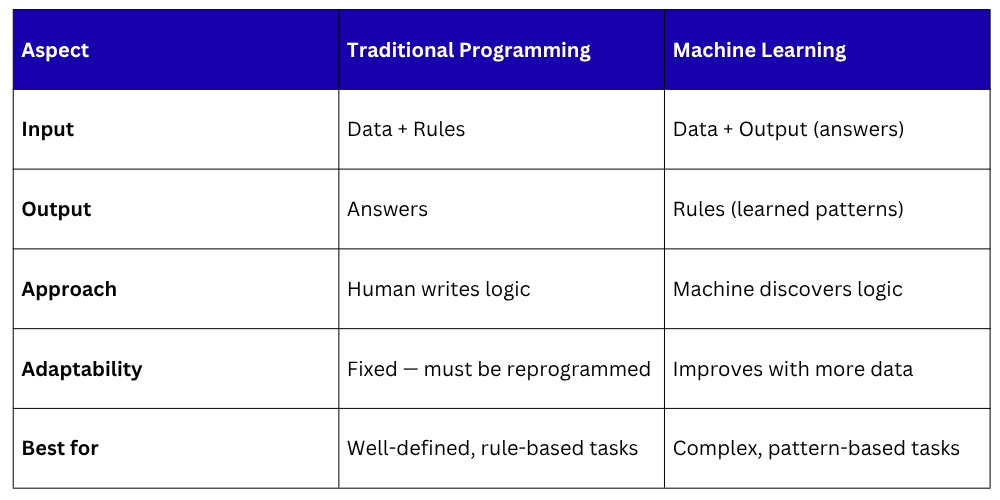
Traditional Programming vs Machine Learning
The clearest way to understand ML is to contrast it with traditional programming.

Step by Step
1. Collect Data: Gather relevant data for the problem.
2. Prepare Data: Clean, format, and split into training and testing sets.
3. Choose Algorithm: Select the appropriate ML algorithm.
4. Train the Model: Feed training data so the model learns patterns.
5. Evaluate: Test the model on unseen data to measure accuracy.
6. Predict: Use the trained model to make predictions on new data.
Key Terminology
Understanding these terms is essential before working with any ML model:
1. Model: The algorithm after it has been trained on data.
2. Training: The process of feeding data to the algorithm so it learns.
3. Features: Input variables used to make a prediction (columns in your dataset).
4. Label / Target: The output variable the model is trying to predict.
5. Training Set: Data used to train the model.
6. Test Set: Unseen data used to evaluate how well the model performs.
7. Prediction: The model's output for new, unseen input.
8. Accuracy: Percentage of correct predictions made by the model.
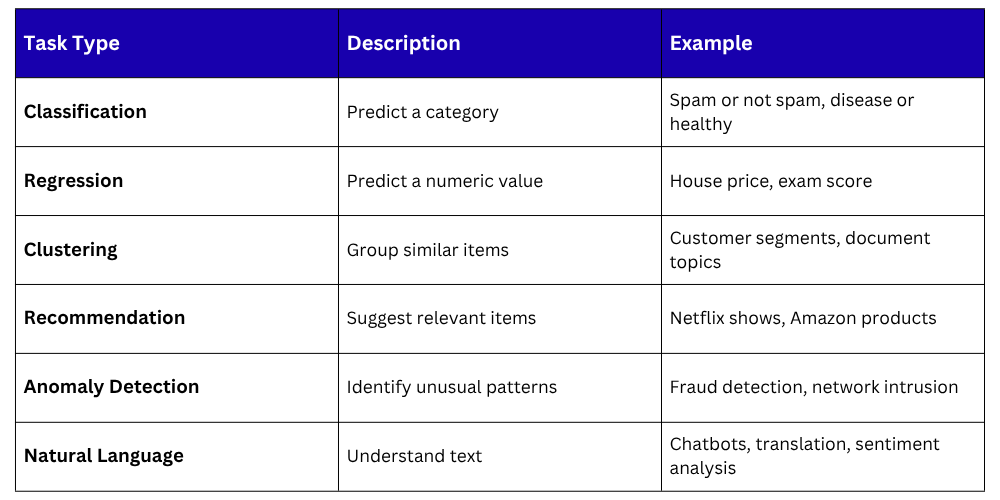
What Can Machine Learning Do?
ML is applied across a wide range of real-world problems:
Real-World Applications of ML
Machine Learning is already deeply embedded in everyday technology:
1. Healthcare: Diagnosing diseases from medical scans, predicting patient risk.
2. Finance: Detecting fraudulent transactions, credit scoring.
3. Retail: Product recommendation engines, demand forecasting.
4. Transport: Self-driving vehicles, traffic prediction.
5. Education: Personalized learning paths, automated grading.
6. Cybersecurity: Detecting malware, identifying suspicious activity.
7. Agriculture: Crop yield prediction, disease detection in plants.
The Role of Data in Machine Learning
Data is the fuel that powers every ML model. The quality, quantity, and relevance of your data directly determines how well your model performs.1. More relevant data generally leads to better models
2. Poor quality data produces unreliable predictions — "garbage in, garbage out".
3. Balanced data ensures the model does not favour one category over another.
4. Representative data means the training data reflects the real-world scenarios the model will face.

1. AI is the broadest field — any technique that makes machines intelligent.
2. ML is a subset of AI — machines that learn from data.
3. Deep Learning is a subset of ML — uses neural networks with many layers, ideal for images, speech, and text.
Why Python for Machine Learning?
Python has become the dominant language for ML for very practical reasons:
1. Scikit-learn — provides ready-to-use ML algorithms with a clean, consistent interface.
2. Pandas & NumPy — handle data loading, cleaning, and numerical operations.
3. Matplotlib & Seaborn — visualize data and model performance.
4. TensorFlow & PyTorch — power deep learning models.
5. Jupyter Notebook — interactive environment ideal for experimenting with data and models.
All of these tools work together seamlessly, making Python the most complete ML ecosystem available.
Think of ML like teaching a child to recognize animals:
1. You show them hundreds of pictures of cats and dogs with labels, this is training.
2. The child starts noticing patterns — ears, tails, size, these are features.
3. They correctly identify the animal, this is a prediction.
4. You test them with a new photo they have never seen, this is evaluation.
The ML algorithm does exactly this, but with data instead of pictures, and mathematics instead of intuition.

Class Sessions
Sales Campaign

We have a sales campaign on our promoted courses and products. You can purchase 1 products at a discounted price up to 15% discount.