Writing every piece of functionality from scratch is neither practical nor efficient. Python solves this through libraries — pre-written collections of code that you can plug into your own programs instantly.
Whether you need to perform complex mathematics, handle large datasets, or visualize data, there is almost always a Python library built for that exact purpose. This is one of the key reasons Python dominates the AI and data science world.
What is a Python Library?
A library is a collection of pre-written Python code — functions, classes, and tools that you can import and use in your own programs without writing everything from scratch.
Think of it like a toolbox. Instead of building a hammer yourself, you simply pick it up and use it. Python libraries work the same way, someone has already built and tested the tool, and you simply import and use it.
Types of Python Libraries
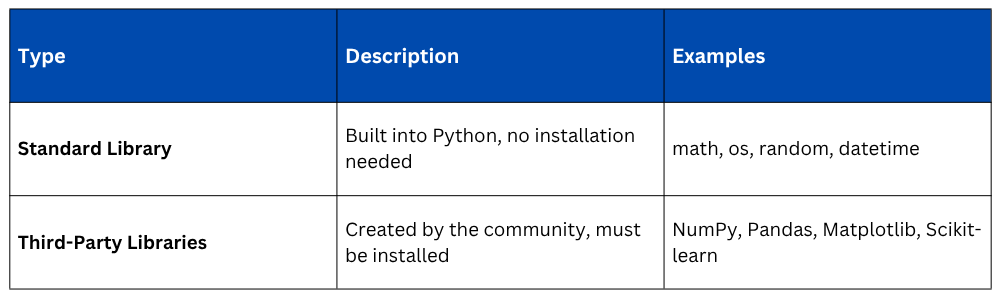
Python libraries fall into two main categories:
How to Import a Library
Python provides three common ways to import a library depending on how much of it you need.
Import the entire library:

Import with an alias (shortcut name):

This is the standard convention in AI and data science — np and pd are universally recognised shortcuts.
Import only what you need:

Key Libraries Used in AI and Data Science
These are the most essential libraries you will work with throughout this course and in real AI projects:
1. NumPy: Handles numerical data and mathematical operations using arrays. It is the foundation of almost every AI library.
2. Pandas: Provides powerful tools for loading, cleaning, and manipulating structured data (tables and spreadsheets).
3. Matplotlib: Used for creating charts and visualizations to understand and present data.
4. Scikit-learn: A beginner-friendly machine learning library that provides ready-to-use ML algorithms.
Why Libraries Matter in AI
AI projects involve multiple stages — loading data, cleaning it, running mathematical operations, training models, and visualizing results.
Without libraries, each of these stages would require hundreds of lines of custom code. Libraries compress that complexity into clean, readable, and reliable one-liners, allowing you to focus on solving the actual problem rather than reinventing the wheel.
Bringing It All Together
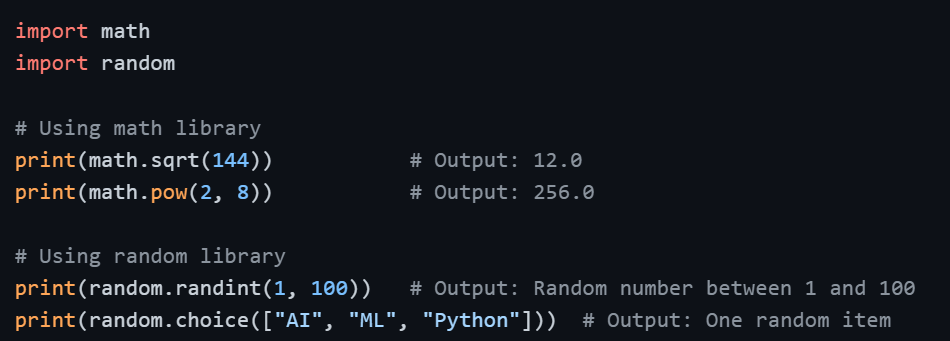
This simple example uses two standard Python libraries without installing anything — demonstrating how quickly libraries extend what Python can do.