Python is a high-level, general-purpose programming language known for its simplicity and readability.
Created by Guido van Rossum and first released in 1991, Python has grown into one of the most widely used programming languages in the world, and it is now the leading language in Artificial Intelligence (AI) and data science.
What is Python?
Python is an interpreted, object-oriented language that emphasizes clean and readable syntax. It is designed so that even beginners can write and understand code quickly.
Key Characteristics of Python:
1. Simple syntax — reads almost like plain English.
2. Interpreted — code runs line by line; no compilation needed.
3. Dynamically typed — no need to declare variable types explicitly.
4. Cross-platform — runs on Windows, macOS, and Linux.
5. Huge community — millions of developers and extensive documentation.
A Simple Example of Python Code:

This single line of output demonstrates how little code Python needs to get things done.
Why is Python Used in AI?
Python has become the standard language for AI development due to several practical advantages.
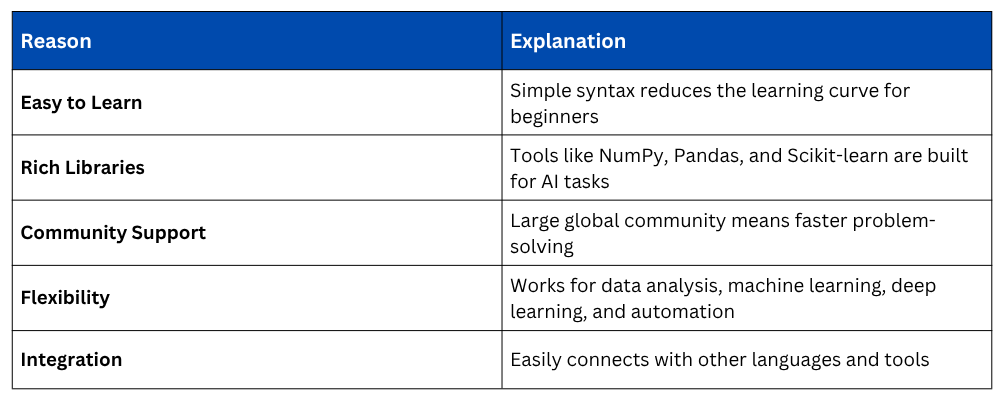
Python's Core AI Libraries
These libraries are what make Python genuinely powerful for AI work:
1. NumPy: Handles numerical data and mathematical operations.
2. Pandas: Manages and processes structured data.
3. Matplotlib / Seaborn: Creates data visualizations.
4. Scikit-learn: Provides ready-to-use machine learning algorithms.
5. TensorFlow / PyTorch: Used for deep learning and neural networks.
Where is Python Used in AI?
Python powers AI applications across many real-world domains:
1. Healthcare — disease prediction, medical image analysis.
2. Finance — fraud detection, stock market forecasting.
3. Retail — recommendation systems (like Amazon or Netflix).
4. Transportation — self-driving car algorithms.
5. Natural Language Processing — chatbots, translation tools.