Artificial Intelligence, commonly known as AI, refers to the ability of machines to perform tasks that would typically require human intelligence.
These tasks include recognising patterns, making decisions, understanding language, and learning from experience.
AI is no longer a futuristic concept, it is already embedded in the tools and services we use every day, from voice assistants to recommendation systems.
What is Artificial Intelligence?
At its core, AI is about enabling computers to think, learn, and act in a way that mimics human reasoning. Rather than following a fixed set of rules, an AI system learns from data and improves over time.
AI can be broadly understood through three levels of capability:
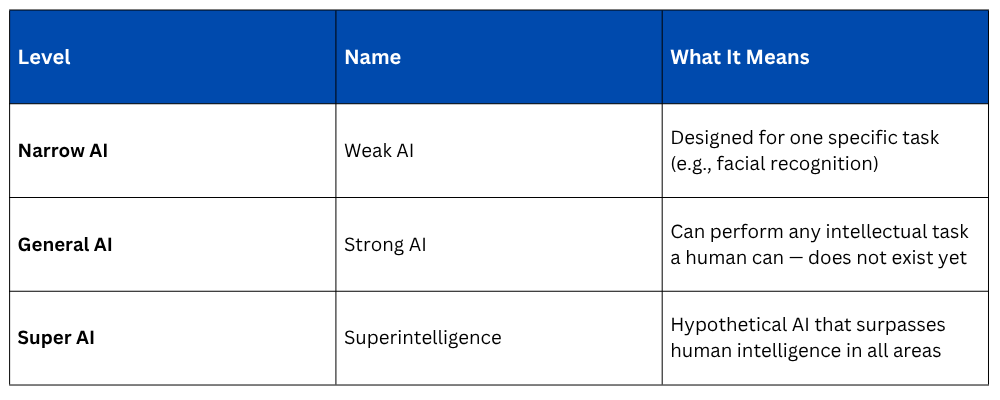 Today, all real-world AI systems fall under Narrow AI.
How Does AI Actually Learn?
AI systems learn by analysing large volumes of data and identifying patterns within it.
Think of it this way: if you show an AI thousands of photos of cats and dogs with labels, it gradually learns what features distinguish one from the other. The next time it sees a new photo, it can make a confident prediction.
This learning process is handled by a subfield of AI called Machine Learning.
Key Branches of AI
AI is a broad field. Here are the main branches you will encounter:
1. Machine Learning (ML): Systems that learn from data without being explicitly programmed.
2. Deep Learning: A subset of ML that uses neural networks to process complex data like images and speech.
3. Natural Language Processing (NLP): Enables machines to understand and generate human language.
4. Computer Vision: Allows machines to interpret and analyse visual data (images, videos)
5. Robotics: Combines AI with physical systems to perform real-world tasks.
Real-World Applications of AI
AI is transforming industries at a rapid pace. Here is a closer look at where it is making the biggest impact:
1. Healthcare: AI analyses medical scans to detect diseases like cancer at early stages and assists doctors in making faster, more accurate diagnoses.
2. Finance: Banks use AI to detect unusual transaction patterns and flag potential fraud in real time. AI is also used to predict market trends.
3. Retail: Platforms like Amazon and Netflix rely on AI-powered recommendation systems to suggest products and content tailored to each user.
4. Transportation: Self-driving car technology uses AI to process sensor data and make split-second driving decisions. Apps like Google Maps use AI to optimise routes.
5. Education: AI enables personalised learning platforms that adapt to a student's pace and style, and can even automate feedback on assignments.
6. Security: AI-powered facial recognition systems and threat detection tools are used in surveillance, cybersecurity, and access control.
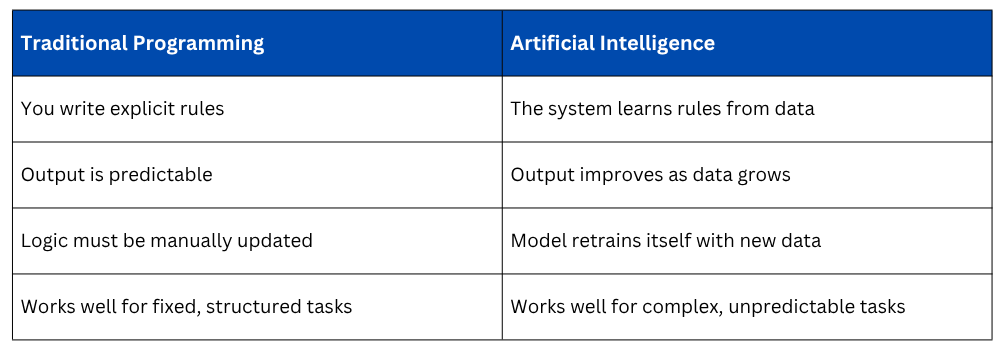
AI vs. Traditional Programming
A key thing to understand before going deeper into AI is how it differs from conventional programming:

Class Sessions
Sales Campaign

We have a sales campaign on our promoted courses and products. You can purchase 1 products at a discounted price up to 15% discount.