Successful implementation of Business Intelligence (BI) solutions extends beyond technology deployment to managing organizational change and fostering user adoption. Change management in BI ensures that users embrace new tools and analytics workflows, integrating them into daily decision processes. Strong user adoption is critical to realizing the value of BI investments, avoiding resistance, and empowering employees to leverage data confidently.
Importance of Change Management in BI
The effectiveness of BI depends on user engagement, process adaptation, and cultural alignment. Here are key factors demonstrating why change management matters.
1. Facilitates smooth transitions from legacy processes to data-driven decision-making.
2. Minimizes resistance stemming from fear of new technology or altered workflows.
3. Enhances BI usability and relevance by involving users in design and deployment phases.
4. Builds a data-driven culture through education, communication, and reinforcement.
5. Increases ROI by maximizing tool utilization and embedding insights into roles.
Common Challenges in BI User Adoption
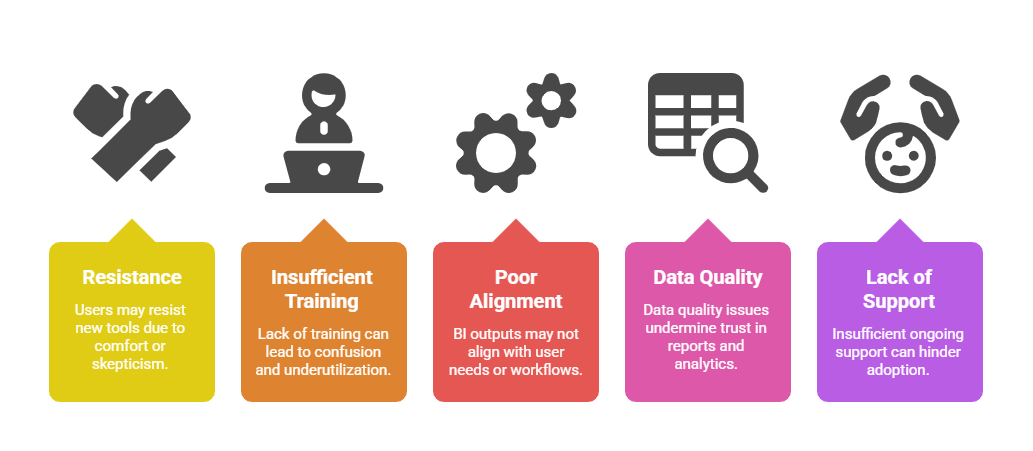
User adoption of BI solutions often faces obstacles that limit effectiveness and ROI. The following challenges highlight common barriers organizations encounter.
Best Practices for Effective Change Management and Adoption
Effective change management aligns technology, people, and processes for BI success. Here are essential practices to facilitate adoption and engagement across the organization.
1. Involve Users Early and Continuously
Include representatives from all stakeholder groups in requirements gathering and pilot testing.
Encourage feedback loops to iterate BI features, ensuring solutions meet real-world needs.
Involving users creates a sense of ownership and reduces resistance.
2. Communicate Clearly and Transparently
Explain the purpose, benefits, and impact of BI tools regularly through multiple channels.
Set realistic expectations about learning curves and timelines.
Address concerns empathetically and promptly.
3. Provide Comprehensive, Role-Based Training
Tailor training programs to different skill levels and use cases.
Use hands-on, scenario-based sessions to build practical skills.
Offer refresher courses and on-demand resources for continuous learning.
4. Empower Change Champions and Leadership Support
Identify and enable super-users or champions to mentor peers and advocate BI adoption.
Secure visible and active support from executives to reinforce BI’s strategic importance.
Leadership modeling of BI usage sets positive organizational norms.
5. Measure Adoption and Act on Insights
Track usage metrics like login frequency, report consumption, and feature engagement.
Conduct surveys and collect qualitative feedback to uncover barriers.
Use findings to tailor communications, training, or platform enhancements.
6. Foster a Data-Driven Culture Beyond Tools
Promote storytelling with data to illustrate BI’s role in successful decisions.
Recognize and celebrate successes driven by BI insights to motivate users.
Encourage exploration and experimentation with data to deepen engagement.

Class Sessions
Sales Campaign

We have a sales campaign on our promoted courses and products. You can purchase 1 products at a discounted price up to 15% discount.