In recent years, the adoption of cloud technology has revolutionized how organizations approach Business Intelligence (BI). Cloud-based BI platforms offer flexible, scalable, and cost-effective solutions that enable companies of all sizes to access and analyze data without heavy initial infrastructure investments.
These platforms support real-time data processing, collaborative analytics, and seamless integration with other cloud services, making them increasingly popular across industries.
As data volumes continue to grow and business needs evolve, understanding the landscape of cloud BI platforms and their emerging trends is essential for organizations seeking to leverage advanced analytics and maintain a competitive advantage.
Features of Cloud-Based BI Platforms
Cloud BI platforms provide a suite of features that enable organizations to build, deploy, and operate analytics solutions efficiently:
1. Scalability and Elasticity: Cloud platforms can easily scale resources up or down based on demand, accommodating large datasets and complex computations while controlling costs.
2. Data Integration and Connectivity: Cloud BI tools seamlessly connect to various data sources, including cloud data warehouses (e.g., Snowflake, BigQuery), SaaS applications, IoT devices, and on-premises systems.
3. Real-Time Analytics: Support for streaming data and live data feeds enables real-time dashboards and decision-making, vital for operational agility.
4. Self-Service Analytics: Designed for business users, these platforms often feature drag-and-drop interfaces, dashboards, and visualization tools that require minimal technical expertise.
5. Collaboration and Sharing: Cloud platforms promote collaborative analysis through shared dashboards, report publishing, and role-based access controls.
6. Security and Compliance: Built-in security features, encryption, audit logs, and compliance standards support data privacy and regulation adherence.
Key Benefits of Cloud BI Platforms
Shifting BI to the cloud supports agile decision-making and reduces the constraints of on-premises systems. Here are some of the most impactful reasons organizations embrace cloud BI:
1. Cost-Effectiveness: Organizations pay for resources they consume, significantly reducing capital expenditures traditionally associated with on-premises systems.
2. Rapid Deployment: Cloud platforms facilitate quick setup and onboarding, reducing time-to-value for BI initiatives.
3. Flexibility and Agility: Businesses can rapidly adapt to changing data needs, adding new data sources or analytical tools without hardware constraints.
4. Improved Accessibility: Users can access BI insights from anywhere, on any device, supporting remote workforces and global teams.
5. Automatic Updates and Maintenance: Cloud vendors handle software upgrades, security patches, and system maintenance, reducing the burden on internal IT teams.
Trends Shaping the Future of Cloud BI
Cloud BI is evolving rapidly as new technologies and architectures reshape how organizations use data. The following trends highlight the key forces influencing the future of cloud-based analytics: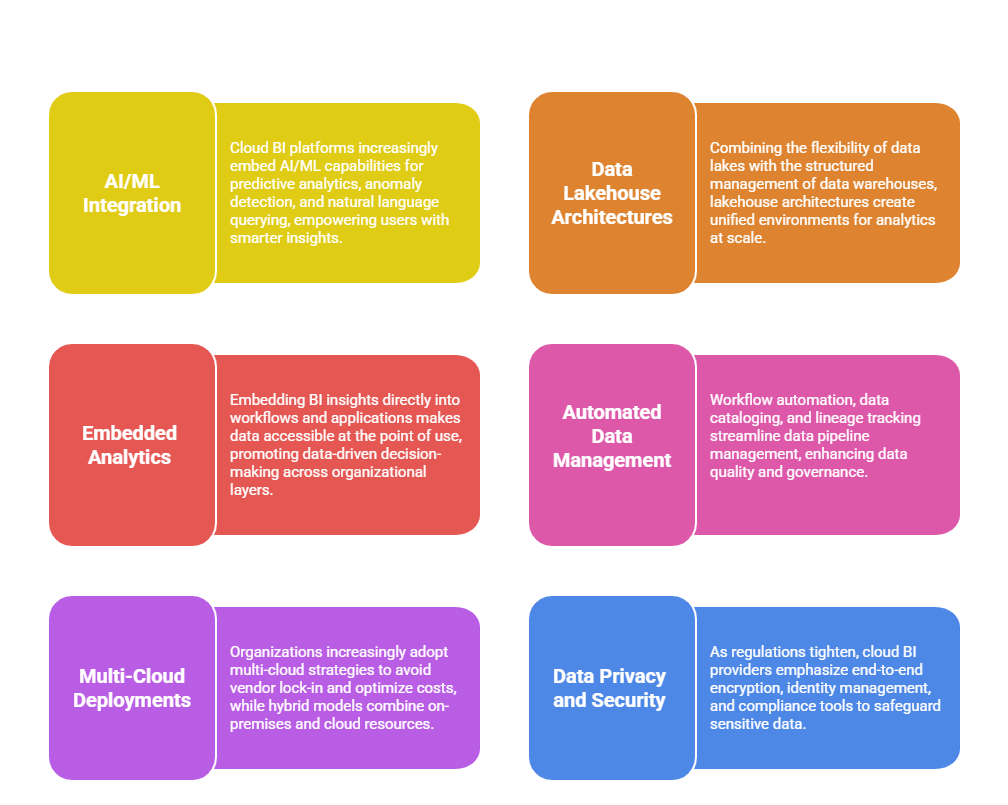
Future Outlook
The trajectory of cloud BI indicates a shift toward more intelligent, automated, and integrated platforms that blend analytics, AI, and data governance. As cloud ecosystem maturity grows, we expect:
1. Broader adoption of AI-powered insights for operational and strategic decisions.
2. Increased use of serverless architectures to eliminate infrastructure management.
3. More unified data platforms that support both structured and unstructured data.
4. Wider democratization, enabling non-technical users to perform complex analytics easily.