Structured Query Language (SQL) is the foundational language for interacting with relational databases and a critical skill in the realm of Business Intelligence (BI). SQL allows users to access, manipulate, and analyze data stored in databases efficiently, making it indispensable for extracting meaningful business insights.
BI professionals utilize SQL to write queries that fetch precise datasets from complex data repositories, enabling custom reporting, data transformation, and deeper analysis. Understanding SQL fundamentals is essential for anyone working with data analytics and BI tools like Power BI, Tableau, and Looker.
Role of SQL in Business Intelligence
Business Intelligence relies on SQL to ensure structured, accurate, and query-ready data for deeper analysis. The points that follow highlight how SQL supports BI operations:
1. Data Retrieval: SQL’s primary function is querying databases to extract relevant data based on business questions.
2. Data Filtering: Enables selecting subsets of data through WHERE clauses, allowing analysts to focus on specific time periods, customer segments, or conditions.
3. Data Aggregation: Summarizing data with functions like COUNT, SUM, AVG, MAX, and MIN helps reveal trends and performance metrics.
4. Data Joining: Combining multiple tables using JOIN operations correlates related data, such as linking sales transactions with customer demographics.
5. Data Transformation: SQL facilitates cleaning, formatting, and restructuring data to prepare it for reporting and visualization.
Essential SQL Concepts for BI
Understanding fundamental SQL elements is crucial for effective BI analysis and reporting.
The key concepts highlighted here form the backbone of SQL-based data operations:
SELECT Statement: Retrieves data fields from database tables.
WHERE Clause: Filters rows based on specified conditions.
GROUP BY Clause: Aggregates data across groups defined by one or more columns.
ORDER BY Clause: Sorts query results for enhanced readability.
JOIN Types: INNER JOIN, LEFT JOIN, RIGHT JOIN, OUTER JOIN support combining tables based on relational keys.
Aliases and Subqueries: Simplify complex queries and enable nested data operations.
Common SQL Operations in BI Context
From revenue analysis to customer segmentation, SQL supports a wide range of analytical tasks in BI. The points that follow illustrate typical SQL operations used by BI teams: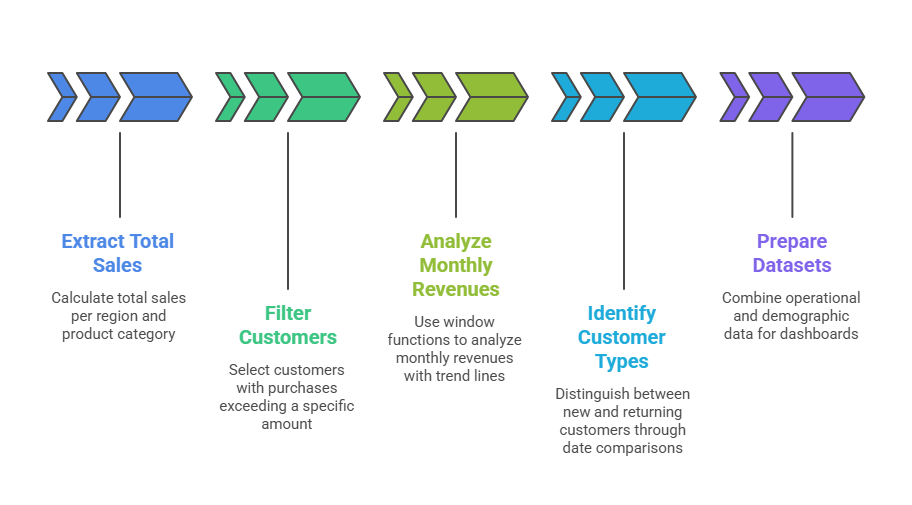
SQL and BI Tools Integration
BI tools use SQL in the background to query databases and generate visualizations. Professionals often write custom SQL queries within these tools to extract specialized insights beyond built-in functions. Mastery of SQL empowers BI practitioners to validate, customize, and optimize the data feeding into dashboards and reports.

Class Sessions
Sales Campaign

We have a sales campaign on our promoted courses and products. You can purchase 1 products at a discounted price up to 15% discount.