Business Intelligence (BI) systems form the backbone of data-driven decision-making within organizations. Understanding the key components and architecture of BI systems is essential to appreciating how raw data transforms into valuable business insights.
These systems are designed to collect, process, store, and analyze data effectively and deliver actionable information through reports and dashboards. The architecture must support scalability, flexibility, and security, adapting to evolving business needs and data complexity.
The architecture of BI systems typically follows a multi-layered design, integrating various tools and technologies to enable seamless data flow from source systems to end-user analytics. Each component plays a critical role in ensuring data accuracy, efficiency of data processing, and usability of insights.
Key Components of BI Systems
BI systems comprise several interconnected components. Each serves a specific function in the data-to-insight journey:
1. Data Sources: They are the starting point. They include internal operational systems like ERP (Enterprise Resource Planning), CRM (Customer Relationship Management), HR systems, and external data such as market data, social media, or sensor data. These sources provide raw data in diverse formats.
2. Data Extraction, Transformation, and Loading (ETL): ETL tools extract data from heterogeneous sources, cleanse and transform it into a consistent format, and load it into a data warehouse. ETL ensures data quality by removing duplicates, correcting errors, and harmonizing data structures, which is critical for reliable analysis.
3. Data Warehouse: The data warehouse centralizes cleansed data for querying and analysis. It stores large volumes of historical and current data optimized for analytical processing rather than transactional operations. Traditional data warehouses use structured schemas designed for complex queries.
4. Data Marts: Data marts are subsets of warehouses tailored for specific business lines or departments, enabling faster and more focused queries on relevant data.
5. Online Analytical Processing (OLAP) Engines: OLAP tools enable multidimensional analysis by organizing data into cubes. Users can drill down, slice, and dice data across multiple dimensions such as time, geography, or product categories, facilitating in-depth exploration.
6. BI Tools and Applications: This layer includes reporting, visualization, and dashboard platforms (e.g., Power BI, Tableau). These tools convert processed data into user-friendly visual formats that support decision-making. Advanced features may include ad-hoc querying and predictive analytics.
7. Metadata Repository: Metadata describes the data’s meaning, relationships, and lineage. It helps in understanding the origin, transformation, and structure of data, making BI systems more transparent and easier to manage.
8. User Interface and Presentation Layer: The final component is the interface through which business users interact with BI outputs. It may include web portals, mobile apps, or specialized software, designed for intuitive navigation and customization.
Architecture of BI Systems
The architecture of BI systems is designed to support efficient, scalable, and reliable data processing. The most common architecture models include:
1. Three-Tier Architecture: This traditional model separates the system into three layers:
Data Source Layer – Where operational systems and external data reside.
Data Integration Layer – ETL processes and data warehouse systems reside here to cleanse and store data.
Presentation Layer – BI tools for reporting, analysis, and visualization that serve business users.
2. Data Warehouse-Centric Architecture: The data warehouse acts as the central repository. Data from multiple sources is integrated, cleaned, and stored before being accessed by BI tools. This approach supports complex queries and historical analysis.
3. Data Lake Architecture: With the increase in unstructured and semi-structured data, some BI systems use data lakes to store all types of data in raw form. Data lakes provide scalability and flexibility but require robust analytics and governance to extract value.
4. Hybrid Architecture: Modern enterprises often combine traditional warehouses and data lakes to handle structured and unstructured data, leveraging the strengths of both architectures.
Cloud-Based BI Architecture
A well-architected BI system enhances data quality, reduces latency, and enables seamless user access. Important architectural considerations include: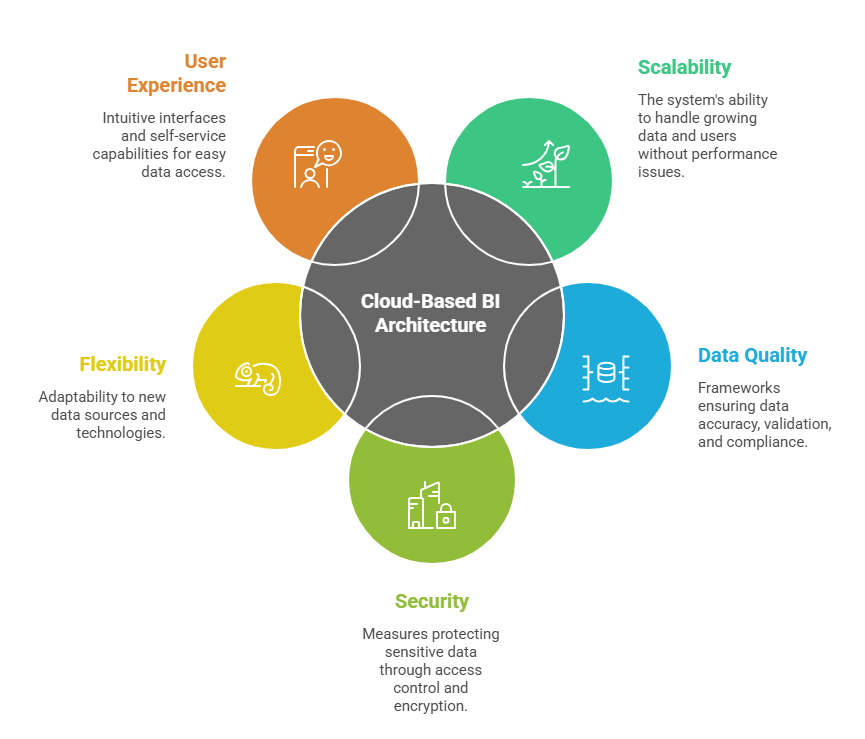

Class Sessions
Sales Campaign

We have a sales campaign on our promoted courses and products. You can purchase 1 products at a discounted price up to 15% discount.