Predictive analytics is a transformative aspect of Business Intelligence (BI) that leverages historical data, statistical algorithms, and machine learning to forecast future events and trends.
Unlike traditional BI, which primarily focuses on descriptive analytics—understanding what happened—predictive analytics aims to anticipate what will happen, allowing organizations to make proactive, data-driven decisions.
As the volume and complexity of data grow, predictive analytics equips businesses with tools to identify patterns, assess risks, and uncover opportunities with higher precision, thereby driving strategic planning and operational efficiency.
Role of Predictive Analytics in Business Intelligence
By integrating statistical models and machine learning, predictive analytics strengthens BI with actionable foresight. Here are the major roles it plays across business functions.
1. Moves BI beyond retrospective insights by adding forward-looking capabilities.
2. Enables forecasting of sales, customer behavior, market trends, and operational risks.
3. Integrates with BI dashboards and reports to provide predictive scores, alerts, and scenarios.
4. Improves resource allocation, marketing targeting, supply chain management, and fraud detection.
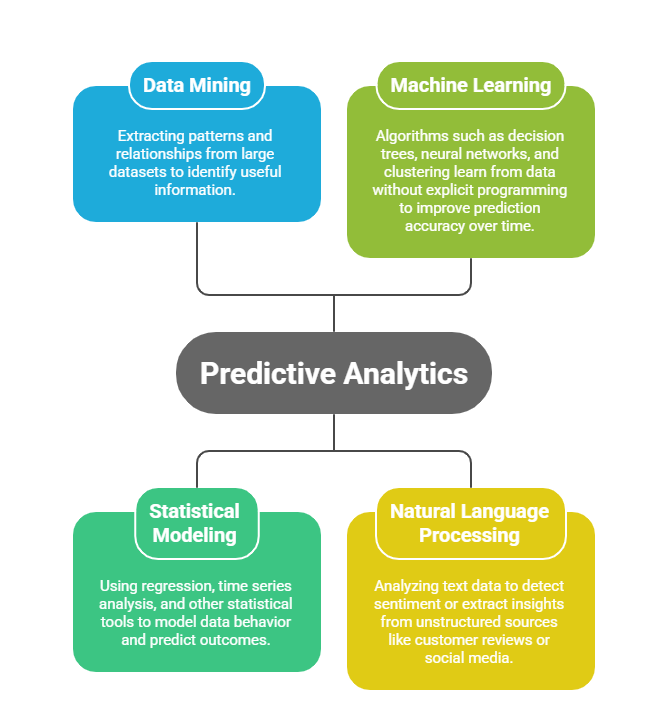
Core Techniques in Predictive Analytics
Organizations leverage a mix of statistical, algorithmic, and text-based techniques to power predictive insights. These essential methods illustrate how predictions are generated from raw data.
Common Applications
Predictive models are applied across many strategic functions to enhance efficiency and improve outcomes. These key applications illustrate how organizations leverage predictive insights daily.
1. Customer Churn Prediction: Identifying customers likely to leave and enabling targeted retention strategies.
2. Demand Forecasting: Predicting product demand trends to optimize inventory and production.
3. Fraud Detection: Detecting anomalous transactions or behaviors that indicate potential fraud risks.
4. Risk Management: Estimating credit risk or operational risks to take preventive measures.
5. Marketing Optimization: Personalizing campaigns by predicting customer responses and segmenting audiences.
Predictive Analytics Process
Building predictive models requires a structured and disciplined workflow to ensure accuracy and reliability. The following steps outline how raw data evolves into actionable predictions.
1. Data Collection and Preparation: Gather accurate historical and current data, clean and preprocess it for analysis.
2. Feature Selection and Engineering: Identify and create relevant variables that influence predictions.
3. Model Selection and Training: Choose appropriate algorithms and train them on labeled data.
4. Model Evaluation: Validate models using metrics such as accuracy, precision, recall, or AUC-ROC.
5. Deployment and Monitoring: Integrate models into BI systems or business processes, monitor their performance continuously, and retrain as needed.
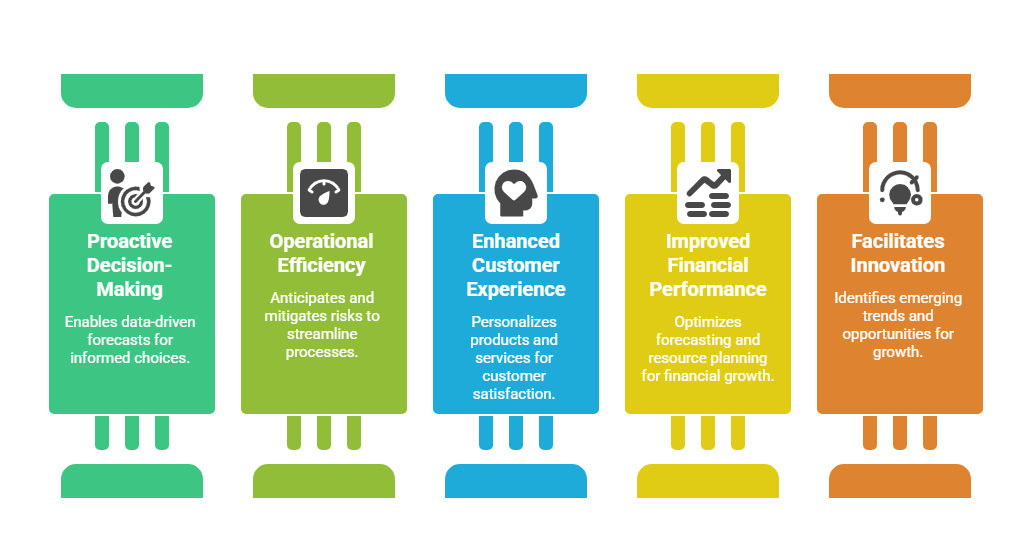
Benefits of Predictive Analytics in BI
Integrating predictive analytics into BI helps companies move from reactive reporting to a forward-looking strategy. The advantages that follow demonstrate its wide-ranging business impact.