Real-time Business Intelligence (BI) represents an advanced analytical approach that provides organizations with immediate access to data insights as events unfold. Unlike traditional BI, which relies on batch processing of historical data, real-time BI processes streaming data continuously, enabling timely decision-making in fast-paced environments.
The integration of streaming data technologies, such as message queues and event processing platforms, with BI tools empowers businesses to monitor operations live, detect anomalies instantly, and respond swiftly to emerging trends or risks. This capability is crucial for industries where time-sensitive decisions can affect customer satisfaction, risk management, and operational efficiency.
Understanding Real-Time Business Intelligence
Real-time BI delivers up-to-the-minute data and analytics dashboards that reflect the current state of business processes. It involves continuously collecting, processing, analyzing, and visualizing data as it is generated, rather than waiting for data batches to complete.
1. Data can originate from IoT devices, web clicks, financial systems, social media feeds, sensors, or transactional databases.
2. Streaming analytics engines analyze data in motion, applying filters, aggregations, and patterns to generate immediate insights.
3. Real-time BI supports rapid alerting, operational monitoring, and instant reporting.
Streaming Data Fundamentals
Streaming data refers to a continuous flow of information generated by diverse sources requiring real-time processing.
1. Streams emit data in small increments (events or messages) instead of large bulk files.
2. Technologies such as Apache Kafka, AWS Kinesis, and Azure Event Hubs collect and transport streaming data efficiently.
3. Processing frameworks (Apache Flink, Spark Streaming) perform computations on the fly.
Enabling Technologies for Real-Time BI
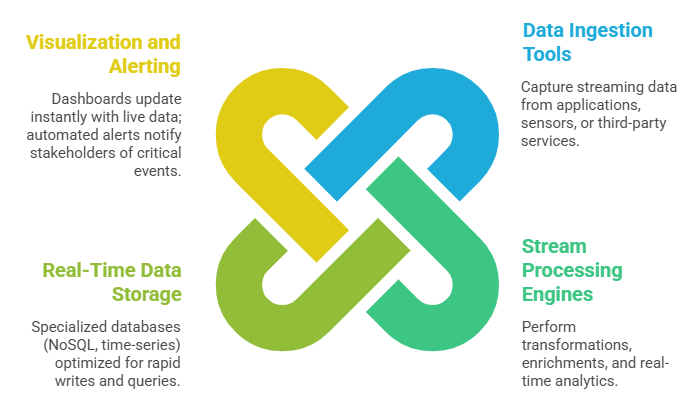
Achieving actionable, real-time insights demands robust infrastructure and software solutions. Here are the primary technologies that support real-time BI capabilities.
Benefits of Real-Time BI
By providing instant insights, real-time BI drives faster decisions and improved outcomes. The following points highlight its key benefits for businesses.
1. Faster Decision-Making: Businesses can act swiftly on emerging opportunities or threats.
2. Operational Efficiency: Real-time monitoring improves uptime, resource allocation, and process control.
3. Enhanced Customer Experience: Rapid response to user behaviors, preferences, or issues increases satisfaction.
4. Competitive Advantage: Early detection of market trends and anomalies provides an edge.
5. Risk Mitigation: Immediate identification of fraud, compliance breaches, or system failures reduces impact.
Challenges in Implementing Real-Time BI
Real-time BI implementation demands careful planning to tackle technical, financial, and operational barriers. The challenges noted here provide a practical overview.
1. Data Quality and Consistency: Ensuring real-time data accuracy and completeness is complex.
2. System Scalability: Handling high-velocity data streams requires robust, scalable infrastructure.
3. Latency Management: Minimizing delays from data capture to actionable insight delivery is critical.
4. Integration Complexity: Stream data must integrate seamlessly with existing BI and IT environments.
5. Cost and Resource Needs: Real-time solutions often demand significant investment and skilled personnel.
Use Cases of Real-Time BI
The scenarios listed here showcase how real-time BI is applied across sectors.
.png)