Data warehousing is a foundational element of modern Business Intelligence (BI) systems that enables organizations to centralize, store, and analyze large volumes of data collected from diverse sources. Unlike transactional databases optimized for day-to-day operations, data warehouses are designed for analytical processing, supporting complex queries, reporting, and data mining.
The primary goal of a data warehouse is to provide a trusted, integrated, and historical repository of data that business users can rely on to derive insights and drive strategic decisions.
Key Concepts of Data Warehousing
Data warehousing is built around several essential concepts that distinguish it from operational data handling:
1. Subject-Oriented: Data warehouses organize information around key business subjects such as sales, customers, products, or finance rather than specific applications. This orientation helps users analyze data in terms meaningful to business outcomes.
2. Integrated: Data is gathered from multiple, heterogeneous sources and standardized to ensure consistency in naming conventions, formats, and codes. Integration resolves discrepancies among data from disparate systems, creating a unified dataset.
3. Time-Variant: Unlike operational systems that keep only current data, data warehouses store historical data, capturing snapshots over time. This time-series data supports trend analysis, forecasting, and historical comparisons.
4. Non-Volatile: Once data is entered into the warehouse, it is stable and not frequently changed or deleted. This stability ensures consistent reports and longitudinal analyses over time.
Architecture of Data Warehousing
The architecture of a data warehouse typically follows a multi-tier design that facilitates data extraction from source systems, its transformation and loading, and provides access for analysis: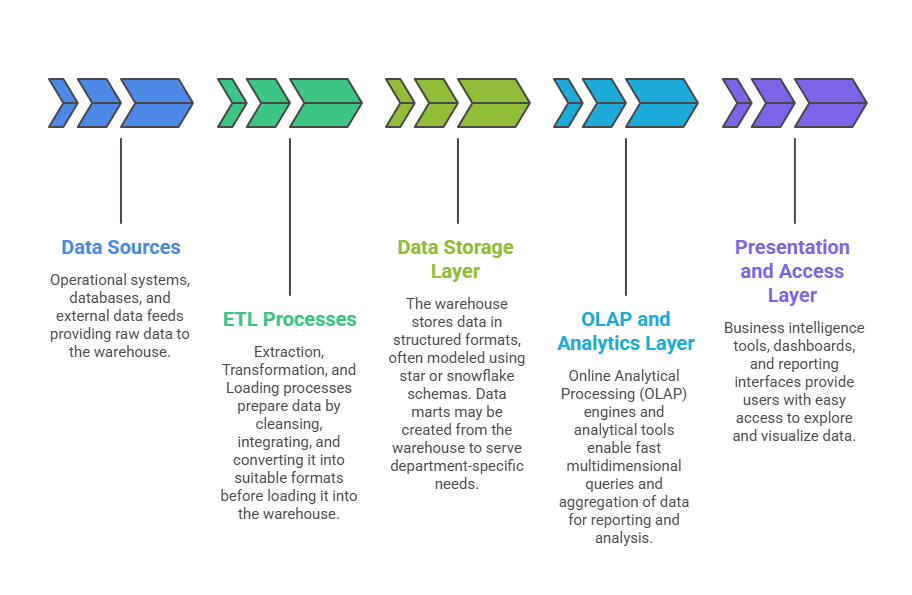
Data Warehousing Design Principles
Effective data warehouse design hinges on best practices for schema modeling, data integration, and scalability:
1. Schema Design
Star Schema: Simplifies queries through a central fact table connected to multiple dimension tables.
Snowflake Schema: Normalizes dimensions into multiple related tables, optimizing storage at some cost of query complexity.
Data Vault: A highly scalable and auditable model suited for handling rapidly changing data and multiple data sources.
2. Data Quality and Integration: Ensuring accuracy and consistency by applying validation, cleansing, and transformation rules during ETL. Data lineage tracking supports governance and auditability.
3. Performance Optimization: Indexing, partitioning, and materialized views improve query speed. Columnar storage and in-memory processing are technology choices to boost performance for analytical queries.
4. Scalability and Flexibility: Modern warehouses leverage cloud platforms for elastic storage and compute resources supporting growing data volumes and user demands without degradation.
 - visual selection.png)

Class Sessions
Sales Campaign

We have a sales campaign on our promoted courses and products. You can purchase 1 products at a discounted price up to 15% discount.