Online Analytical Processing (OLAP) cubes are a cornerstone technology in Business Intelligence (BI) that empower analysts and decision-makers to rapidly explore and analyze multidimensional data from multiple perspectives.
An OLAP cube is a specialized data structure that organizes data into dimensions and measures, enabling complex queries, aggregations, and calculations to be performed quickly.
The term "cube" reflects the multidimensional nature of the data, often representing multiple axes such as time, geography, and products, allowing users to drill down, slice, dice, and pivot data for insightful analysis.
What are OLAP Cubes?
An OLAP cube is fundamentally a multidimensional array of data where each dimension represents a distinct business perspective or attribute, and the measures are the numeric facts or metrics of interest.
For example, a sales OLAP cube might have dimensions like time (years, quarters, months), locations (regions, cities), and products (categories, items), with measures such as sales revenue and units sold.
Dimensions: Categories or attributes by which data is segmented, providing the "axes" of the cube for analysis.
Measures: Numeric data points that quantify performance, like sums, averages, counts, or ratios.
Core OLAP Operations
OLAP cubes support a variety of dynamic and intuitive operations for multidimensional data exploration:
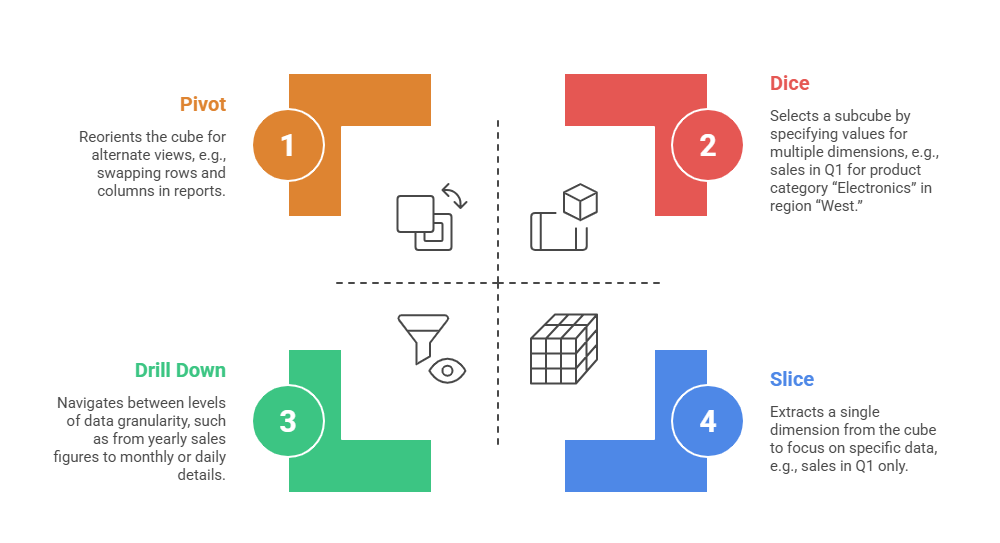
These operations enable users to analyze data across multiple granularities and dimensions seamlessly.
Structure and Implementation of OLAP Cubes
OLAP cubes can be implemented in different ways:
1. Multidimensional OLAP (MOLAP): Data is pre-aggregated and stored in a multidimensional array for rapid access. MOLAP is known for fast query performance but may have storage limitations.
2. Relational OLAP (ROLAP): Utilizes traditional relational databases and calculates aggregations on the fly. It handles large data volumes but may have slower query response times.
3. Hybrid OLAP (HOLAP): Combines MOLAP and ROLAP to balance storage efficiency and performance.
OLAP cubes generally leverage star or snowflake schemas in data warehouses for organizing data into fact and dimension tables.
Benefits of Using OLAP Cubes
To support scalable and user-friendly analytics, OLAP cubes introduce several value-adding features. Here are the primary benefits they offer:
1. Speed: Pre-aggregated data in OLAP cubes allows for swift responses to complex analytical queries.
2. Multidimensional Analysis: Facilitates comprehensive data investigation from multiple perspectives simultaneously.
3. User-Friendly Data Exploration: Intuitive operations like slicing and dicing allow business users to self-serve insights without great technical skills.
4. Consistent Metrics: Ensures uniform definitions and calculations across reports and analyses.
5. Supports Complex Calculations: Includes time-series analysis, trend forecasting, and “what-if” scenarios.
Challenges and Considerations
Before adopting MOLAP, teams should be aware of potential bottlenecks that affect flexibility and efficiency. The points below outline these critical concerns:.png)

Class Sessions
Sales Campaign

We have a sales campaign on our promoted courses and products. You can purchase 1 products at a discounted price up to 15% discount.