Machine Learning (ML) is a transformative technology that complements Business Intelligence (BI) by enabling systems to automatically learn from and analyze data, uncovering patterns and making predictions without explicit programming.
While traditional BI focuses on describing and diagnosing past events through historical data, ML adds a forward-looking dimension that can forecast outcomes, optimize operations, and provide more dynamic insights.
As organizations face increasing data volumes and complexity, integrating ML within BI systems offers the potential to enhance decision-making accuracy, automate repetitive analysis, and uncover hidden opportunities.
What is Machine Learning in BI?
Machine learning is a subset of artificial intelligence that involves algorithms training on historical datasets to recognize patterns and relationships, enabling the system to predict or classify new, unseen data. In BI, ML automates and augments the analytical capabilities by:
1. Extending descriptive analytics with predictive and prescriptive insights.
2. Analyzing structured and unstructured data beyond human capability.
3. Continually improving models from real-time data, adapting to changing environments.
Types of Machine Learning Relevant to BI
Different machine learning methods serve distinct analytical purposes, from prediction to pattern discovery. Here are the primary learning types that help organizations extract deeper value from BI.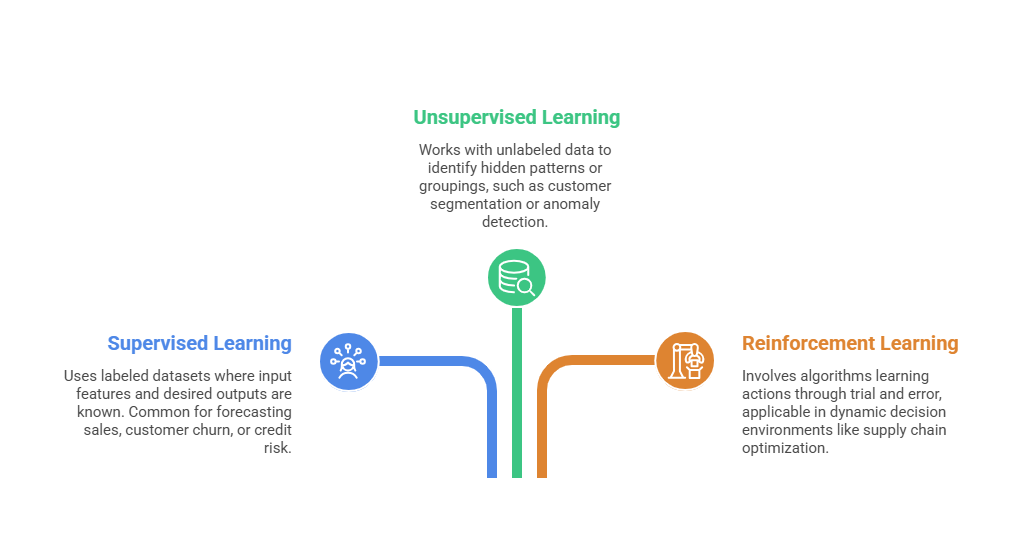
Machine Learning Workflow in BI
A well-designed ML workflow forms the backbone of predictive and advanced analytics in BI. Here are the key stages that shape how models are developed, integrated, and maintained.
1. Data Preparation: Cleansing, normalizing, and transforming data to suitable formats. Feature engineering involves selecting or creating variables that enhance predictive power.
2. Model Training: Feeding relevant algorithms data to learn underlying patterns. Common algorithms include decision trees, logistic regression, support vector machines, and neural networks.
3. Model Evaluation: Testing model performance using metrics like accuracy, precision, recall, or AUC-ROC ensures reliability in real-world predictions.
4. Deployment and Integration: Embedding trained models within BI dashboards or workflows to provide ongoing predictions and recommendations.
5. Monitoring and Retraining: Continual updating as new data is gathered to maintain model accuracy and relevance.
Benefits of Machine Learning in BI
Integrating ML into BI empowers organizations with smarter, faster, and more accurate insights. The list that follows outlines the key advantages this combination delivers.
1. Enhanced Prediction Accuracy: ML models identify complex data relationships that traditional BI may miss.
2. Automation of Repetitive Tasks: Reduces manual analysis workload with automated anomaly detection, forecasting, and pattern recognition.
3. Dynamic Insights: Adapts to new data trends, enabling businesses to respond proactively.
4. Broader Data Scope: Processes unstructured data sources like text, images, and logs for richer insights.
5. Improved Decision Support: Provides actionable recommendations and risk assessments beyond static reports.
Challenges and Considerations
Adopting advanced analytics demands readiness across people, processes, and data. Here are some of the critical obstacles that typically impact ML-driven BI initiatives..png)

Class Sessions
Sales Campaign

We have a sales campaign on our promoted courses and products. You can purchase 1 products at a discounted price up to 15% discount.