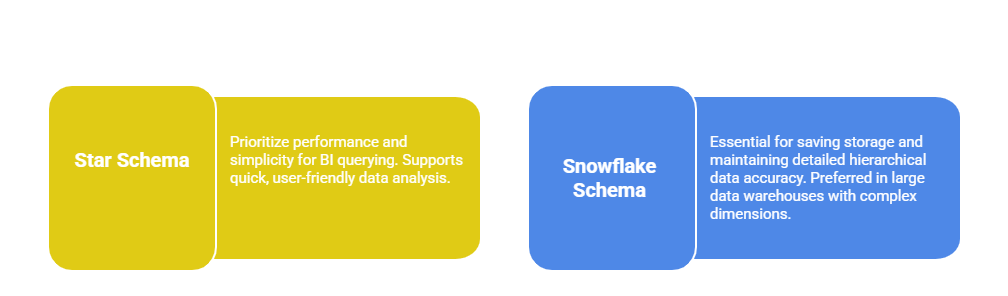
Dimensional modeling is a vital design technique in data warehousing and Business Intelligence (BI) that structures data into understandable, efficient formats optimized for analytical querying. Two of the most commonly used dimensional models are the star schema and the snowflake schema.
These schemas organize and relate data into fact tables and dimension tables to enable fast, accessible analysis of business metrics. Understanding the differences, advantages, and use cases of star and snowflake schemas is essential for designing high-performance and scalable BI systems.
Star Schema: Simple and Fast Analytical Access
The star schema gets its name from its structure, where a central fact table is linked directly to multiple dimension tables surrounding it, forming a star-like shape.
Fact Table: Contains quantitative data (measures) such as sales amount or order quantity. It also holds keys linking to dimension tables.
Dimension Tables: Store descriptive attributes related to facts, such as customer details, product descriptions, time periods, or locations. These tables are typically denormalized (flattened), meaning they include all relevant attributes in one table without further normalization.
Features of Star Schema
1. Simple, intuitive design, easy to understand and query.
2. Denormalized dimension tables reduce the number of joins needed, improving query performance.
3. Enables fast retrieval of data, making it ideal for reporting and slicing data across dimensions.
4. Easier to implement and maintain due to straightforward relationships.
Snowflake Schema: Normalized and Space-Efficient
The snowflake schema is a more complex dimensional model derived from the star schema. Instead of denormalized dimension tables, the snowflake schema normalizes dimensions into multiple related tables, creating hierarchical relationships between these tables.
Normalized Dimension Tables: Dimension tables are split into related sub-tables to eliminate redundancy. For example, a “Product” dimension might be divided into “Product,” “Product Category,” and “Product Brand” tables.
Fact Table: Remains central, linking to the normalized dimension tables.
Features of Snowflake Schema
1. A more normalized structure reduces data redundancy and storage requirements.
2. Reflects real-world hierarchical relationships among attributes more accurately.
3. Potentially more complex and requires multiple joins in queries, which can slow performance.
4. Suitable for environments where data storage optimization is important and complex hierarchies exist.