Implementing a successful Business Intelligence (BI) project requires a structured lifecycle that guides the initiative from initial concept through deployment and ongoing maintenance.
The BI project lifecycle ensures that the solutions delivered effectively meet business goals, enable data-driven decision-making, and provide measurable value while managing risks and resources systematically. Best practices integrated into each phase foster collaboration among stakeholders, maintain data quality, and ensure alignment with organizational strategies.
BI Project Lifecycle Phases
From understanding requirements to optimizing performance, each phase in a BI project adds value. Here are the primary lifecycle stages and their focus areas.
1. Project Planning and Requirement Analysis: The foundation of any BI project is understanding the business objectives and requirements.
Engage stakeholders to define the business problems, goals, and success criteria.
Assess current data infrastructure, identify data sources, and evaluate system readiness.
Develop a comprehensive project plan including scope, timeline, resources, and risk assessment.
2. Data Modeling and Design: Design lays the blueprint for data architecture and user interactions.
Create logical and physical data models reflecting business logic and analytics needs.
Define schema structures (star, snowflake) and data integration approaches (ETL/ELT).
Design user interfaces, reports, and dashboards focusing on usability and decision support.
3. Development and Construction: This phase builds the BI environment and analytics components.
Implement data pipelines, ETL processes, and establish data warehouses or data lakes.
Build reports, dashboards, and analytical models per design specifications.
Perform iterative testing to validate data accuracy, system performance, and usability.
4. Testing and Validation: Comprehensive testing ensures reliability and adherence to requirements.
Conduct unit, system, and user acceptance testing (UAT).
Validate data consistency, report correctness, and security controls.
Adjust and refine BI components based on feedback and test results.
5. Deployment and User Training: Transitioning BI solutions into production is critical for adoption.
Execute deployment plans including data migration, access controls, and backup strategies.
Train end-users and administrators on system features and capabilities.
Communicate benefits and provide support channels to encourage user engagement.
6. Operation, Monitoring, and Maintenance: Sustaining the BI system includes ongoing support and continuous improvement.
Monitor system performance, data quality, and user activity.
Schedule regular maintenance—software updates, security patches, and infrastructure tuning.
Collect user feedback to prioritize enhancements and adapt to evolving business needs.
7. Evaluation and Iteration: Assess the impact of BI initiatives and refine approaches.
Measure business value against predefined success metrics and ROI.
Analyze usage patterns and decision outcomes influenced by BI insights.
Iterate project phases as needed for optimization and additional analytic coverage.
Best Practices for BI Project Success
Achieving successful BI outcomes involves balancing technology, people, and processes. Here are the recommended approaches for guiding projects to success.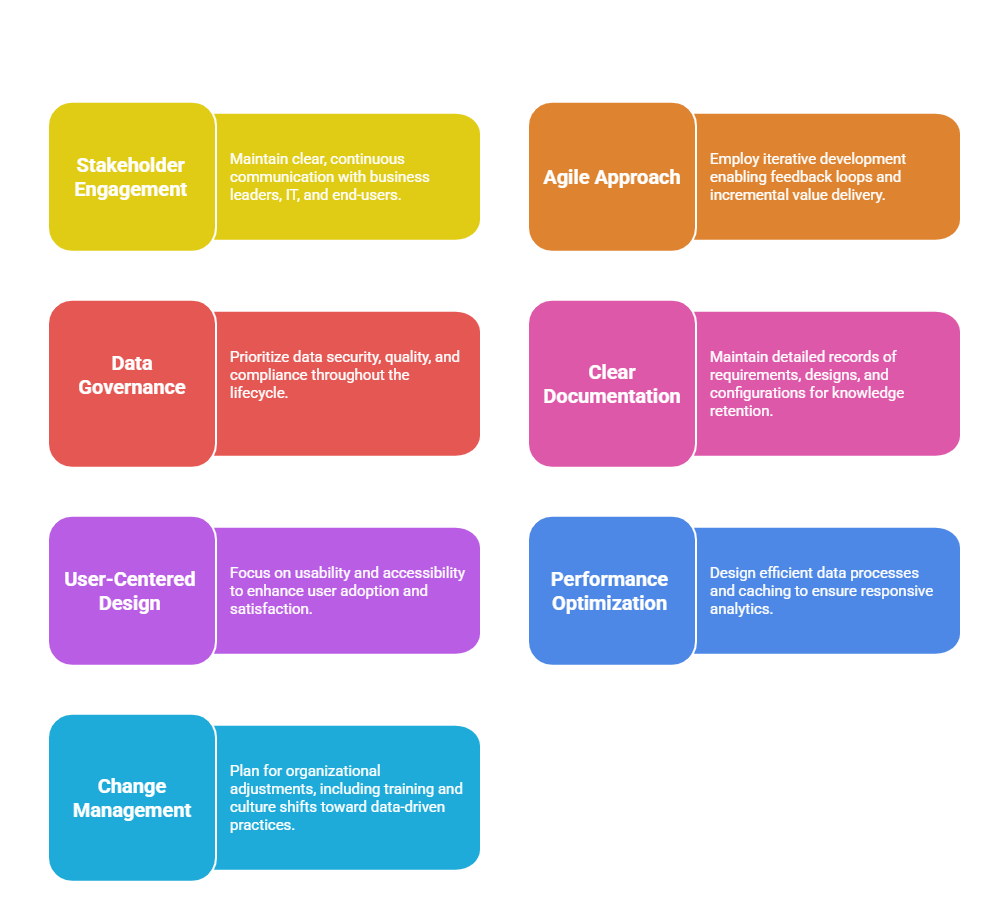

Class Sessions
Sales Campaign

We have a sales campaign on our promoted courses and products. You can purchase 1 products at a discounted price up to 15% discount.