In the world of data-driven decision-making, terms like Business Intelligence (BI), Business Analytics, and Data Science are often used interchangeably, yet they represent distinct disciplines with unique roles, methodologies, and outcomes.
Understanding the differences and relationships among these fields is critical for organizations and professionals aiming to harness data effectively. Each focuses on leveraging data but differs in scope, techniques, and the nature of insights produced.
Business Intelligence (BI)
Business Intelligence focuses on descriptive analytics—what has happened in the business? It involves collecting, integrating, analyzing, and presenting historical and current data to help organizations monitor performance and make informed decisions. BI relies heavily on data aggregation, dashboards, reporting, and visualization tools to deliver actionable insights.
Purpose: Monitor business performance and generate reports on historical data trends.
Data Type: Structured, mainly from internal systems like ERP, CRM.
Techniques: Querying, reporting, dashboards, OLAP.
Users: Business managers, executives, operations teams.
Outcome: Answers questions like "How many sales were made last quarter?" or "What is the current inventory status?"
BI supports routine decision-making with standardized reports and KPIs to track the organization’s health efficiently.
Business Analytics
Business Analytics dives deeper into data by focusing on exploratory and predictive aspects, answering "Why did it happen?" and "What might happen next?"
It uses statistical analysis, data mining, and predictive modeling to derive insights that guide strategic decisions. Business Analytics often builds upon the outputs of BI systems by applying more complex techniques to uncover patterns and trends.
Purpose: Understand causes, predict future trends, and inform strategy.
Data Type: Structured and semi-structured data.
Techniques: Statistical analysis, predictive modeling, forecasting, optimization.
Users: Analysts, strategists, data-savvy managers.
Outcome: Provides answers such as "Why did customer churn increase?" or "Which sales strategy will likely be most effective?"
Business Analytics supports proactive decision-making and strategy formulation using data-driven evidence and forecasts.
Data Science
Data Science is a broader, more technical field that applies scientific methods, algorithms, and machine learning to extract knowledge from structured and unstructured data. It includes building complex predictive models, natural language processing, image recognition, and automation.
It often handles big data and integrates BI and analytics outputs, but pushes boundaries further into innovation and automation.
Purpose: Create advanced models to predict, automate, and optimize using large-scale and diverse datasets.
Data Type: Structured, semi-structured, unstructured (text, images, video).
Techniques: Machine learning, deep learning, AI, data engineering, statistical modeling.
Users: Data scientists, engineers, researchers.
Outcome: Answers complex questions like "What patterns predict customer behavior?" or "How can we automate fraud detection?"
Data Science drives innovation and automates decision processes using the latest computational tools and algorithms.
Integrating BI, Business Analytics, and Data Science
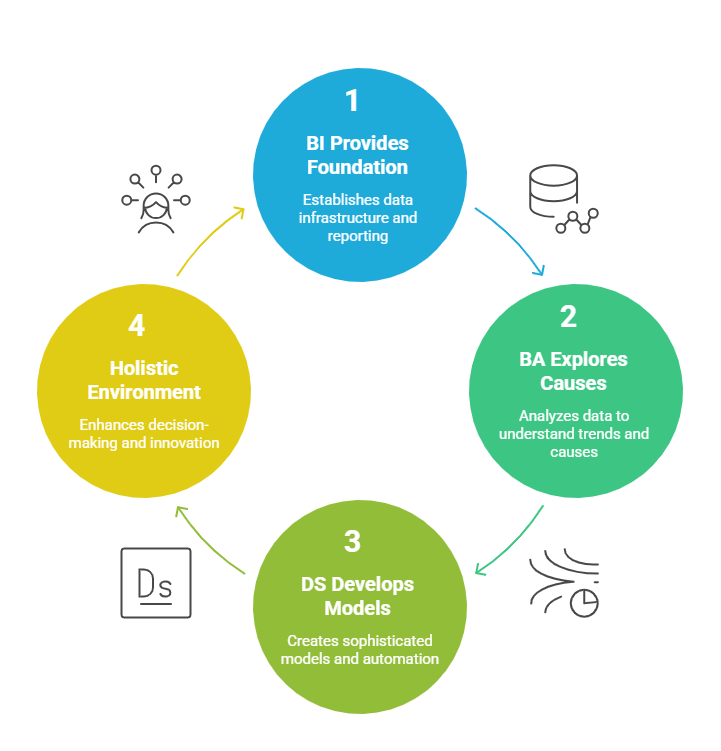
While distinct, these disciplines often complement each other in a data ecosystem. BI provides the foundational data infrastructure and reporting needed to monitor business health. Business Analytics builds on that foundation to explore causes and forecast trends.
Data Science leverages the outputs and data from these systems to develop sophisticated models and automation solutions. Modern enterprises leverage all three to create holistic, data-driven environments that enhance decision-making from operational monitoring to strategic innovation.

Class Sessions
Sales Campaign

We have a sales campaign on our promoted courses and products. You can purchase 1 products at a discounted price up to 15% discount.