Business Intelligence (BI) has become a cornerstone of modern enterprise strategy by empowering organizations to make well-informed decisions and sustain competitive advantage. In a business environment marked by rapid changes and intense competition, timely access to precise and comprehensive data insights is essential.
BI systems allow enterprises to systematically collect, analyze, and interpret data, transforming it into actionable knowledge. This capability significantly enhances decision-making quality and agility, enabling companies to respond swiftly to opportunities and challenges.
BI’s Role in Enhanced Decision-Making
Effective decision-making hinges on the availability of accurate and relevant information. BI provides decision-makers across all organizational levels with comprehensive data insights, which help reduce uncertainty and bias.
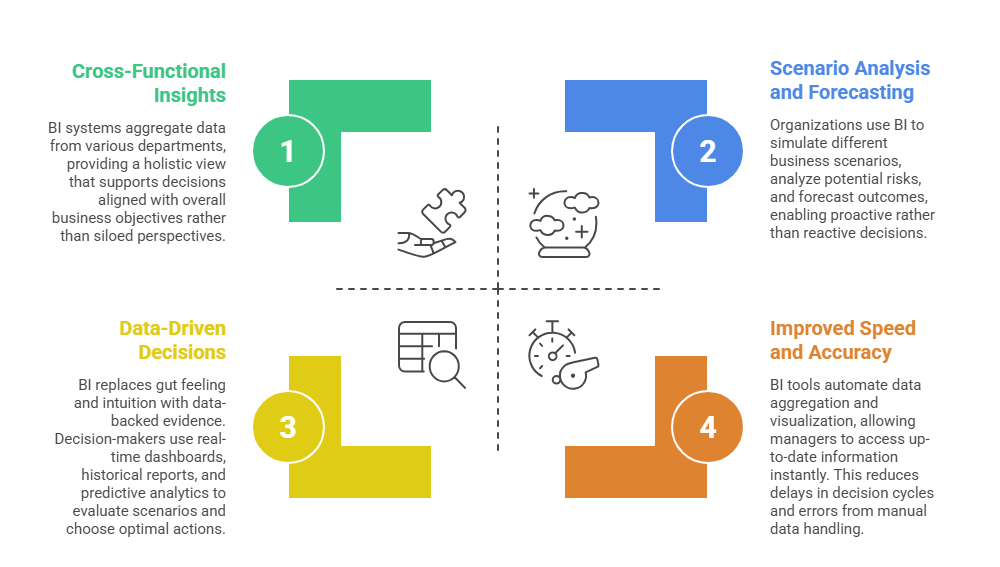
Examples of BI in Decision Making
1. Finance teams use BI to monitor cash flow and budget variances, enabling timely adjustments.
2. Marketing departments analyze campaign performance to refine targeting and optimize return on investment (ROI).
3. Supply chain managers leverage BI to identify inefficiencies and improve logistics and inventory management.
4. Sales teams access real-time sales data to prioritize leads and personalize customer interactions.
BI as a Source of Competitive Advantage
In addition to improving decision-making, BI strengthens a company’s strategic position by enabling differentiation and innovation.
1. Market Trend Analysis: BI tools analyze customer preferences, competitor moves, and emerging trends, helping businesses anticipate market shifts and adapt product offerings.
2. Customer Understanding and Personalization: Detailed customer insights allow enterprises to tailor experiences, foster loyalty, and increase lifetime value, differentiating them from competitors.
3. Operational Efficiency and Cost Reduction: By identifying bottlenecks and inefficiencies, BI drives cost savings and improves productivity, allowing businesses to offer competitive pricing or invest in innovation.
4. Innovation Enablement: BI fuels innovation by revealing unmet market needs and performance gaps, guiding R&D and product development aligned with data-driven opportunities.
Strategic BI Capabilities Supporting Competitive Edge
To fully leverage BI for competitive advantage, organizations must develop certain strategic capabilities:
1. Agility and Speed: The ability to rapidly analyze data and act on insights enables businesses to outpace competitors in responding to market changes.
2. Continuous Improvement: BI supports ongoing performance monitoring and benchmarking, fostering a culture of continuous enhancement.
3. Informed Risk Management: Data insights help assess potential risks and create mitigation strategies, reducing vulnerabilities.
4. Alignment with Business Goals: Effective BI aligns analytical efforts with strategic priorities, ensuring resources focus on high-impact areas.
Challenges and Considerations
While BI offers significant advantages, successful implementation requires overcoming challenges such as:
.png)

Class Sessions
Sales Campaign

We have a sales campaign on our promoted courses and products. You can purchase 1 products at a discounted price up to 15% discount.