Advanced scripting is key to efficient, reliable infrastructure automation and management. By applying principles like modularization and reusability, integrating robust error handling, embedding logging and monitoring, and optimizing performance, scripts evolve from simple command sequences to production-grade automation assets. These enhancements ensure maintainability, improve troubleshooting, and increase operational resilience in complex infrastructure environments.
Script Modularization and Reusability
These involve breaking scripts into smaller, well-defined functions and libraries to promote code reuse and simplify maintenance. By designing clear interfaces and using argument passing, functions can operate independently and flexibly across different scripts.
Common utilities and configuration settings should be stored separately and sourced when needed, ensuring consistency, reducing duplication, and making scripts easier to manage and update over time.
Example:
# common_utils.sh

log_info() { echo "[INFO] $*"; }

log_error() { echo "[ERROR] $*" >&2; }
Imported in main scripts to centralize logging.
Error Handling in Production Scripts
Use set -euo pipefail to make scripts exit on errors, unset variables, or pipeline failures. Check return codes of critical commands explicitly for finer control. Use traps to catch termination signals and perform cleanup:
trap 'echo "Script interrupted"; cleanup; exit 1' INT TERMProvide meaningful exit codes and error messages for automation tracking.
Logging and Monitoring Integration
It involves implementing standardized logging within scripts to support auditing and debugging, typically directing logs to files or a syslog server. Logs should include timestamps and appropriate log levels such as INFO, WARN, or ERROR to provide clear context for events.
Additionally, scripts can be integrated with monitoring platforms by exposing metrics or triggering alerts on failures, enabling proactive detection of issues and ensuring system reliability.
Example logging function:
log() { echo "$(date '+%F %T') [$1] $2"; }

log INFO "Starting backup process"
Script Performance Optimization
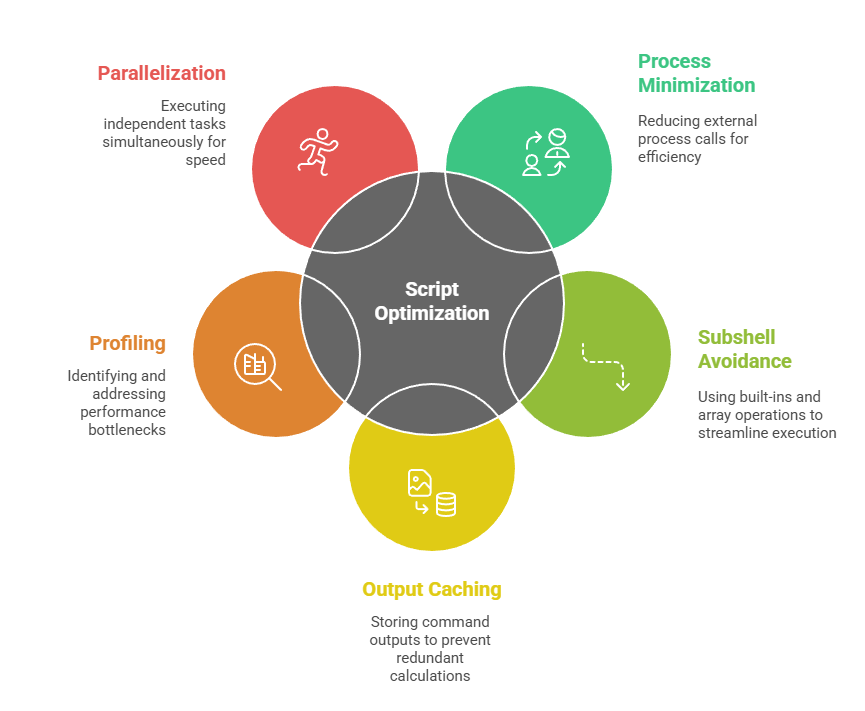
Optimized scripts improve reliability and scalability in automated workflows. Following are the main approaches for enhancing script performance.