Security best practices in Linux establish a foundation for protecting systems against vulnerabilities, unauthorized access, and attacks.
Core principles such as the principle of least privilege and defense-in-depth, combined with proactive vulnerability assessments, robust patch management, and adherence to security hardening checklists, create resilient Linux environments.
Implementing these practices mitigates risk, safeguards data and services, and aligns systems with compliance and industry standards.
Principle of Least Privilege
The Principle of Least Privilege states that users, applications, and system processes should be granted only the minimum access rights necessary to perform their required tasks and no more.
By limiting permissions to what is strictly needed, this approach reduces the system’s overall attack surface and minimizes the potential impact if an account or process is compromised.
As a result, least privilege helps contain security breaches, prevent unauthorized actions, and strengthen the overall security posture of an operating environment.
Implement by:
1. Restricting user permissions at the file and directory level.
2. Configuring sudo tightly to allow specific commands rather than full root access.
3. Running services with non-root accounts.
Defense-in-Depth Strategies
It Involves layering multiple independent security controls throughout a system to create redundancy and provide comprehensive protection. Instead of relying on a single safeguard, this approach combines measures such as firewall rules, SELinux or AppArmor policies, intrusion detection systems, encryption mechanisms, and strict access controls.
By implementing overlapping layers of defense, Defense-in-Depth helps compensate for failures or weaknesses in individual security components, ensuring that if one control is bypassed, others remain in place to detect, prevent, or limit the impact of an attack.
Vulnerability Assessment
It is the practice of regularly scanning systems to identify known security weaknesses using tools such as OpenVAS, Nessus, or Lynis. These assessments evaluate installed software packages, exposed network services, and system configurations to uncover potential security gaps that could be exploited by attackers.
The findings are then analyzed and prioritized based on risk impact and exploitability, allowing organizations to focus remediation efforts on the most critical vulnerabilities and improve their overall security posture.
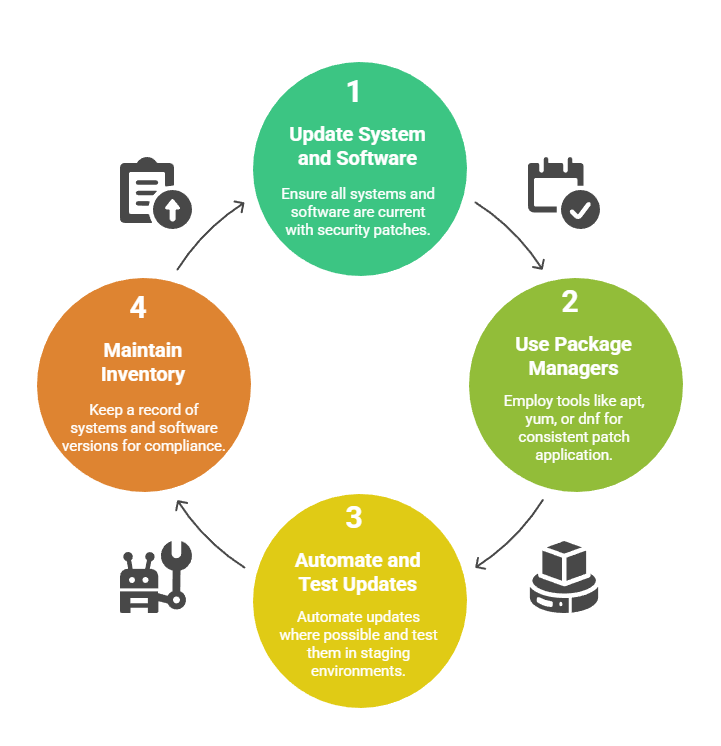
Patch Management
Patch management ensures systems and applications remain protected against known vulnerabilities. Following are the key practices used to maintain secure and up-to-date environments.
Security Hardening Checklists
Follow standardized hardening guides like CIS Benchmarks, DISA STIGs, or vendor-specific recommendations.
Typical hardening tasks:
1. Disable or remove unnecessary services
2. Enforce strong password policies
3. Configure firewall rules and SELinux
4. Secure SSH and remote access settings
5. Harden kernel parameters
6. Restrict physical access to hardware and BIOS settings