Clinical Decision Support Systems (CDSS) and AI-driven diagnostic tools are transforming modern healthcare by assisting clinicians in making faster, more accurate, and more informed decisions.
CDSS integrates data from electronic health records (EHRs), medical guidelines, patient histories, and real-time monitoring systems to generate alerts, recommendations, and risk assessments that support clinical judgment.
These systems help reduce errors, standardize care, improve patient outcomes, and optimize workflows. AI enhances CDSS by analyzing complex datasets and detecting subtle patterns that may not be easily visible to human clinicians.
AI diagnostics extend these capabilities by using machine learning, deep learning, NLP, and image-analysis techniques to interpret clinical images, detect anomalies, classify diseases, and predict disease progression.
From radiology and pathology to dermatology and cardiology, AI systems provide highly accurate interpretations that complement clinician expertise.
They assist in early detection of diseases such as cancer, sepsis, stroke, and heart disease—conditions where timely intervention significantly impacts outcomes.
Together, CDSS and AI-powered diagnostics play a crucial role in clinical decision-making, guiding treatment planning, improving diagnostic precision, and reducing the burden on healthcare professionals.
Their integration into healthcare ecosystems enables a shift toward personalized, data-driven, and efficient care delivery.
Foundations of AI-Based Clinical Decision Support
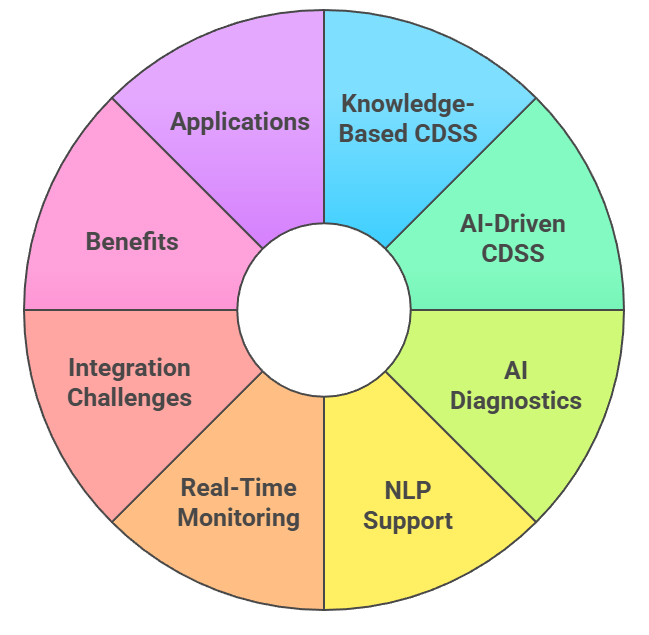
1. Role of CDSS in Supporting Clinical Decision-Making
CDSS helps clinicians interpret patient data by providing evidence-based recommendations, alerts, and insights directly during clinical workflows.
These systems assist in identifying drug-drug interactions, recommending diagnostic tests, adjusting medication dosages, and detecting potential clinical risks.
CDSS reduces human errors by ensuring that critical information is not overlooked, especially in complex or high-pressure settings. It standardizes care by aligning recommendations with clinical guidelines and best practices.
By filtering through massive amounts of patient data, CDSS supports timely decision-making and enhances the accuracy of diagnoses and treatments.
This leads to better outcomes, reduced complications, and improved healthcare efficiency.
2. Types of CDSS: Knowledge-Based and AI-Driven Systems
Traditional knowledge-based CDSS relies on rule-based logic and curated medical guidelines to generate recommendations.
These systems are transparent and easier to interpret but limited by the scope of predefined rules.
AI-driven CDSS, on the other hand, uses machine learning and deep learning to identify patterns in historical patient data and generate predictive insights.
They adapt and improve as more data becomes available, enabling more personalized and dynamic decision-making.
Combining both types creates hybrid CDSS that balances interpretability with high predictive accuracy.
These systems support everything from treatment recommendations to real-time risk scoring across clinical departments.
3. AI Diagnostics for Early Detection and Disease Classification
AI diagnostics analyze clinical data such as radiology images, pathology slides, ECG signals, and lab results to identify abnormalities with high precision.
Deep learning models can detect early signs of cancer, cardiac dysfunction, lung disease, and neurological disorders before symptoms fully manifest.
These models can flag subtle patterns that human eyes may miss, improving early detection rates. AI systems also classify diseases based on image features, assisting clinicians in making faster, more confident diagnoses.
They reduce diagnostic variability between clinicians, ensuring more consistent interpretations across the healthcare system. AI-driven diagnostic tools significantly strengthen diagnostic accuracy and efficiency.
4. NLP-Based Diagnostic Support Using Clinical Text
Natural language processing enables AI to analyze clinical notes, discharge summaries, pathology reports, and patient narratives to detect symptoms, assess conditions, and identify potential complications.
NLP models can summarize patient histories and highlight key findings that impact diagnosis.
They help extract structured information from unstructured text, making it usable for diagnostic prediction models.
NLP-powered diagnostics can identify risk indicators embedded in narrative clinical documentation, such as worsening symptoms or side effects.
This reduces manual chart review time and ensures critical information is not missed. NLP significantly enhances diagnostic completeness and data accessibility.
5. Real-Time AI Monitoring and Predictive Diagnostic Alerts
AI systems integrated with bedside monitors and wearable devices process real-time data streams to detect early signs of deterioration.
These models trigger alerts when abnormal patterns emerge in vital signs, lab trends, or physiological signals.
Real-time diagnostics help clinicians act quickly before conditions escalate, especially in emergency rooms, ICUs, and neonatal units.
Predictive alerts support early identification of sepsis, respiratory failure, arrhythmias, and cardiac arrest.
Continuous monitoring enhances patient safety and ensures timely interventions. Real-time AI diagnostics serve as an essential layer of support in high-risk environments.
6. Integration Challenges: Data Quality, Explainability, and Workflow Fit
Successful deployment of CDSS and AI diagnostics depends on high-quality data, seamless integration into EHR systems, and trust from clinicians.
Poor data quality or incomplete documentation can lead to inaccurate predictions.
Explainability is crucial because clinicians must understand how AI generates a recommendation before relying on it. Workflow disruption can hinder adoption if systems generate excessive or irrelevant alerts (alert fatigue).
Ensuring fairness, reducing bias, and maintaining privacy are essential for ethical deployment.
Continuous model monitoring and clinician training help address these challenges and promote safe, effective use.
7. Benefits in Reducing Diagnostic Errors and Enhancing Efficiency
AI-driven CDSS significantly reduces diagnostic errors by offering a second level of verification for clinical decisions.
These systems standardize assessments across clinicians with varying levels of experience, improving care equity.
Automation of routine tasks such as image screening, chart review, and symptom extraction saves clinician time, allowing them to focus on complex decision-making.
Improved diagnostic efficiency shortens the time to treatment, reduces hospital stays, and enhances patient outcomes. In high-volume departments like radiology and pathology,
AI increases throughput without compromising accuracy. Ultimately, these systems contribute to safer and more reliable healthcare delivery.
8. Applications Across Radiology, Pathology, Cardiology & Beyond
AI is widely used in radiology for tumor detection, fracture identification, lung disease screening, and automated image segmentation.
In pathology, deep learning supports digital slide analysis for detecting cancerous cells and grading tissue abnormalities.
Cardiology benefits from AI models that interpret ECGs, identify arrhythmias, and assess cardiac risk.
Dermatology uses AI to analyze skin lesions, while ophthalmology applies it to detect conditions like diabetic retinopathy. These applications demonstrate the breadth of AI's impact across specialties.
By augmenting clinician expertise, AI enhances diagnostic depth and precision across the entire clinical landscape.