Predictive modelling plays a central role in modern healthcare by identifying patients at high risk of hospital readmission and adverse clinical events.
Readmission prediction is especially important because frequent returns to the hospital indicate gaps in care, poor post-discharge management, or underlying complications.
Predictive models use historical patient data clinical records, vitals, comorbidities, medications, demographic factors, social determinants, and discharge notes to estimate the probability that a patient will be readmitted within a defined time frame (usually 30 days).
These insights enable hospitals to implement targeted interventions that improve outcomes, reduce costs, and enhance care continuity.
Patient risk scoring systems extend this capability by quantifying the likelihood of conditions such as sepsis, cardiac arrest, deterioration, or complications based on real-time or near–real-time data.
Using machine learning techniques, including logistic regression, decision trees, random forests, gradient boosting, and deep learning, these models help clinicians detect risks before they become critical.
Hospitals can prioritize high-risk individuals for monitoring, allocate resources efficiently, and personalize treatment plans.
With the rise of electronic health records (EHRs), wearable sensors, streaming ICU data, and social-health factors, predictive modelling has become more accurate and comprehensive.
These models empower healthcare systems to move from reactive treatment to proactive, preventive, and precision-driven care.
Data-Driven Readmission Risk Assessment in Healthcare Systems
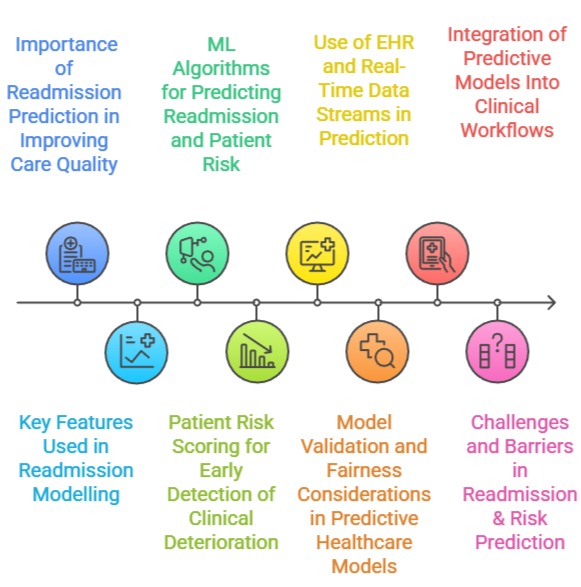
1. Importance of Readmission Prediction in Improving Care Quality
Hospital readmission predicts disease progression, complications, and gaps in post-discharge care.
Machine learning models help identify patients likely to return within 30 days by analyzing patterns across medical history, comorbidities, medication adherence, and discharge circumstances.
Predicting readmission allows hospitals to plan follow-up appointments, home monitoring, and community care support.
This reduces preventable readmissions and improves patient satisfaction. Moreover, it helps healthcare systems comply with policies and regulations related to readmission penalties.
By proactively identifying vulnerable individuals, hospitals can optimize resources and improve continuity of care. Effective prediction strengthens overall healthcare efficiency and quality.
2. Key Features Used in Readmission Modelling
Predictive models rely on a wide range of features including past diagnoses, lab results, inpatient history, number of previous admissions, vital signs, medication lists, imaging summaries, and social factors like caregiver support.
Each factor contributes to understanding the risk dynamics for individual patients.
For example, repeated admissions for chronic diseases like heart failure significantly increase readmission likelihood, while lab abnormalities may indicate future complications.
Incorporating real-time vitals and clinician notes further enhances model accuracy.
Feature engineering helps extract meaningful insights, such as trends in vitals or patterns in medication changes. Comprehensive feature sets create robust and clinically useful readmission models.
3. ML Algorithms for Predicting Readmission and Patient Risk
Different algorithms are used depending on the complexity and size of the data. Logistic regression provides interpretable, baseline models suitable for regulatory contexts.
Decision trees and random forests capture non-linear patterns and interactions between clinical variables. Gradient boosting models (XGBoost, LightGBM) offer strong performance for structured healthcare data.
Deep learning techniques, including LSTMs and transformers, are applied to sequential data like lab trends or clinical notes. Ensemble methods combining multiple models often produce the highest accuracy.
The choice of algorithm depends on interpretability requirements, data quality, and clinical application. ML models outperform traditional scoring systems in predicting readmission and clinical deterioration.
4. Patient Risk Scoring for Early Detection of Clinical Deterioration
Risk scoring converts complex patient data into actionable metrics that help clinicians identify those needing urgent attention.
Models analyze vitals, lab values, comorbidities, and behavioral indicators to detect early signs of sepsis, cardiac instability, respiratory failure, and other complications.
Risk scores support continuous monitoring in emergency departments, inpatient wards, and ICUs.
These systems allow clinicians to prioritize care, allocate resources, and intervene early, potentially preventing severe outcomes.
In addition, risk scoring can be personalized using dynamic patient data updates, giving more accurate predictions. Integration with hospital dashboards ensures real-time visibility and timely action.
5. Use of EHR and Real-Time Data Streams in Prediction
EHRs provide rich historical data, while ICU monitors and wearable devices supply continuous real-time information.
Combining both sources enhances predictive accuracy because models can detect subtle changes that precede deterioration.
Clinical notes processed via NLP also provide context about patient symptoms, social conditions, or treatment responses.
Real-time analytics alert care teams instantly when the risk score crosses a threshold.
Streaming data enables timely interventions, reducing mortality, ICU transfers, and emergency readmissions. Integrating these data sources requires strong data pipelines, interoperability, and automated processing.
The result is a digitally intelligent hospital environment capable of proactive care delivery.
6. Model Validation and Fairness Considerations in Predictive Healthcare Models
Validation ensures predictive models work reliably across diverse populations and clinical settings. Cross-validation, calibration curves, AUROC, precision-recall, and fairness metrics help assess performance.
Healthcare models must avoid bias against specific demographic groups, especially when training data is imbalanced. Bias can lead to unequal care or incorrect predictions for vulnerable populations.
External validation across multiple hospitals strengthens generalizability.
Ongoing monitoring ensures models remain accurate as patient demographics or disease patterns change. Robust validation builds trust among clinicians and supports safe deployment in real-world settings.
7. Integration of Predictive Models Into Clinical Workflows
Deploying predictive models into real-world care requires seamless integration with EHR systems, clinical dashboards, and alert mechanisms.
Models must provide interpretable results so clinicians understand why a patient is high-risk. Alerts should be actionable, reducing alarm fatigue by prioritizing meaningful recommendations.
Workflow integration helps providers schedule follow-ups, modify treatment plans, or initiate home-care support.
Predictive insights enhance multidisciplinary collaboration by giving all care teams access to unified risk information. Effective implementation improves overall clinical decision support and strengthens care coordination.
8. Challenges and Barriers in Readmission & Risk Prediction
Predictive modelling faces challenges such as missing data, inconsistent EHR records, and variations in clinical documentation across providers.
Social determinants of health—like housing, income, and support systems are often underreported yet significantly affect readmission risk. Overfitting can occur if models rely on limited datasets.
Clinician resistance or lack of interpretability may slow adoption.
Data privacy and regulatory compliance must be ensured when deploying AI-driven predictions.
Despite these challenges, continuous advancements in data integration, explainable AI, and real-time monitoring are improving reliability and increasing adoption.