Descriptive and inferential statistics are fundamental components of clinical research, enabling healthcare professionals and researchers to summarize patient data, understand disease patterns, and draw scientifically valid conclusions from samples to larger populations.
Descriptive statistics provide a structured way to present clinical variables such as age, blood pressure, treatment outcomes, or lab values using measures like mean, median, standard deviation, frequency tables, and visualizations.
These summaries help identify trends, anomalies, and baseline characteristics across patient groups, supporting early insights before advanced modeling begins.
Inferential statistics goes a step further by enabling researchers to make predictions, test hypotheses, and determine whether observed clinical differences are statistically significant rather than occurring by chance.
Techniques such as confidence intervals, p-values, t-tests, chi-square tests, ANOVA, regression, and survival analysis help evaluate treatment effectiveness, compare interventions, assess risk factors, and determine associations in population-level studies.
Inferential methods are widely used in randomized controlled trials (RCTs), epidemiological studies, drug effectiveness research, and precision medicine.
Together, descriptive and inferential statistics create a scientific foundation for clinical decision-making, ensuring that healthcare recommendations are evidence-based, reproducible, and statistically reliable.
Importance of Statistics in Clinical Research and Healthcare Decision-Making
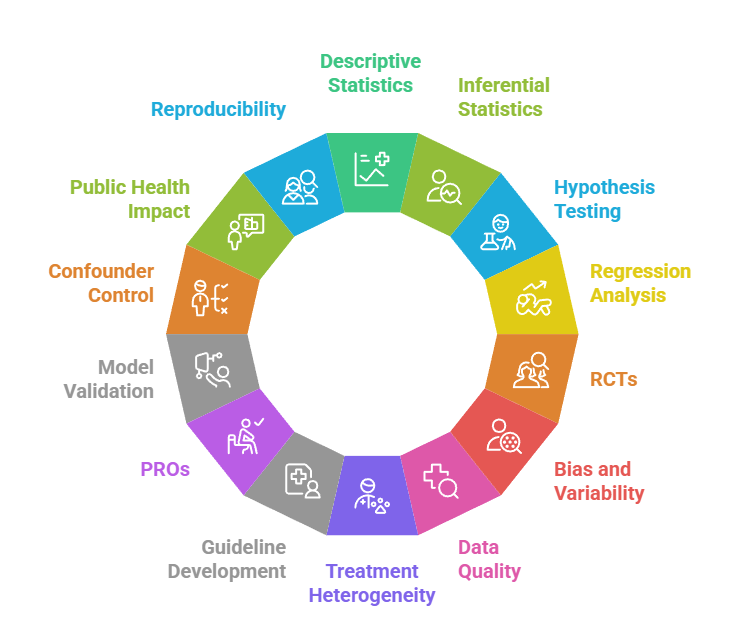
1. Role of Descriptive Statistics in Clinical Data Exploration
Descriptive statistics help summarize large volumes of clinical data into understandable formats, providing the first layer of insight for researchers and clinicians.
Measures like mean, median, range, and standard deviation allow interpretation of vital signs, lab results, and demographic characteristics across patient groups.
Frequency tables and percentages help identify distribution patterns, such as the prevalence of a condition or treatment usage rates.
Visual tools like histograms, box plots, and bar charts assist in detecting outliers or anomalies that may indicate data quality issues or unique clinical patterns.
Descriptive statistics ensure clarity and consistency when presenting baseline patient characteristics in clinical studies.
2. Importance of Inferential Statistics for Clinical Decision-Making
Inferential statistics enable researchers to generalize findings from a study sample to a broader patient population, which is essential for clinical evidence generation.
Hypothesis testing helps determine whether differences between treatment groups are statistically meaningful or simply due to random variation.
Methods like t-tests, chi-square tests, and ANOVA support comparison of interventions, while regression models identify predictors of disease outcomes.
Confidence intervals provide a range of plausible estimates for clinical parameters, offering more informative insights than single-value estimates.
These techniques ensure conclusions are scientifically valid and reduce the risk of false assumptions in patient care.
3. Hypothesis Formulation and Significance Testing in Clinical Research
Clinical research often begins with a hypothesis, such as whether a new treatment reduces hospital stay duration or whether a biomarker predicts disease severity.
Inferential statistics provide tools to test these hypotheses using p-values, effect sizes, and confidence intervals. High significance levels provide strong evidence for or against interventions, guiding decisions in drug trials or treatment evaluations.
Researchers must balance statistical significance with clinical significance to ensure results are meaningful for patient care.
Proper hypothesis testing minimizes biases and increases confidence in clinical findings. These methods form the backbone of evidence-based medicine.
4. Regression Analysis and Clinical Predictive Modeling
Regression methods such as linear regression, logistic regression, and Cox proportional hazards models help identify relationships between clinical variables and outcomes.
These techniques allow researchers to estimate risk factors, predict disease progression, and model treatment responses.
Logistic regression is particularly important for binary outcomes like disease presence or treatment success, while survival models analyze time-to-event outcomes such as mortality or readmission.
Regression models also help adjust for confounders, ensuring results reflect true clinical effects rather than external influences.
These insights support precision medicine by identifying patient-specific predictors.
5. Descriptive & Inferential Statistics in Randomized Controlled Trials (RCTs)
In RCTs, descriptive statistics summarize patient characteristics at baseline to ensure treatment groups are comparable. Inferential statistics then evaluate differences in outcomes between groups, determining whether interventions are effective.
Methods like intention-to-treat analysis, relative risk, and hazard ratios help interpret treatment impact.
Significance testing ensures that observed improvements are not based on chance, while confidence intervals quantify uncertainty.
Proper statistical analysis in RCTs ensures regulatory acceptance, scientific credibility, and patient safety. This framework is essential for evaluating new drugs, therapies, and clinical protocols.
6. Addressing Bias and Variability in Clinical Inference
Clinical data often contains variability due to patient differences, measurement errors, or sampling inconsistencies.
Inferential statistics provide tools for managing these uncertainties through variance analysis, confidence interval computation, and sampling techniques. Proper randomization, stratification, and blinding minimize bias in clinical trials.
Descriptive statistics also help detect data inconsistencies before conducting advanced analysis.
Understanding variability ensures more accurate, reproducible conclusions and prevents misleading interpretations.
These safeguards are essential for maintaining the trustworthiness of clinical research.
7. Assessing Data Quality and Consistency
Descriptive statistics play a vital role in evaluating the overall integrity of clinical research data by highlighting outliers, extreme values, and unexpected patterns.
Measures such as ranges, distributions, and summary tables help researchers quickly identify possible data errors or reporting inconsistencies.
Inferential methods then verify whether detected anomalies significantly affect study outcomes or are statistically negligible.
This integrated approach ensures that clinical findings are built on reliable, high-quality data that reflect real patient conditions.
8. Evaluating Treatment Heterogeneity
In many clinical trials, different groups of patients may respond differently to the same treatment. Descriptive tools help quantify variations in response, while inferential techniques such as subgroup analysis or interaction testing determine whether these differences are statistically meaningful.
Understanding treatment heterogeneity helps personalize therapies, identify high-responding patient groups, and eliminate ineffective interventions early. This enhances clinical decision-making and optimizes treatment outcomes across diverse populations.
9. Supporting Evidence-Based Guideline Development
Descriptive and inferential statistics collectively contribute to formulating clinical guidelines by summarizing past research and testing the significance of treatment effects.
Pooled averages, effect sizes, and meta-analytic inferential tests help determine which interventions consistently show benefit across multiple studies.
This ensures that medical guidelines are backed by rigorous statistical validation, making them reliable for large-scale adoption in clinical practice.
10. Measuring Patient-Reported Outcomes (PROs)
Clinical research increasingly incorporates patient-reported outcomes such as pain scores, quality-of-life surveys, or mental health indices.
Descriptive statistics help summarize patient experiences, while inferential tests determine whether observed improvements or declines are statistically significant.
This dual approach ensures that patient perspectives are integrated into treatment evaluations, making healthcare more patient-centered and aligned with real-world needs.
11.Validating Predictive Models in Clinical Research
While predictive analytics is widely used in healthcare, its reliability depends on statistical validation.
Descriptive statistics summarize model predictions and reveal trends or biases, while inferential methods like confidence intervals, error estimation, and cross-validation assess the significance and accuracy of predictions.
This ensures that predictive tools used in hospitals—such as readmission risk models or mortality predictors—are trustworthy, generalizable, and clinically safe.
12. Handling Clinical Confounders Through Statistical Controls
Clinical datasets often contain confounding variables such as age, genetics, lifestyle, or comorbidities that may skew the results.
Descriptive analysis identifies the presence and distribution of these variables, while inferential tools (e.g., multivariate regression, ANCOVA) help statistically adjust for their effects.
This ensures that the true relationship between treatment and outcome is isolated, preventing misleading conclusions and reinforcing scientific rigor in clinical studies.
13. Determining Public Health Impact Through Statistical Modeling
Descriptive statistics provide initial insight into disease spread, mortality rates, and demographic patterns, while inferential methods validate whether observed trends can be generalized to larger populations.
These tools help estimate disease burden, predict outbreak risks, and evaluate the statistical impact of interventions such as vaccination campaigns.
Such analysis strengthens public health planning and ensures resources are allocated based on statistically sound evidence.
14. Ensuring Reproducibility and Transparency
Proper use of descriptive and inferential statistics enhances the reproducibility of clinical research by providing clear, standardized reporting of study data and analytical findings.
Detailed summary tables, confidence intervals, and p-values allow independent researchers to verify results and replicate analyses.
This transparency strengthens the credibility of clinical evidence and promotes global trust in scientific outcomes.

Class Sessions
Sales Campaign

We have a sales campaign on our promoted courses and products. You can purchase 1 products at a discounted price up to 15% discount.