Healthcare data science is the rapidly growing discipline that combines statistical analysis, machine learning, data engineering, and medical knowledge to extract meaningful insights from clinical, operational, and administrative healthcare data.
With hospitals, diagnostic centres, and digital health applications now generating massive volumes of structured and unstructured data such as electronic health records (EHRs), medical images, genomics, wearables, and patient-reported outcomes—data science has become essential for delivering personalised, efficient, and evidence-driven care.
This field enables healthcare professionals to predict diseases, optimise treatment plans, reduce medical errors, and improve hospital workflows using analytical models.
Predictive analytics helps identify high-risk patients before complications arise, while natural language processing helps interpret clinical notes that traditionally remain unused.
The impact extends beyond clinical care: operational analytics improves hospital resource allocation, reduces waiting times, enhances staff scheduling, and optimises supply chains.
In public health, data science strengthens outbreak prediction, population monitoring, and health policy planning.
Today, with advancements in AI, IoT, and cloud systems, healthcare data science is becoming central to proactive, preventive, and patient-centered healthcare.
Importance of Healthcare in Data Science
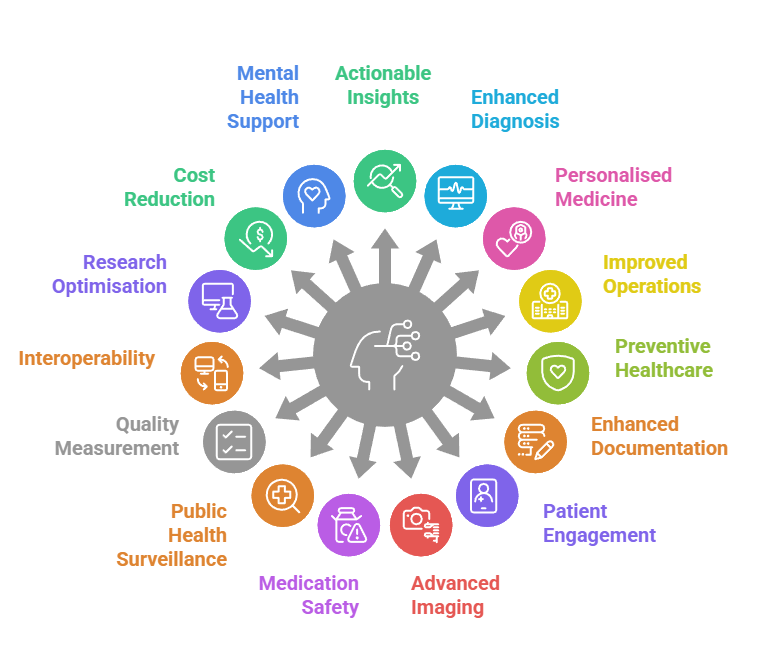
1. Transformation of Raw Medical Data into Actionable Insights
Healthcare generates complex data—EHRs, lab reports, imaging scans, genomic files, and wearable device streams—that often remain underutilised.
Data science converts this fragmented data into clinically meaningful insights that support diagnosis and treatment decisions. Techniques such as pattern detection, anomaly identification, and correlation analysis reveal disease risks, progression patterns, and patient behaviour trends.
Hospitals use these insights to design protocols, prioritise cases, and predict resource needs. As a result, decision-making becomes more evidence-based, consistent, and transparent.
This transformation helps clinicians save time while improving treatment accuracy and overall care quality.
2. Enhancing Diagnosis Through Predictive and AI-Driven Models
Machine learning and deep learning models can detect early signs of diseases such as cancer, diabetes, sepsis, or heart failure with high accuracy.
By analysing thousands of medical images or patient biomarkers, these models often identify patterns invisible to the human eye. Early detection enables clinicians to intervene sooner, reducing mortality and treatment costs.
AI-powered decision-support systems guide doctors during diagnosis and minimise human error in interpreting complex health data.
These tools augment—not replace—clinical expertise, resulting in faster, safer, and more reliable patient care. Today’s models continue improving as more data becomes available.
3. Personalised and Precision Medicine for Better Outcomes
Data science fuels precision medicine by integrating genomics, lifestyle data, and treatment history to recommend individualized therapies.
This approach shifts healthcare from a “one-size-fits-all” model to customized treatment plans tailored to each patient’s biology and needs.
For example, cancer treatment can be optimised based on genetic mutations, while chronic disease management can be personalised using wearable device data.
Personalised care reduces adverse drug reactions, improves treatment effectiveness, and enhances long-term patient satisfaction. As genomic sequencing becomes cheaper, precision medicine is becoming mainstream, transforming both prevention and treatment strategies.
4. Improving Hospital Operations and Resource Management
Hospitals face challenges such as bed shortages, long waiting times, staff burnout, and inefficient scheduling. Data science analyses patient flow, admission trends, and resource utilisation patterns to optimise operational efficiency.
Predictive analytics helps forecast patient admissions, emergency department surges, or ICU bed demand.
Workflow automation and intelligent scheduling reduce delays, improve patient experience, and increase staff productivity.
Optimised resource allocation ensures critical supplies and equipment are available when needed. This results in smoother hospital operations and improved patient throughput without compromising care quality.
5. Supporting Preventive Healthcare through Risk Prediction
Preventive care is more cost-effective and patient-friendly than reactive treatment. Data science identifies individuals at risk of chronic diseases by analysing lifestyle data, medical history, and behavioural patterns.
Risk scores help doctors intervene before serious complications occur, improving long-term health outcomes.
Public health organisations use predictive models to monitor disease outbreaks and assess environmental or social factors affecting population health.
Wearables and mobile health apps provide continuous patient monitoring, enabling early alerts for anomalies. This proactive approach reduces hospitalizations and promotes healthier communities.
6. Enhancing Clinical Documentation and Decision Making
Natural Language Processing (NLP) extracts valuable information from clinical notes, discharge summaries, and pathology reports. This transforms unstructured text into structured insights that support diagnosis, billing, and quality audits.
Decision-support systems integrate patient history, test results, and clinical guidelines to recommend next steps during care.
These tools reduce administrative workload, minimise documentation errors, and help clinicians focus more on patient interaction.
Automated clinical insights also ensure consistency in care delivery and support compliance with healthcare regulations.
7. Strengthening Patient Engagement and Digital Healthcare Delivery
Data science powers telemedicine, remote monitoring, and digital health platforms that improve accessibility, especially for rural or underserved regions.
Personalised health dashboards help patients track progress, adhere to medications, and follow lifestyle recommendations. Chatbots powered by AI offer basic triage, appointment scheduling, and symptom guidance, reducing hospital burden.
Patient behaviour analytics allows healthcare providers to design better engagement strategies and interventions. This digital shift results in a more connected, informed, and proactive patient population.
8. Advancing Medical Imaging Through AI and Deep Learning
Data science has significantly transformed radiology, pathology, and diagnostic imaging by enabling automated image analysis using deep learning.
These models can detect tumors, fractures, lesions, and organ abnormalities with high accuracy and consistency, often meeting or exceeding human-level performance.
Automated image segmentation helps clinicians understand disease boundaries and progression more clearly. AI tools reduce the workload on radiologists by filtering normal scans, allowing them to focus on complex cases.
Early and accurate interpretation leads to faster treatment decisions and improved patient outcomes. As imaging data grows, these models continue refining their diagnostic capabilities, making imaging more precise and efficient.
9. Improving Medication Safety and Reducing Adverse Drug Events
Medication errors such as incorrect dosages or harmful drug interactions are a major concern in healthcare. Data science systems analyse patient records, allergies, lab results, and drug histories to detect potential risks before prescriptions are issued.
Machine learning models can alert clinicians about unsafe combinations or dosage incompatibilities in real time.
Predictive risk scoring identifies patients more likely to experience adverse drug reactions.
This leads to safer prescribing practices and fewer emergency visits linked to medication issues. By reducing preventable errors, data science improves patient safety and builds trust in healthcare systems.
10. Boosting Public Health Surveillance and Epidemic Forecasting
Data science plays a crucial role in monitoring community health trends and predicting disease outbreaks. By analysing mobility data, demographic patterns, and clinical indicators, predictive models can anticipate the spread of infectious diseases.
Public health organisations use these insights to prepare medical resources, enforce timely interventions, and design targeted awareness campaigns.
Data-driven surveillance helps detect early warning signs for emerging health threats.
During pandemics, real-time dashboards and analytics support rapid decision-making. This improves government readiness and minimizes the societal impact of health crises.
11. Strengthening Healthcare Quality Measurement and Compliance
Hospitals must adhere to strict quality standards and regulatory frameworks. Data science tools analyse clinical workflows, infection rates, readmissions, and treatment compliance to assess performance.
Automated dashboards help healthcare administrators track quality indicators and identify areas for improvement.
This promotes continuous quality enhancement and ensures adherence to national guidelines and accreditation standards. Predictive analytics helps forecast performance risks before they escalate.
With clearer insights, healthcare systems can make better strategic decisions focused on patient safety and service excellence.
12. Facilitating Interoperability and Unified Patient Views
Healthcare data is often scattered across different systems—EHRs, labs, pharmacies, and imaging centres. Data science enables the integration of these systems through interoperability frameworks, producing a unified patient profile.
A consolidated view helps clinicians make faster and more informed decisions. It reduces duplication of tests, prevents information gaps, and enhances care coordination between departments.
Unified data also supports holistic treatment planning, especially for chronic disease management. This ensures smoother communication, better continuity of care, and improved patient satisfaction.
13. Enhancing Research and Clinical Trial Optimisation
Data science accelerates medical research by analysing large datasets to identify patterns in disease progression and treatment response. Patient data helps researchers select suitable participants for clinical trials, reducing recruitment time and improving accuracy.
Predictive models can identify which groups are more likely to benefit from a drug, increasing trial efficiency.
AI-driven simulations support drug discovery by predicting molecule behaviour. Overall, data science speeds up research cycles and helps bring effective treatments to the public faster.
14. Reducing Healthcare Costs Through Efficiency and Prediction
One of the biggest impacts of data science is cost reduction through optimised operations, fewer errors, and preventive care strategies. Predictive models can warn hospitals about high-cost patients, allowing early intervention to avoid expensive complications.
Automation reduces administrative overhead and eliminates manual inefficiencies. Hospitals save money by forecasting supply needs accurately and minimizing waste.
For patients, personalised care reduces unnecessary procedures, diagnostic delays, and medication mismanagement. This leads to more affordable, value-driven healthcare delivery.
15. Supporting Mental Health Through Behavioural Analytics
Mental health conditions often go undiagnosed due to subtle symptoms or limited clinical interaction. Data science examines patterns in speech, activity levels, digital behaviour, and wearable metrics to detect signs of stress, anxiety, or depression.
AI-powered applications can provide early alerts, enabling timely therapy or intervention. Behavioural analytics also helps therapists monitor patient progress remotely.
This supports more proactive, accessible, and continuous mental healthcare. As mental health awareness increases globally, data science plays a vital role in bridging treatment gaps.