Natural Language Processing (NLP) plays a critical role in healthcare by converting vast amounts of unstructured clinical text into meaningful, analyzable insights.
Healthcare generates millions of written documents clinical notes, discharge summaries, radiology reports, pathology findings, referral letters, prescriptions, and patient interactions.
NLP enables automated understanding of this text, helping healthcare systems overcome documentation overload while improving accuracy and efficiency.
Techniques such as named entity recognition (NER), text classification, sentiment analysis, summarization, question answering, and relation extraction allow models to identify symptoms, diagnoses, medications, treatments, and clinical relationships directly from free-text records.
Modern NLP in healthcare is driven by deep learning models, especially transformers like BERT, BioBERT, ClinicalBERT, BioGPT, and large language models (LLMs) fine-tuned on medical corpora.
These models offer advanced contextual understanding, enabling accurate interpretation of medical terminology, negations (“no signs of infection”), abbreviations, and domain-specific language patterns. NLP supports critical tasks such as automated coding, clinical decision support, clinical summarization, chatbot interactions, and real-time documentation assistance.
It also aids research by extracting insights from scientific literature and supporting large-scale evidence synthesis.
By integrating NLP into healthcare systems, hospitals can reduce clinician workload, enhance patient safety, improve diagnostic accuracy, and make data from unstructured text available for analytics and machine learning. NLP has become a foundational technology for modern, AI-driven healthcare.
Applications of Natural Language Processing in Healthcare
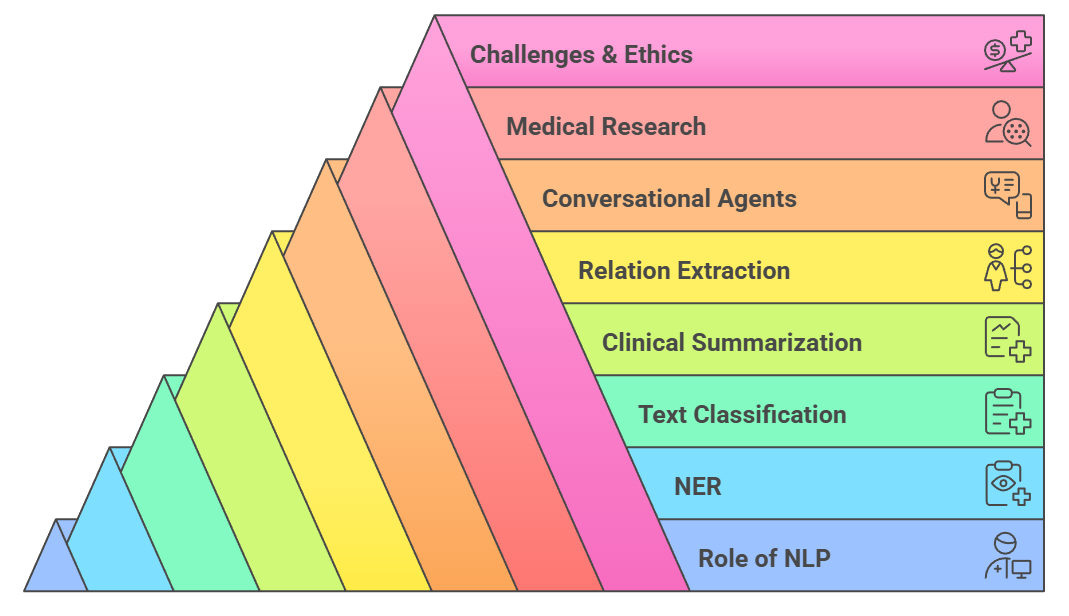 1. Role of NLP in Converting Unstructured Clinical Text Into Usable Data
Healthcare data is predominantly unstructured, and NLP transforms these free-text records into structured formats that can be analyzed or used to support decision-making. NLP algorithms identify key concepts such as conditions, symptoms, medications, and test results hidden in narrative notes.
This conversion unlocks vast amounts of clinical knowledge that would otherwise remain inaccessible.
With structured outputs, hospitals can perform analytics, improve patient records, and integrate insights into predictive models.
This process strengthens patient safety by reducing manual errors and variability in documentation.
The conversion also enables better interoperability and supports regulatory reporting requirements.
2. Named Entity Recognition (NER) for Identifying Medical Concepts
NER systems extract medically relevant entities like diseases, drugs, procedures, lab measurements, and anatomical terms from clinical documents.
Advanced deep learning models allow NER to understand complex clinical language, including abbreviations, synonyms, and context-specific usage.
By labeling key terms, NER simplifies downstream tasks like billing automation, risk stratification, and diagnostic support. It helps hospitals organize their documentation and detect clinically important patterns across large populations.
In research, NER accelerates literature mining and helps identify emerging trends in medical investigations. NER is foundational for building trustworthy and scalable healthcare NLP systems.
3. Text Classification for Diagnosis Prediction and Triage Support
Text classification assigns categories to clinical documents such as diagnosis categories, urgency levels, or problem types.
This capability supports automated triage by helping models quickly assess patient severity from textual records.
It is widely used in medical coding, where algorithms map notes to ICD codes for billing and reporting.
Classification models help detect complications, identify high-risk patients, and guide clinicians toward relevant information.
They are also used in filtering and routing clinical communications, reducing the cognitive burden on medical staff. As a result, classification enhances workflow efficiency and improves patient care quality.
4. Clinical Summarization for Reducing Documentation Burden
Summarization models condense lengthy clinical documents into concise, clinically meaningful summaries that highlight essential findings, diagnoses, and plans.
This is particularly useful for discharge summaries, multi-day ICU notes, or referral letters. NLP summarization reduces clinician burnout by saving time otherwise spent reviewing extensive medical histories.
It also improves handoff quality, ensuring that new care teams receive accurate and timely information.
Advanced transformer-based summarizers maintain context and medical coherence, making them reliable enough for clinical environments.
Summarization enhances continuity of care and supports faster decision-making.
5. Relation Extraction to Understand Clinical Relationships
Relation extraction identifies how clinical entities are connected—for example, linking symptoms to diagnoses, medications to dosages, or treatments to outcomes.
Understanding relationships is essential for building knowledge graphs and decision-support systems.
These models can detect drug–drug interactions, identify adverse events, and link lab abnormalities to potential causes. Relation extraction enhances clinical reasoning by allowing systems to interpret complex scenarios outlined in doctor notes.
It supports research by discovering new clinical associations across large-scale datasets. This capability helps convert textual information into actionable medical intelligence.
6. NLP-Powered Conversational Agents and Voice Documentation Tools
NLP enables voice assistants and chatbots that support clinicians and patients through natural, conversational interactions.
Clinicians can dictate notes, retrieve patient histories, or generate reports using voice-based NLP tools, reducing administrative strain. Patients can interact with symptom checkers, appointment chatbots, and medication reminders, improving engagement and adherence.
These conversational systems must handle medical language accurately, making advanced NLP essential for reliability.
They can also support emergency triage and remote consultations when integrated with clinical protocols. Such tools improve accessibility and streamline communication across the healthcare ecosystem.
7. Using NLP in Medical Research and Evidence Synthesis
NLP accelerates research by mining unstructured medical literature, clinical trial reports, and case records. It helps researchers extract biomarkers, treatment outcomes, and risk factors from thousands of documents in minutes.
NLP-based literature review tools assist in systematic reviews, allowing faster identification of relevant studies.
These capabilities help clinicians stay updated with emerging research and support evidence-based practice. NLP also aids drug discovery by extracting information on molecular interactions and disease pathways.
Overall, it enhances scientific productivity and speeds up innovation in healthcare.
8. Challenges and Ethical Considerations in Healthcare NLP
Despite its potential, NLP faces challenges such as noisy clinical notes, inconsistent terminology, and variations in writing styles across clinicians.
Transformer models require large labeled datasets, which are expensive and time-consuming to create.
Privacy and security concerns are especially significant due to sensitive patient information contained in text.
Bias in training data can lead to unfair interpretations or decisions.
Ensuring transparency and explainability is essential for clinical acceptance. Addressing these challenges requires specialized models, careful dataset curation, and ongoing monitoring to ensure responsible deployment.

Class Sessions
Sales Campaign

We have a sales campaign on our promoted courses and products. You can purchase 1 products at a discounted price up to 15% discount.