Missing and imbalanced data are two of the most critical challenges in healthcare analytics, significantly impacting the reliability of predictive models and clinical decision-making.
Healthcare datasets commonly contain missing values due to incomplete patient histories, inconsistent documentation, device malfunction, skipped tests, or human errors during clinical entry.
Since medical decisions often rely on precise and complete data, inappropriate handling of missing values can lead to incorrect conclusions, biased predictions, and potentially harmful recommendations.
Techniques such as imputation, data fusion, statistical modeling, and domain-driven estimation help preserve data integrity while preventing loss of valuable information.
Imbalanced data is another major issue in healthcare because many medical conditions, such as rare diseases, adverse drug reactions, or uncommon complications, occur infrequently.
As a result, datasets contain far more examples of the majority class (healthy or common cases) than the minority class (rare events), making predictive models biased toward the majority.
This imbalance can cause models to miss critical high-risk cases, leading to poor sensitivity and low clinical usefulness.
Methods such as SMOTE, undersampling, oversampling, anomaly detection, and cost-sensitive learning enable more balanced training and safer predictions.
Challenges and Solutions for Missing and Imbalanced Healthcare Data
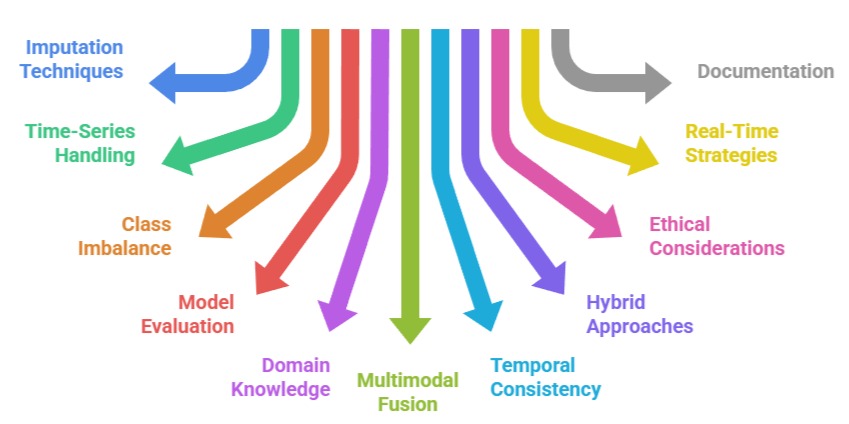
1. Causes and Patterns of Missing Data in Healthcare
Missing data arises from multiple sources such as incomplete medical histories, patient non-compliance, skipped lab tests, device errors, and manual entry mistakes.
Some values may be Missing Completely at Random (MCAR), while others follow clinically meaningful patterns like Missing Not at Random (MNAR), where severity influences test availability.
Recognizing the type of missingness is essential because it determines the appropriate handling strategy. For instance, a missing glucose test may indicate a stable patient, whereas missing imaging could signal clinical urgency.
Understanding these patterns prevents incorrect assumptions and improves algorithmic reliability. Healthcare analysts must detect and interpret missingness using domain knowledge, statistical tests, and EHR metadata.
2. Techniques for Imputing Missing Healthcare Data
Traditional methods like mean, median, or mode imputation are often inadequate for healthcare datasets because they may distort clinical relationships.
Instead, advanced techniques like KNN imputation, regression imputation, multiple imputation (MICE), or time-series interpolation preserve temporal and clinical dependencies.
Machine learning–based imputation such as autoencoders or random forest imputation can estimate values more accurately by learning patterns from similar patients.
These methods help retain sample size and model performance while reducing bias. Choosing the right imputation strategy depends on the variable type, clinical context, and missingness mechanism.
Proper imputation ensures that downstream analytics reflect real physiological behavior.
3. Handling Missing Data in Time-Series & Wearable Signals
Healthcare time-series data from ICU monitors, ECG sensors, and wearables often contain gaps caused by signal noise, connectivity issues, or patient movement.
Filling these gaps requires techniques like forward-fill, backward-fill, spline interpolation, Kalman filtering, or probabilistic imputation methods.
Since patient vitals can change rapidly, smoothing or incorrect interpolation may hide clinically significant fluctuations. Analysts must validate imputed signals against medical constraints to prevent unrealistic patterns.
Maintaining the continuity of time-series data is essential for early-warning systems, deterioration prediction, and real-time monitoring.
Robust gap-handling enhances the accuracy and reliability of clinical alarms and predictive algorithms.
4. Understanding Class Imbalance in Clinical Prediction Tasks
Class imbalance is common in healthcare because many critical events—sepsis onset, cardiac arrest, readmission, rare genetic diseases—occur infrequently.
Traditional machine learning models trained on imbalanced data tend to favor the majority class, resulting in poor detection of high-risk or rare cases.
Sensitivity, recall, and precision for minority classes become extremely low, making models clinically unsafe. Healthcare applications require detecting the minority class accurately because it often represents the most critical condition.
Understanding the extent and nature of imbalance helps determine the best balancing strategy and ensures fairness and safety in predictive modeling.
5. Sampling-Based Solutions for Imbalanced Healthcare Data
Sampling methods like random oversampling, undersampling, and SMOTE (Synthetic Minority Oversampling Technique) are widely used to create balanced datasets.
Oversampling adds more minority examples, while undersampling reduces the majority class to improve balance. SMOTE and its variants generate synthetic patient records by interpolating between real minority samples, helping models learn more generalized decision boundaries.
Care must be taken to avoid overfitting, especially with small minority classes. In healthcare, sampling must also preserve physiological validity, ensuring synthetic or reduced data still reflect real clinical scenarios.
Proper sampling improves sensitivity and helps models detect rare but critical events.
6. Cost-Sensitive & Algorithm-Level Solutions for Imbalanced Data
Cost-sensitive learning assigns higher penalties to misclassifying minority cases, forcing the model to prioritize rare critical events like sepsis onset or adverse reactions.
Algorithms such as XGBoost, Random Forest, and Logistic Regression can incorporate class weights to influence decision boundaries.
Ensemble methods and anomaly detection strategies are often effective when minority data is extremely limited. Adjusting decision thresholds also helps improve recall for clinically significant outcomes.
These techniques reduce bias toward the majority class and ensure that high-risk patients receive greater focus in predictive models. Such approaches are crucial for maintaining clinical relevance and patient safety.
7. Evaluating Model Performance with Missing & Imbalanced Data
Standard accuracy metrics are misleading in imbalanced healthcare datasets because a model may appear accurate but fail to detect critical minority cases.
Metrics like AUC-ROC, AUC-PR, recall, sensitivity, F1-score, and confusion matrices provide a more complete evaluation. Calibration plots help ensure predicted probabilities align with clinical expectations.
Cross-validation must be stratified to preserve class distribution and prevent biased performance estimates.
Robust evaluation ensures that models are safe, interpretable, and effective in identifying high-risk conditions.
Proper performance assessment is essential before deploying healthcare models into clinical workflows.
8. Leveraging Domain Knowledge for Better Data Handling
In healthcare analytics, domain knowledge plays a crucial role in determining how missing or imbalanced data should be treated.
Clinicians, nurses, and domain experts can explain whether a missing value has clinical meaning for example, a missing diagnostic test may imply low suspicion of disease.
Understanding medical workflows helps analysts decide whether missingness is expected, avoid incorrect imputations, and choose safe assumptions.
Domain input also ensures that synthetic samples and imputed values maintain physiological accuracy and clinical plausibility.
Collaboration with medical professionals prevents algorithmic errors and ensures that models truly reflect real-world healthcare processes.
This approach greatly improves both reliability and trust in AI-driven insights.
9. Multimodal Fusion to Reduce Impact of Missing Data
Healthcare often involves multimodal data clinical notes, imaging, lab results, vitals, and genomics—which can compensate for missing values in one modality.
For example, when lab tests are missing, vitals or physician notes may provide enough context for modeling. Integrating multimodal data reduces dependence on any single data source, making predictions more robust.
Deep learning architectures like transformers and multimodal fusion networks can combine diverse inputs to fill knowledge gaps.
This approach not only reduces the effect of missing data but also improves detection of complex conditions.
Multimodal strategies are increasingly important in modern precision medicine pipelines.
10. Temporal Consistency Checks for Healthcare Imputation
Healthcare variables often follow predictable physiological patterns heart rate trends, glucose cycles, and blood pressure fluctuations.
Temporal consistency checks ensure that imputed values respect these medical patterns instead of introducing medically impossible trends. Analysts can use constraints such as typical vital-sign ranges or clinical thresholds during imputation.
Tools like Kalman filters, state-space models, and recurrent neural networks can produce temporally stable imputations. These checks prevent false patterns that could mislead early-warning systems or ICU prediction models.
Ensuring temporal coherence is essential when handling time-series data in high-stakes clinical environments.
11. Hybrid Approaches for Severe Class Imbalance
Some healthcare datasets involve extreme imbalance, such as predicting rare cancers or adverse drug reactions with occurrence rates of 0.1% or lower.
In such cases, hybrid approaches combining oversampling, anomaly detection, and ensemble methods work best. Autoencoder-based anomaly detectors can learn typical patient profiles and flag deviations as potential anomalies.
Combining SMOTE with cost-sensitive learning provides both improved representation and balanced training.
These hybrid systems ensure minority cases are identified despite their extremely low frequency. This approach is becoming essential for modern biomedical research involving rare diseases.
12. Ethical and Bias Considerations in Data Handling
Improper handling of missing or imbalanced data can create or worsen bias in healthcare models, disproportionately affecting vulnerable groups.
For example, if certain demographic groups have more missing data due to limited access to care, naive imputation may misrepresent their clinical risk. Similarly, imbalanced datasets may cause models to under-detect diseases prevalent in minority communities.
Ethical handling includes monitoring fairness metrics, applying equitable sampling strategies, and validating model performance across demographic subgroups.
Ensuring fair treatment of minority populations is essential for safe deployment of healthcare AI systems. Ethical data handling ensures models support inclusive and equitable decision-making.
13. Real-Time Strategies for Streaming Healthcare Data
In ICU and remote monitoring systems, missing data occurs in real time due to sensor dropout, battery drain, or connectivity failures.
Real-time gap handling requires fast interpolation, redundancy mechanisms, or fallback predictive models that operate despite missing signals. Streaming platforms like Kafka, Spark Streaming, and cloud-based health monitors implement continuous data correction.
Real-time anomaly detection systems alert clinicians when missingness may signal equipment malfunction or clinical deterioration.
Handling missingness in streaming data is crucial for maintaining reliability in life-support systems and virtual care platforms. These strategies directly impact patient safety and continuity of care.
14. Documentation & Metadata Tracking for Transparency
Healthcare datasets must maintain detailed metadata documenting missing values, imputation methods, and class-balancing techniques.
Proper documentation helps clinicians and auditors understand how the data was transformed, ensuring transparency and trust. Metadata also supports reproducibility in research and helps future analysts avoid misinterpretation of modified datasets.
Tracking imputation history is especially important in regulated healthcare environments where data changes must be audited. This transparency ensures models meet compliance standards while enabling safer clinical deployment.