Unsupervised learning plays a vital role in healthcare analytics by discovering hidden patterns in patient data without relying on predefined labels.
Unlike supervised learning, where the outcome variable is known, unsupervised techniques help identify natural groupings, similarities, and abnormalities within large and complex clinical datasets.
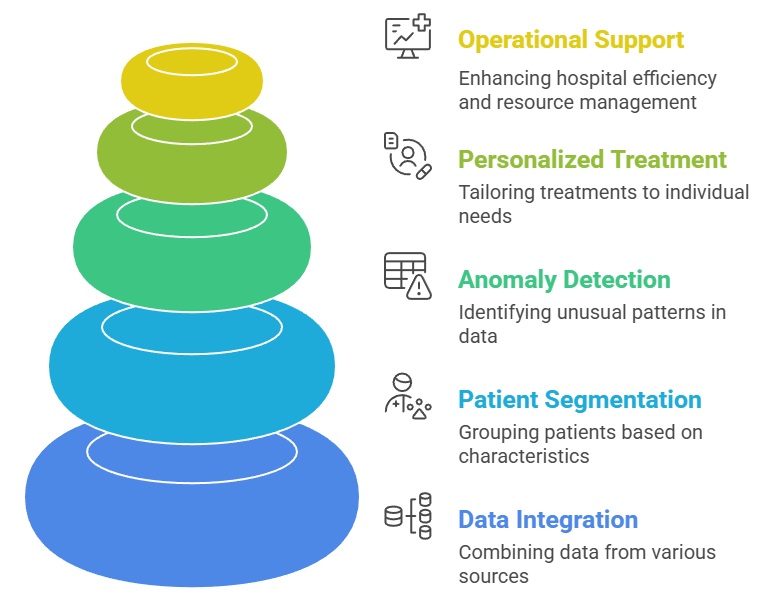
This makes them particularly valuable in tasks such as patient segmentation, risk stratification, early anomaly detection, rare disease identification, and uncovering emerging clinical trends.
Patient segmentation enables healthcare providers to classify individuals into homogenous groups based on factors like demographics, comorbidities, treatment history, lifestyle risk variables, genomic profiles, or disease progression patterns.
Such segmentation helps hospitals design targeted interventions, optimize resource allocation, and personalize care strategies for improved patient outcomes.
On the other hand, anomaly detection is used to flag unusual clinical patterns, rare symptoms, abnormal lab values, or unexpected physiological changes that may indicate medical errors, disease outbreaks, or early signs of critical deterioration.
With the rapid growth of EHR data, wearable health-monitoring devices, and real-time hospital monitoring systems, unsupervised learning has become a core component of predictive and preventive healthcare.
Techniques like clustering, dimensionality reduction, density-based detection, and representation learning help uncover structures that are not visible through traditional statistical methods.
When applied responsibly and validated with clinical expertise, unsupervised learning reveals high-value insights that improve care delivery, reduce operational burden, and detect medical risks before they escalate.
Pattern Discovery Using Unsupervised Learning in Healthcare
1. Role of Clustering in Patient Segmentation
Clustering algorithms such as K-Means, Hierarchical Clustering, and DBSCAN group patients with similar clinical characteristics, allowing hospitals to understand varied patient populations more clearly.
These clusters often reveal subgroups that differ in disease severity, lifestyle behavior, treatment response, or risk trajectories.
For example, diabetic patients may cluster into groups with different metabolic profiles or medication adherence patterns. Such segmentation helps clinicians personalize care plans instead of applying a “one-size-fits-all” treatment strategy.
Segmentation also helps administrators forecast hospital demand and justify resource allocation. When integrated into care pathways, clustering-based segments improve patient engagement, targeted intervention, and clinical outcomes.
2. Identifying High-Risk Patient Subgroups
Unsupervised learning can highlight patient clusters that are more prone to adverse medical events such as readmission, rapid deterioration, or chronic disease complications.
These high-risk segments often emerge from patterns in lab values, vitals, demographics, genetic predispositions, or lifestyle factors. By recognizing such groups early, healthcare teams can shift from reactive treatment to proactive prevention.
Hospitals can prioritize frequent monitoring, early diagnostics, and specialized interventions for these vulnerable groups.
This approach significantly reduces emergency events and healthcare costs and improves long-term outcomes. The ability to recognize hidden risk structures makes unsupervised learning a foundational tool in preventive healthcare strategies.
3. Dimensionality Reduction for Clinical Pattern Discovery
Techniques such as PCA (Principal Component Analysis), t-SNE, and UMAP help simplify high-dimensional clinical data into low-dimensional representations that reveal meaningful patterns.
Healthcare datasets often contain hundreds of variables lab tests, genomic markers, medication histories, symptoms and reducing dimensionality makes it easier to identify correlations that remain hidden in raw data.
Visualization of these reduced components helps clinicians interpret disease clusters, identify progression trends, and detect patient subgroups with similar biological profiles.
Additionally, dimensionality reduction supports downstream modeling by removing noise and redundant variables. This makes models more stable, easier to interpret, and computationally efficient.
4. Detecting Medical Anomalies and Irregular Patterns
Anomaly detection algorithms such as Isolation Forest, One-Class SVM, LOF (Local Outlier Factor), and autoencoders help identify unusual patterns that may indicate early signs of medical issues.
These anomalies could reflect abnormal lab fluctuations, unexpected symptom combinations, sudden vital sign deviations, or subtle physiological changes indicating disease onset.
In ICU settings, anomaly detection can flag life-threatening events such as sepsis or cardiac deterioration before clinical symptoms fully manifest.
In operational contexts, anomalies may reveal medical errors, faulty sensors, EHR irregularities, or fraud. Early identification enables timely clinical action, reducing complications and mortality.
5. Rare Disease Detection and Outlier Analysis
Rare diseases often appear as outliers within large clinical datasets, making unsupervised learning essential for early identification.
Clustering algorithms or distance-based anomaly detectors can isolate unusual feature patterns that deviate from typical patient groups. This helps clinicians flag undiagnosed genetic disorders, unusual infection patterns, or uncommon treatment responses.
Outlier detection also helps researchers discover previously unknown disease subtypes, improving diagnostic accuracy and personalized treatment strategies.
By identifying abnormal trajectories early, healthcare providers can perform targeted testing, accelerate diagnosis, and potentially prevent mismanagement of rare conditions.
6. Improving Personalized Treatment Pathways
Segmentation enables healthcare providers to deliver more personalized therapies by understanding unique patient profiles.
Grouping patients based on disease progression speed, biomarker responses, or medication history helps clinicians design tailored treatment plans.
For example, cancer patients may cluster by tumor behavior, genetic mutation, or response to chemotherapy. Personalization not only increases treatment effectiveness but also reduces side effects and enhances patient satisfaction.
Unsupervised learning provides the foundation for precision medicine initiatives, which require deep understanding of patient heterogeneity.
7. Supporting Hospital Operations and Resource Management
Unsupervised learning helps hospitals segment patients based on utilization patterns, readmission likelihood, length of stay, or emergency department behavior.
These segments guide operational planning, staffing, bed allocation, and risk-adjusted care coordination.
Anomaly detection can also highlight unusual spikes in patient flow or identify atypical care patterns that indicate inefficiency.
By improving operational intelligence, hospitals can reduce waiting times, manage workloads more effectively, and ensure appropriate resource distribution. This contributes to smoother workflows, lower costs, and improved overall service quality.
8. Integration With Wearable & Real-Time Monitoring Data
Wearables and continuous monitoring devices generate time-series physiological signals such as heart rate, glucose levels, oxygen saturation, and sleep patterns.
Unsupervised learning identifies early anomalies in this data, indicating conditions like arrhythmia, nocturnal hypoxia, or abnormal glucose excursions.
Clustering helps classify lifestyle or behavior-based risk groups, improving preventive care. These insights allow doctors to intervene early, customize wellness plans, and monitor chronic conditions remotely with higher precision.
9. Using Autoencoders for Complex Anomaly Detection
Autoencoders deep learning models designed to reconstruct input data—are highly effective for detecting anomalies in complex healthcare datasets such as imaging, lab sequences, and ECG waveforms. When trained on normal patient data, autoencoders learn the underlying structure and patterns.
Any input that significantly deviates from this learned pattern results in high reconstruction error, signaling potential clinical anomalies.
This makes autoencoders useful for identifying early disease patterns, medical device malfunctions, or errors in sensor recordings.
They are especially valuable in radiology, neurology, and cardiology, where subtle abnormalities aren’t easily captured by rule-based detection.
Their ability to handle high-dimensional data makes them a powerful tool for modern healthcare analytics.
10. Density-Based Clustering for Complex Patient Populations
Density-based algorithms like DBSCAN and HDBSCAN capture clusters of varying shapes and densities, making them ideal for heterogeneous patient populations.
Healthcare data often includes uneven distributions, overlapping conditions, or mixed disease severity levels.
Density clustering naturally separates dense regions representing common patient groups from sparse regions, which often contain rare or high-risk individuals.
These algorithms also identify outliers automatically, supporting anomaly detection. This is valuable in clinical research, where disease subtypes rarely follow neat boundaries.
The method enables more realistic segmentation and uncovers hidden patient patterns that traditional clustering may miss.
11. Graph-Based Unsupervised Learning for Patient Networks
Healthcare data can be represented as networks—patients connected through shared diseases, biomarkers, treatments, or lifestyle attributes.
Graph-based clustering and community detection algorithms (e.g., Louvain, Spectral Clustering) help identify hidden patient communities within these networks.
Such methods reveal relationships between conditions, comorbidity clusters, or progression pathways.
Graph-based learning is especially useful in understanding chronic disease networks such as diabetes–hypertension–kidney disease chains. It also assists in epidemiology by identifying transmission clusters.
By analyzing patient networks, healthcare providers gain deeper insights into how diseases spread, co-occur, and evolve.
12. Unsupervised Feature Learning for Clinical Representation
Unsupervised learning helps extract meaningful features from raw clinical data using techniques such as embeddings, deep learning representations, and clustering-based feature generation.
This is especially important for EHRs, which contain unstructured text, categorical fields, and irregular time-series data.
Feature learning produces compressed representations that improve downstream predictive models, making them more accurate and stable. For example, embeddings can map medical codes (ICD, CPT, SNOMED) into vector spaces that capture clinical similarity.
These representations help identify disease relationships, treatment patterns, and patient risk groups more effectively.
13. Unsupervised Temporal Pattern Mining in Healthcare
Healthcare involves time-based changes, and unsupervised sequence mining identifies patterns in longitudinal patient data.
Algorithms such as motif discovery, clustering of time-series, and sequence alignment detect repeating medical events or abnormal trajectories.
This is crucial for chronic disease monitoring, where progression rates vary widely between patients.
Temporal pattern mining can reveal early warning signs, such as gradually rising inflammation markers or irregular heart rhythm patterns.
Detecting these trends early supports preventive care and reduces the burden on emergency services. It also helps clinicians tailor treatment intervals, medication schedules, and follow-up plans.
14. Identifying Treatment Response Subgroups
Unsupervised methods help uncover how different patients respond to the same treatment, revealing responder and non-responder groups.
These clusters highlight variations caused by genetics, lifestyle, comorbidities, or physiological differences.
This enhances treatment precision, reduces medication waste, and minimizes adverse effects.
Pharmaceutical researchers use these insights to design more effective clinical trials, identify biomarker-based responder groups, and refine drug development strategies.
15. Early Detection of Hospital-Acquired Complications
Anomaly detection models can monitor hospital workflows, patient vitals, and lab trends to identify early signs of complications such as sepsis, post-surgery infections, or unexplained deterioration.
These models learn the “normal” trajectory of a patient’s recovery and alert clinicians when deviations occur.
Detecting anomalies early reduces ICU admissions, prevents medical emergencies, and improves outcomes. This also supports infection control by identifying unusual spikes in hospital-acquired infections. Early detection is vital in improving patient safety and reducing mortality rates.
16. Fraud, Abuse, and Operational Anomaly Detection
Beyond clinical use, anomaly detection supports financial and administrative integrity.
Algorithms identify unusual billing patterns, invalid insurance claims, duplicate procedures, or suspicious provider behavior.
In supply chain operations, anomalies may indicate stock mismanagement, equipment failure, or unexpected usage trends.
This strengthens healthcare governance and reduces financial waste.
Hospitals can prevent fraud-related losses and ensure compliance with regulatory requirements. The insights gained contribute to overall system efficiency and accountability.