Healthcare data collection, storage, and processing form the foundational backbone of modern data-driven healthcare systems.
As hospitals and health organizations increasingly adopt digital technologies, vast volumes of data are generated every second from patient admissions and diagnostic results to wearables, telemedicine platforms, and remote monitoring systems.
Effective data collection ensures accuracy at the source through structured inputs like EHR forms, medical devices, and standardized coding systems, which reduces errors and strengthens downstream analytics.
Storage of healthcare data has evolved significantly with the adoption of cloud-based solutions, distributed databases, and interoperable data repositories.
These storage systems must support high-security requirements, large-scale data volumes, compliance with health regulations, and fast accessibility for clinical decision-making.
Processing, on the other hand, transforms raw healthcare data into meaningful insights using cleaning, normalization, integration, feature extraction, and advanced analytics pipelines.
This step is crucial because healthcare data is often heterogeneous, incomplete, unstructured, and sensitive.
Today’s healthcare organizations must ensure that data flows seamlessly across departments, systems, and platforms while maintaining strict privacy, accuracy, and interoperability standards.
The efficiency of these processes directly impacts diagnosis speed, patient outcomes, resource optimization, regulatory compliance, and the overall quality of healthcare delivery.
Data Collection in Healthcare
Healthcare data collection involves capturing patient information from a wide variety of touchpoints, including EHR entries, medical imaging, lab tests, billing systems, IoT devices, and telehealth interactions.
Accurate collection is essential because errors at this stage can propagate throughout the entire clinical workflow, leading to misdiagnosis or incorrect treatment.
Modern healthcare uses structured forms, standardized terminologies like ICD-10 and SNOMED CT, and automated device integration to reduce human error and increase data quality.
Wearables and remote monitoring tools have also expanded the scope of data collection beyond hospitals, enabling continuous and real-time patient tracking.
Additionally, mobile health apps facilitate patient self-reporting, adding behavioral and lifestyle data to clinical histories.
With rising data complexity, collection systems must be interoperable to ensure seamless data exchange. Overall, effective data collection sets the stage for successful storage and analytics.
Data Storage in Healthcare
Storing healthcare data requires secure, scalable, and compliant infrastructure because medical data is among the most sensitive information categories.
Traditional on-premise systems are increasingly being replaced by hybrid and cloud-based architectures, which offer improved flexibility, storage capacity, and real-time access.
Healthcare storage systems must support EHR repositories, imaging archives (PACS), genomic databases, and streaming data from wearables and sensors. Encryption, access control, audit trails, and multi-layered authentication are crucial to protect patient confidentiality.
Regulatory frameworks like HIPAA, GDPR, and Indian DISHA guidelines strongly influence storage architecture and require strict data governance policies. Redundancy and backup designs ensure availability even during system failures or cyberattacks.
Ultimately, robust storage systems ensure that data remains safe, accessible, and usable for clinicians and data science teams.
Data Processing in Healthcare
Data processing converts raw healthcare data into standardized, clean, and analyzable form through multiple stages such as validation, cleaning, normalization, integration, and transformation.
Processing is often challenging due to inconsistent formats, missing values, irregular entries, unstructured notes, and incompatible systems. Advanced algorithms and ETL pipelines help automate this workflow by mapping different data types into unified structures.
Natural language processing (NLP) is increasingly used to extract insights from free-text physician notes, radiology reports, and discharge summaries.
Data integration techniques combine information from labs, imaging systems, EHRs, and external databases to create a complete patient view, essential for analytics and AI applications.
After preprocessing, analytics tools apply statistical, predictive, and machine learning models to derive insights for diagnosis, treatment optimization, and operational improvements.
Effective processing ensures that healthcare data becomes actionable, reliable, and ready for decision-making.
Importance of Healthcare Data Collection
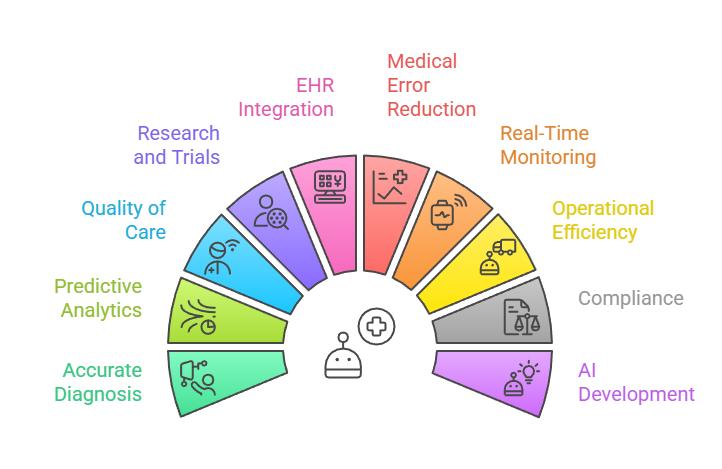
1. Enables Accurate Diagnosis and Treatment Planning
Effective data collection provides clinicians with complete and timely information, including symptoms, vitals, medical histories, diagnostic test results, and imaging scans.
When this data is comprehensive and error-free, it helps physicians make more accurate diagnoses and select better treatment pathways.
High-quality data reduces ambiguity, prevents misdiagnosis, and ensures that treatment plans are based on real patient needs rather than assumptions.
2. Supports Predictive Analytics and Risk Stratification
Predictive healthcare models rely entirely on historical and real-time data. Proper data collection enables the development of algorithms that predict hospital readmissions, detect early signs of chronic disease, and identify high-risk patients.
By capturing accurate and diverse data—such as lab results, lifestyle indicators, socio-demographics, or medication adherence—systems can generate reliable risk scores, allowing for timely interventions and preventive care.
3. Enhances Quality of Care and Patient Outcomes
When data is collected consistently across clinical workflows, it provides a benchmark for monitoring treatment effectiveness and identifying gaps in care. This includes tracking recovery progress, monitoring chronic disease management, and understanding patient behavior.
Healthcare providers can identify patterns associated with negative outcomes and adjust protocols, improving clinical quality and reducing avoidable complications.
4. Strengthens Research, Clinical Trials, and Evidence-Based Medicine
Accurate data collection is essential for clinical research, drug development, public health studies, and randomized controlled trials. Well-gathered datasets ensure scientific validity, reproducibility, and unbiased analysis.
Researchers depend on clean and well-documented data to discover disease patterns, evaluate new therapies, and generate medical evidence that directly shapes healthcare guidelines and policy decisions.
5. Enables Integration with EHRs and Interoperable Healthcare Systems
Consistent and standardized data collection makes it easier to integrate records across hospitals, labs, imaging centers, and remote patient monitoring systems.
Frameworks like HL7, FHIR, and modern EHR platforms rely on structured data to ensure interoperability. Proper data collection enables seamless data exchange, enhances care coordination, and ensures that patient histories follow them across care settings.
6. Reduces Medical Errors and Improves Patient Safety
Incomplete or inaccurate data is one of the biggest causes of medication errors, duplicate testing, surgical mistakes, and adverse events.
By collecting and validating data at every step of the clinical workflow, healthcare institutions can significantly reduce risks. Accurate data also supports alerts, reminders, and automated error-detection systems used in Clinical Decision Support Systems (CDSS).
7. Facilitates Real-Time Monitoring and Chronic Disease Management
Wearables, IoT medical devices, and remote monitoring tools generate continuous streams of health data. Proper data collection ensures this information is captured, synchronized, and analyzed to support real-time intervention.
This allows clinicians to track chronic diseases like diabetes, hypertension, or heart failure remotely and adjust care plans immediately when risks arise.
8. Supports Healthcare Operations, Resource Planning, and Cost Optimization
Hospitals use collected operational data—such as patient flow, bed occupancy, staffing levels, and supply usage—to optimize resources. Accurate data helps reduce waiting times, prevent bottlenecks, streamline workflows, and manage costs.
Health administrators depend on high-quality data to make strategic decisions regarding equipment purchases, workforce distribution, and emergency preparedness.
9. Ensures Compliance with Legal, Ethical, and Regulatory Standards
Regulations such as HIPAA, GDPR, and national health data policies require healthcare organizations to maintain accurate, secure, and well-documented patient data.
Proper data collection ensures organizations meet legal standards for privacy, consent, data accuracy, and audit readiness. This builds patient trust and protects organizations from liability and compliance violations.
10. Drives the Development of AI, ML, and Deep Learning Applications
Advanced AI and deep learning models for diagnostics, medical imaging, NLP-based clinical text mining, and disease prediction require large volumes of high-quality data.
Proper data collection enables consistent labeling, reduces noise, and supports diverse training datasets. Without structured, clean data, AI models fail, bias increases, and predictions become unsafe for clinical use.