Hypothesis testing is a foundational statistical method used in healthcare research to determine whether observed differences, patterns, or treatment effects are real or simply due to random chance.
It supports evidence-based medicine by providing a structured way to evaluate clinical interventions, diagnostic tools, drug efficacy, disease associations, and patient outcomes.
In healthcare studies, researchers begin by formulating a null hypothesis (H₀)—typically stating that no significant difference or effect exists—and an alternative hypothesis (H₁) that represents the expected clinical change or improvement.
Statistical tests such as t-tests, chi-square tests, ANOVA, and non-parametric methods help determine whether the evidence is strong enough to reject the null hypothesis.
Healthcare decisions often involve high-risk scenarios, where incorrect conclusions can lead to patient harm or ineffective treatments being adopted.
Therefore, hypothesis testing incorporates confidence levels, p-values, Type I and Type II error controls, and clinical significance measures to ensure robust interpretation.
Modern healthcare research also uses advanced hypothesis-testing frameworks, including Bayesian analysis and sequential testing, especially in adaptive clinical trials and personalized medicine studies.
As healthcare becomes increasingly data-driven, hypothesis testing ensures scientific rigor, supports regulatory approvals, and strengthens the quality of clinical insights. It remains a critical tool for transforming raw data into validated medical evidence that improves patient care.
Role of Hypothesis Testing in Healthcare and Clinical Research
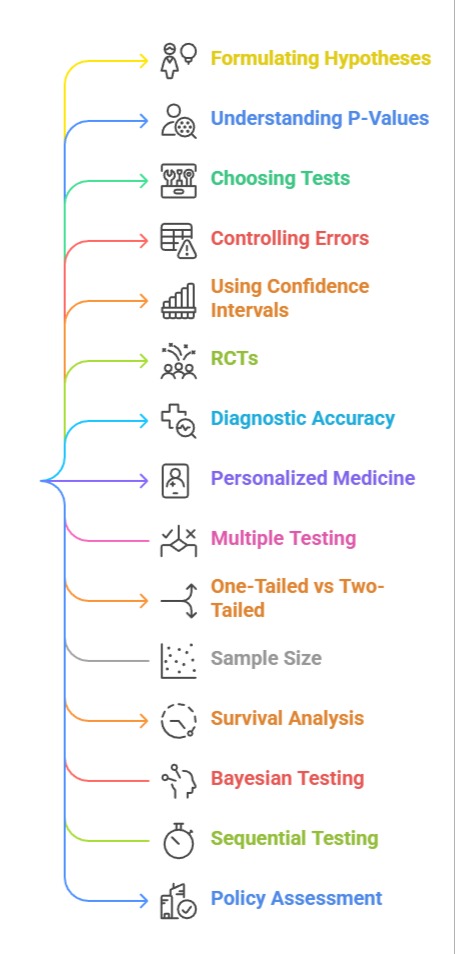
1. Formulating Null and Alternative Hypotheses
The first step in hypothesis testing is defining a clear null hypothesis (H₀), which assumes no effect, no difference, or no association in a clinical context.
For example, H₀ may state that a new drug does not lower blood pressure more than an existing medication.
The alternative hypothesis (H₁) proposes that a clinically meaningful effect does exist.
Formulating these hypotheses sets the direction of the analysis and shapes the statistical test to be used. In healthcare research, hypotheses must be precise, measurable, and aligned with clinical objectives to ensure meaningful results.
Poorly framed hypotheses can mislead interpretations or invalidate study findings, making this step one of the most critical in clinical research design.
2. Understanding P-Values and Statistical Significance
P-values help determine the strength of evidence against the null hypothesis by measuring the probability of obtaining results as extreme as those observed if H₀ were true.
In healthcare, a p-value below a chosen threshold (typically 0.05) suggests that an observed effect is unlikely due to chance alone. However, p-values must be interpreted carefully they indicate statistical evidence, not clinical importance.
Modern healthcare studies also emphasize reporting effect sizes and confidence intervals to avoid overreliance on p-values.
Misinterpretation of p-values can lead to false conclusions, making proper statistical education essential in evidence-based medicine.
3. Choosing Appropriate Statistical Tests
Selecting the correct statistical test depends on data type, study design, sample size, and distribution assumptions.
For example, t-tests compare means between two groups, chi-square tests evaluate associations between categorical variables, and ANOVA assesses differences among multiple treatment groups.
Healthcare data often vary widely, requiring careful choices to avoid invalid results.
When assumptions like normality or equal variance are violated, non-parametric tests such as Mann–Whitney or Kruskal–Wallis become more appropriate.
The selection of the right test ensures that results are valid, reliable, and interpretable within a clinical context.
4. Controlling Type I and Type II Errors
Type I errors occur when researchers incorrectly reject a true null hypothesis, potentially endorsing ineffective treatments. Conversely, Type II errors happen when failing to reject a false null hypothesis, causing beneficial interventions to be overlooked.
Healthcare studies aim to minimize these errors through proper sample sizes, power analysis, and carefully chosen significance levels.
The balance between α (Type I error rate) and β (Type II error rate) ensures that clinical conclusions are both accurate and safe. Maintaining this balance is essential because patient outcomes rely on statistical decisions that must be both cautious and reliable.
5. Using Confidence Intervals for Clinical Interpretation
Confidence intervals (CIs) provide a range of plausible values for the true treatment effect, offering more insight than a single p-value.
In healthcare studies, CIs help clinicians assess the credibility and magnitude of results such as how much a therapy reduces pain or improves survival rates. Wide intervals indicate uncertainty, while narrow intervals suggest precise estimates.
Using CIs allows researchers to evaluate both statistical and clinical significance, ensuring therapies are not only effective on paper but also meaningful in real-world care settings. This enhances transparency and supports better clinical decision-making.
6. Hypothesis Testing in Randomized Controlled Trials (RCTs)
RCTs heavily rely on hypothesis testing to compare treatment groups and evaluate intervention efficacy. Randomization reduces bias, making statistical comparisons more reliable and generalizable.
Hypothesis testing assesses whether differences in outcomes such as recovery rates or side effects are due to the treatment rather than random variation. Proper statistical testing ensures RCTs meet regulatory requirements and produce credible medical evidence.
As RCTs are the gold standard in clinical research, hypothesis testing directly influences drug approvals, treatment guidelines, and overall healthcare policy.
7. Role of Hypothesis Testing in Diagnostic Accuracy Studies
Diagnostic studies often evaluate whether a test correctly detects disease using metrics like sensitivity, specificity, and predictive values.
Hypothesis testing validates whether observed diagnostic performance exceeds a clinically meaningful threshold. For example, researchers may test whether a new imaging method detects tumors significantly better than traditional scans.
This statistical validation ensures that diagnostic tools adopted in hospitals are safe, reliable, and capable of early disease detection an essential factor in improving long-term patient outcomes.
8. Application in Personalized and Precision Medicine
Hypothesis testing also supports the development of precision medicine by verifying whether treatments work differently for specific genetic or demographic subgroups.
Researchers test hypotheses such as whether a gene variant significantly affects drug response or disease risk. These statistical insights enable more tailored treatment recommendations and reduce adverse reactions.
As genomic and biomarker-driven therapies expand, hypothesis testing ensures these advances are grounded in rigorous scientific validation rather than assumptions.
9. Multiple Hypothesis Testing and Adjustment Techniques
Healthcare studies often test many variables simultaneously—for example, evaluating dozens of biomarkers or genetic variants.
Testing multiple hypotheses increases the risk of false positives (Type I errors), where random patterns appear statistically significant.
To address this, researchers apply correction methods such as Bonferroni adjustment, False Discovery Rate (FDR), or Holm’s method.
These techniques ensure that statistical significance remains meaningful even when analyzing large clinical datasets.
Proper adjustment prevents misleading conclusions and maintains scientific integrity, especially in genomic studies, multi-arm trials, and high-dimensional health data analysis.
10. One-Tailed vs Two-Tailed Tests in Clinical Decisions
Healthcare researchers must choose between one-tailed and two-tailed hypothesis tests based on clinical goals.
A one-tailed test checks for an effect in a specific direction (e.g., whether a new drug performs better), while a two-tailed test evaluates any difference better or worse.
Two-tailed tests are more conservative and commonly used in clinical research because patient safety requires detecting unexpected adverse outcomes.
Selecting the incorrect test can bias conclusions or hide clinically important effects. Thus, thoughtful test selection ensures that clinical recommendations are both cautious and scientifically valid.
11. Sample Size and Power Analysis Before Hypothesis Testing
A crucial step before hypothesis testing is determining the appropriate sample size to ensure adequate statistical power. Inadequate sample sizes may fail to detect true treatment effects, while excessively large samples may inflate trivial differences into “statistically significant” results.
Power analysis considers effect size, acceptable error rates, and study design to balance efficiency and accuracy.
In healthcare research where patient recruitment, ethics, and cost must be considered power analysis ensures that studies are feasible, ethical, and capable of producing reliable conclusions. Without it, hypothesis testing can lead to biased or underpowered results.
12. Hypothesis Testing in Survival and Time-to-Event Analysis
Many healthcare outcomes involve timing such as time until relapse, recovery, readmission, or death.
Hypothesis testing in survival analysis uses specialized methods like the log-rank test or Cox proportional hazards model.
These tools determine whether differences in survival curves between treatment groups are statistically meaningful.
They account for censoring, where patient outcomes are not fully observed due to dropouts or early study termination.
This type of hypothesis testing is vital in oncology, chronic disease studies, and long-term clinical trials. It enables more realistic interpretations of treatment effectiveness over time.
13. Bayesian Hypothesis Testing in Modern Healthcare Research
Bayesian methods are increasingly used in adaptive trials, personalized medicine, and decision-making under uncertainty.
Unlike traditional (frequentist) hypothesis tests, Bayesian hypothesis testing incorporates prior knowledge, such as previous clinical study results or expert beliefs.
It calculates the probability of a hypothesis being true given the data, which aligns closely with real-world clinical reasoning.
This approach allows for continuous learning during trials and more flexible evidence interpretation.
Bayesian testing is especially impactful in rare disease studies, where data are limited, and traditional methods may not be feasible.
14. Sequential and Interim Hypothesis Testing in Clinical Trials
Many clinical trials use interim analyses to determine early whether a treatment is highly effective, ineffective, or unsafe.
Sequential hypothesis testing methods such as group sequential tests or alpha spending functions allow researchers to evaluate data at multiple points without inflating error rates.
This can lead to faster approvals for effective therapies or early discontinuation of harmful interventions.
In a healthcare environment where timely decisions save lives, sequential testing enhances trial efficiency while maintaining rigorous statistical standards.
15. Hypothesis Testing for Assessing Healthcare Policies and Interventions
Beyond clinical trials, hypothesis testing is used to evaluate healthcare policies such as vaccination programs, telemedicine adoption, public health campaigns, or insurance reforms.
Tests assess whether observed improvements such as reduced hospitalization rates or better disease control—are statistically significant.
This brings a scientific foundation to policymaking, ensuring that large-scale interventions are supported by robust data.
By distinguishing real effects from random variation, hypothesis testing helps healthcare systems allocate resources more effectively and implement evidence-based reforms.