Transforming raw data insights into practical, revenue-driving marketing strategies is one of the most critical skills in modern marketing analytics.
While businesses today collect massive volumes of customer, campaign, and competitor data, the true value emerges only when these insights are converted into tactical decisions—such as who to target, what message to deliver, which channel to prioritise, and how to allocate budget efficiently.
In today’s competitive landscape, marketers rely on predictive analytics, segmentation studies, ROI models, and behavioural insights to shape strategies that are both customer-centric and business-focused.
However, simply discovering insights isn’t enough; the key challenge is operationalizing them across campaigns, teams, workflows, and customer touchpoints.
This requires clear communication, alignment with business goals, and the ability to evaluate potential impact before implementation.
Data-to-Decision Framework for Modern Marketing
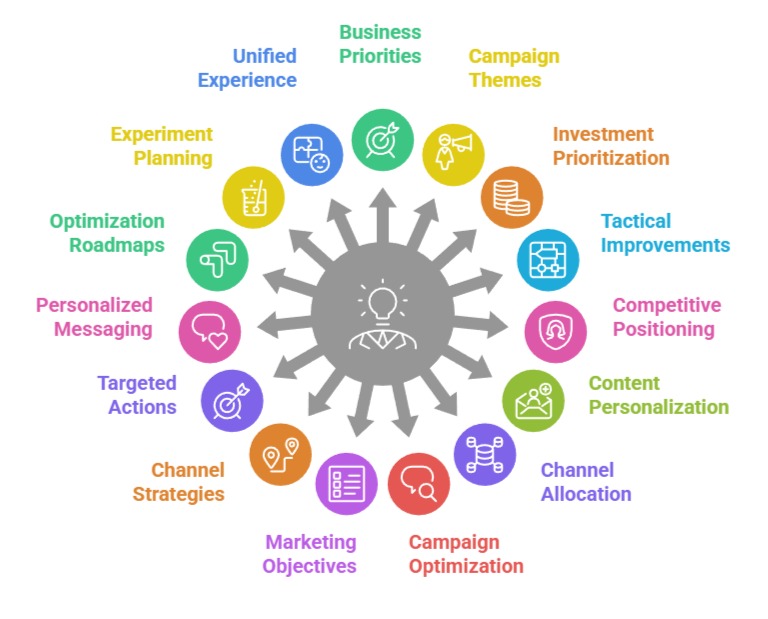
1. Understanding How Insights Link to Business Priorities
The first step in turning data into strategy is identifying how insights connect to real business priorities such as revenue growth, brand awareness, retention, and acquisition.
Marketers must interpret analytical findings through the lens of organisational goals to ensure relevance and strategic alignment.
This often requires breaking down insights into practical implications that leadership teams can easily understand.
When analysis clearly supports larger business needs, decision-making becomes faster and more confident.
This alignment ensures resources are invested in the right areas and campaigns support measurable outcomes. Ultimately, this link creates a strong foundation for effective marketing actions.
2. Converting Customer Segmentation into Campaign Themes
Segmentation becomes actionable only when it shapes campaign concepts, messaging direction, and creative themes.
Each segment responds differently to value propositions, emotional triggers, and communication styles.
Translating these insights into marketing themes helps deliver more personalised storytelling that speaks directly to each group’s motivations.
This approach increases engagement and makes campaigns feel relevant rather than generic.
By aligning creative direction with segment characteristics, brands build stronger resonance, improve conversion potential, and ensure marketing efforts connect more naturally with customer needs.
3. Using Predictive Insights to Prioritise Marketing Investments
Predictive models help forecast trends like buying probability, churn risk, or product interest.
These forecasts guide marketers in deciding where to invest budgets for the highest return.
For example, high-propensity customers may justify increased ad spend, while at-risk customers may require retention offers.
The insight-to-investment translation ensures spending is backed by data rather than guesses.
This leads to more efficient allocation, improved ROI, and reduced wastage. Predictive insights become even more powerful when continually updated with real-time behavior data.
4. Mapping Customer Journey Insights into Tactical Improvements
Journey analytics reveal friction points, drop-off stages, and areas where customers need support.
Translating these insights into action means optimizing touchpoints, improving UX design, refining content, or reworking CTAs.
Each journey stage should feel seamless, guided, and personalized. Insights help identify where marketing communication is misunderstood, overlooked, or not compelling enough.
Addressing these gaps results in smoother pathways toward conversion and better overall customer experience.
This ensures that insights drive not just campaigns but the entire brand-customer interaction.
5. Turning Market Trends into Competitive Positioning Strategies
External data such as competitor behavior, market shifts, emerging technologies, or consumer expectations must be turned into strategic positioning.
Marketers analyze these trends and translate them into decisions about differentiation, messaging tone, and value-added offerings.
This helps brands stay relevant and competitive in fast-changing markets.
When insights signal opportunities or threats, marketers can adapt product communication, pricing, or promotional strategies accordingly.
This proactive approach ensures strategies remain dynamic, future-ready, and based on evidence rather than assumptions.
6. Using Behavioral Insights to Shape Content Personalization
Behavioral data—such as browsing patterns, session duration, clicks, and past purchases—reveals what customers care about most.
Translating these insights into personalized content means tailoring recommendations, emails, landing pages, and ad creatives.
Content becomes more engaging when it reflects real behavior rather than demographic assumptions alone.
Personalization also improves customer satisfaction and increases the likelihood of conversion.
Over time, this creates deeper relationships and boosts overall loyalty through meaningful interactions.
7. Transforming Channel Performance Insights into Allocation Decisions
Each marketing channel generates data about audience engagement, conversion potential, and cost efficiency.
Turning these insights into decisions means reallocating budgets toward high-performing channels while refining or scaling back underperforming ones.
This ensures every rupee spent contributes to broader marketing goals.
Insights also reveal which channels work best for specific customer segments or campaign objectives.
This improves strategic clarity and drives consistent optimization for better multi-channel performance.
8. Applying A/B Testing Insights to Optimize Campaign Variations
A/B testing reveals what creatives, messages, layouts, or CTAs resonate with audiences.
Translating these insights into strategy involves selecting winning variations and systematically rolling them out across campaigns.
Marketers must also analyze why certain variations perform better to inform future creative decisions.
This creates a continuous improvement loop that strengthens campaign performance over time.
A/B insights reduce guesswork and lead to highly efficient marketing execution.
9. Connecting Analytical Insights to Real Marketing Objectives
Insights must be tied directly to specific goals such as increasing conversions, reducing churn, improving LTV, or boosting engagement.
This requires understanding how each metric influences business performance.
Translating insights into objectives ensures campaigns stay focused and accountable.
It also helps teams prioritize actions with the highest strategic value. This alignment ensures that insights lead to targeted, results-oriented marketing strategies.
10. Turning Customer Segmentation into Channel-Specific Strategies
Segmentation helps identify which channels best suit each customer group based on behavior and preferences.
Translating this into action means customizing communication formats, tones, and touchpoints for each segment.
This increases the relevance of messaging and improves channel efficiency.
It also ensures customers receive content where they are most active, boosting engagement and conversions.
This approach maximizes the impact of segmentation analytics.
11. Converting Predictive Models into Targeted Campaign Actions
Predictive models provide actionable triggers that can activate targeted marketing interventions.
High-value segments receive premium recommendations, while at-risk users receive retention-focused offers.
Translating these predictions into workflows ensures timely and relevant communication.
This improves customer experience and helps the brand stay proactive rather than reactive. It strengthens loyalty and increases overall marketing performance.
12. Crafting Personalized Messaging from Behavioral Insights
Behavioral insights reveal preferences, motivations, and intent signals.
Translating these into messaging involves designing tailored content journeys that reflect real customer actions.
This makes communication more human and relatable. Personalized messages consistently outperform generic ones, creating higher engagement and deeper trust.
Over time, brands benefit from stronger customer relationships and improved campaign efficiency.
13. Transforming Performance Metrics into Optimization Roadmaps
Campaign metrics highlight strengths, weaknesses, and areas needing improvement.
Turning these into actionable plans means identifying bottlenecks and creating targeted solutions.
This includes refining audiences, adjusting creatives, modifying budgets, or redefining goals.
Insights guide marketers toward data-driven enhancements that improve campaign outcomes. These roadmaps ensure continuous learning and long-term success.
14. Using Insight-Driven Prioritization to Plan Marketing Experiments
Translating insights into experiments requires selecting hypotheses that offer high potential impact.
Marketers use data to identify which elements—like messaging, design, pricing, or timing—should be tested first.
This ensures experimentation is purposeful rather than random. Insight-driven testing helps reveal patterns that shape future strategy.
Over time, this leads to more refined, evidence-backed marketing decisions that consistently improve results.
15. Turning Cross-Channel Insights into Unified Customer Experience Strategies
Customers engage across multiple channels, and insights reveal how they move between them.
Translating these patterns into strategy ensures a cohesive and seamless cross-channel experience.
This may include synchronizing messaging, aligning offers, or integrating data for consistent personalization.
A unified strategy eliminates confusion and builds stronger brand trust.
This insight-to-action approach ensures customers enjoy smooth, connected journeys across every interaction.