In today’s competitive digital marketplace, marketers can no longer rely only on intuition or past experience to make decisions.
Customers interact with brands across multiple platforms, generating huge amounts of data every second—website clicks, social media behavior, purchase patterns, feedback, and more.
Data science helps transform this raw information into meaningful insights that guide smarter marketing decisions.
By using techniques such as statistical analysis, customer segmentation, predictive modeling, and machine learning, data science allows marketers to understand what customers want, how they behave, and what actions are likely to drive better results.
Instead of guessing which campaign will work or which audience to target, marketers can now make choices backed by evidence and data-driven predictions.
This leads to more efficient spending, improved customer experiences, and higher business growth.
Role of Data Science in Marketing Decision Making
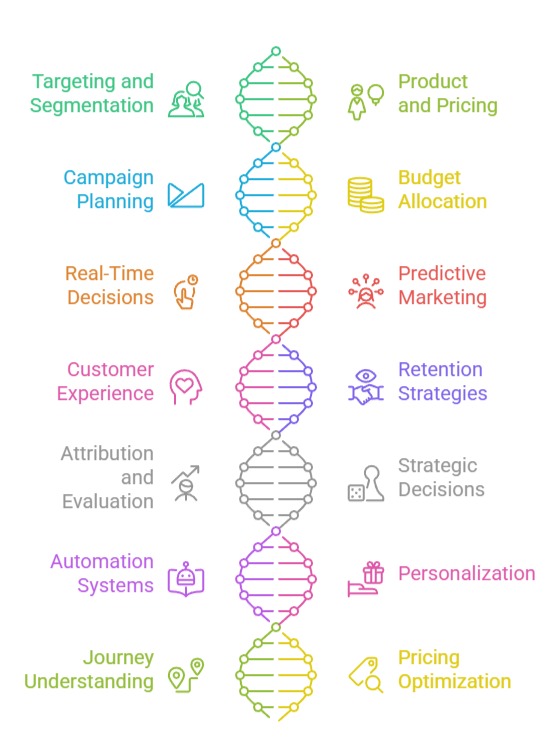
1. Enhancing Targeting and Customer Segmentation
Data Science helps marketers identify precise customer segments by analyzing demographic data, purchase behavior, browsing patterns, and engagement history.
Instead of relying on broad audience groups, companies can create micro-segments with very specific characteristics.
This allows marketers to design targeted campaigns that resonate with each group’s needs and interests.
Better segmentation improves personalization and increases campaign effectiveness.
Ultimately, data-driven targeting ensures that marketing efforts reach the right people at the right time, improving ROI.
2. Supporting Product and Pricing Decisions
Marketers use Data Science to analyze customer preferences, competitor pricing, market demand, and historical sales to make smarter product and pricing decisions.
Regression models and price elasticity analysis help determine how price changes affect customer purchasing behavior.
This allows companies to find the optimal pricing strategy that balances profitability and competitiveness.
Data also reveals which product features customers value most, guiding product development and upgrades.
With these insights, businesses can design offerings that match customer expectations and market conditions.
3. Improving Campaign Planning and Strategy Formulation
Data Science provides marketers with deep insights into what type of campaigns work, which messages resonate, and which channels perform best.
By studying past campaign results, customer interactions, and conversion trends, companies can plan future campaigns more strategically.
Predictive analytics helps determine which strategies are likely to succeed before they are launched.
This ensures that marketing plans are based on facts rather than assumptions. As a result, overall marketing strategy becomes more structured, impactful, and data-driven.
4. Optimizing Budget Allocation and Resource Management
Budget allocation is one of the most critical decisions in marketing, and Data Science helps make it more efficient.
Marketers can analyze ROI from previous campaigns, channel performance, customer acquisition costs, and lifetime value to identify the best investment areas.
Advanced attribution models reveal which channels truly drive conversions, helping marketers avoid wasteful spending.
By understanding where each rupee or dollar delivers the most value, companies can allocate budgets more confidently and strategically.
This leads to more efficient resource management and higher overall marketing performance.
5. Enabling Real-Time Decision-Making and Rapid Adjustments
Data Science tools provide real-time insights into campaign performance, customer behavior, and market dynamics.
Marketers can instantly check how ads, emails, or promotions are performing and make quick adjustments when needed.
This rapid decision-making prevents losses caused by poorly performing campaigns and helps capture opportunities faster.
Real-time monitoring also allows marketers to react to sudden changes in customer preferences or competitor actions.
In fast-moving digital environments, the ability to make immediate, data-backed decisions becomes a major competitive advantage.
6. Driving Predictive and Proactive Marketing Decisions
Using machine learning models, marketers can predict outcomes such as customer churn, purchase probability, seasonal demand, and future sales trends.
This predictive capability helps companies take proactive steps instead of reacting late.
For example, if a customer is likely to leave, personalized retention strategies can be deployed in advance.
Forecasting also helps in planning inventory, designing promotions, and preparing for high-demand periods.
Data Science transforms marketing from a reactive function into a proactive, future-ready discipline.
7. Improving Customer Experience and Journey Optimization
Data Science provides a complete view of the customer journey across websites, apps, stores, and social media channels.
By analyzing where customers face difficulties, marketers can improve touchpoints and remove friction in the journey.
This leads to smoother navigation, clearer messaging, and personalized interactions at each stage.
Understanding how customers move through the journey helps marketers design better engagement strategies.
Ultimately, data-driven decisions enhance customer satisfaction and lead to stronger brand loyalty.
8. Strengthening Retention and Loyalty Strategies
Retention decisions—such as who to target, what offers to provide, and when to intervene—are significantly improved through Data Science.
Churn prediction models identify customers at risk of leaving, allowing marketers to take timely action.
Behavioral analytics helps determine what keeps customers loyal and what causes disengagement.
By analyzing feedback, usage patterns, and purchase frequency, companies can design effective loyalty programs. Data-driven retention improves long-term profitability and customer lifetime value.
9. Providing Accurate Marketing Attribution and Performance Evaluation
Attribution models powered by Data Science help marketers understand which channels, ads, or touchpoints contribute most to conversions.
This clarity helps marketers stop guessing and start investing in what truly works.
Advanced models like multi-touch attribution, Markov chains, or time-decay methods provide a deeper understanding of customer paths.
With accurate attribution, decision-making becomes more accountable and transparent. This leads to better campaign planning and more effective budgeting.
10. Supporting Long-Term Strategic and Competitive Decisions
Data Science offers insights into market trends, competitor strategies, customer sentiment, and emerging opportunities.
These insights help companies make long-term strategic decisions with confidence.
Businesses can forecast future demand, evaluate potential markets, and plan expansions based on reliable data.
Competitive intelligence also helps marketers stay ahead by anticipating competitor movements.
Overall, Data Science strengthens strategic decision-making and improves a company’s long-term market positioning.
11. Facilitating Automation and Intelligent Decision Systems
Automation tools powered by Data Science help marketers decide when to send emails, which leads to prioritize, and how to segment users automatically.
Machine learning algorithms can guide decisions on bidding strategies in advertising platforms or recommend the most promising audience groups.
This reduces manual workload and ensures decision-making is consistent and objective.
Automation also allows marketing teams to operate at scale without compromising quality. Over time, intelligent decision systems lead to faster, more reliable, and more efficient marketing operations.
12. Enhancing Personalization at Scale
Data science enables marketers to personalize customer experiences not just for a few segments but for millions of users simultaneously.
By analyzing browsing behavior, purchase patterns, and engagement signals, algorithms can automatically tailor product recommendations, email content, and ad creatives.
This level of personalization builds stronger customer relationships and elevates brand loyalty.
It also improves campaign relevance, ensuring that each customer receives the message most likely to influence their behavior.
As a result, marketing becomes more efficient, targeted, and customer-centric.
13. Improving Customer Journey Understanding
Modern customers interact with brands across multiple touchpoints—search, social media, email, apps, and in-store experiences.
Data science helps marketers map these complex journeys by analyzing patterns across channels and identifying the most influential touchpoints.
This enables organizations to understand where customers drop off, what motivates conversions, and which pathways deliver the highest value.
With these insights, businesses can optimize customer journeys to be smoother and more intuitive. Ultimately, this leads to higher satisfaction and stronger brand engagement.
14. Optimizing Pricing and Promotional Decisions
Data science supports smarter pricing strategies by analyzing competitor prices, customer demand, seasonality trends, and buying behavior.
Predictive models help determine the best price that maximizes both sales volume and profit.
Similarly, promotions can be optimized by identifying which discounts, bundles, or limited-time offers yield the best results.
This prevents excessive discounting that reduces revenue while ensuring customers feel incentivized.
Data-driven pricing makes marketing decisions more precise, profitable, and aligned with real-time market conditions.