Python is one of the most widely used tools in modern marketing analytics because of its simplicity, flexibility, and powerful data-handling capabilities.
As marketing becomes more data-driven, professionals need tools that can process large volumes of information, uncover patterns, automate repetitive tasks, and generate insights quickly.
Python provides all these advantages through its easy-to-learn syntax and extensive ecosystem of data analysis libraries.
This submodule introduces learners to the fundamentals of Python and explains how it specifically supports data analysis in marketing environments.
Why Python is Important for Marketing Data Analysis
Python has become a preferred tool for marketers because it helps convert raw marketing data into meaningful insights.
Its clear syntax allows beginners to start writing code quickly, while its advanced features support sophisticated analysis for experienced users.
Marketers commonly deal with data from multiple sources—CRM systems, websites, social media, advertising platforms, and customer interactions—and Python can merge, clean, process, and visualize all of it efficiently.
Key Reasons Python is Valuable in Marketing
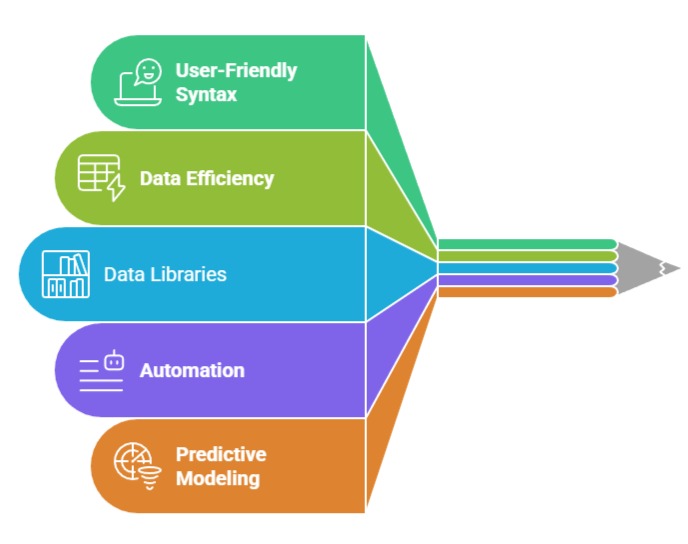
Python bridges the gap between marketing intuition and data-driven decisions, enabling analysts to explore customer behavior, measure campaign results, and optimize performance using real-time insights.
Basic Python Concepts for Marketers
Understanding core Python concepts helps marketers manipulate data and perform basic operations needed for analysis.
These fundamentals act as building blocks for more advanced tasks, such as cleaning customer data or running calculations on campaign metrics.
Key Basic Python Concepts Include:
1. Variables – used to store customer counts, budgets, sales numbers, etc.
2. Data types – integers, floats, strings, booleans for storing different types of marketing information.
3. Lists and dictionaries – essential structures for organizing products, geographies, or customer details.
4. Loops and conditionals – automate reporting tasks like calculating conversion rates for multiple campaigns.
5. Functions – reusable blocks of code to compute KPIs or clean data efficiently.
These concepts empower marketers to move beyond static spreadsheets and start interacting dynamically with their data. Once these basics are mastered, marketers can handle complex tasks like merging datasets, identifying trends, and preparing dashboards.
Python Libraries for Data Analysis in Marketing
Python’s true power comes from its vast collection of libraries that simplify data analysis.
These libraries make it possible to perform advanced tasks with just a few lines of code, saving time and reducing human error.
Essential Python libraries for Marketing Data Analysis:
1. Pandas – for cleaning, filtering, merging, and analyzing marketing datasets
2. NumPy – for numeric calculations such as budget modeling and forecasting
3. Matplotlib / Seaborn – for creating visualizations like trend charts, segmentation plots, or campaign performance graphs
4. Requests / BeautifulSoup – for extracting data from websites or social media
5. Scikit-Learn – for predictive models like customer segmentation, churn prediction, or lead scoring
These libraries allow marketers to discover insights in large and complex datasets, visualize performance trends clearly, and build automated systems that continuously analyze customer behavior.
How Python Supports Marketing Use Cases
Python is not just a technical tool; it directly impacts marketing strategy and execution.
By using Python, analysts can uncover patterns that guide decisions such as when to launch a campaign, which customers to target, and how to optimize the marketing budget.
Common Marketing Tasks Python Can Handle
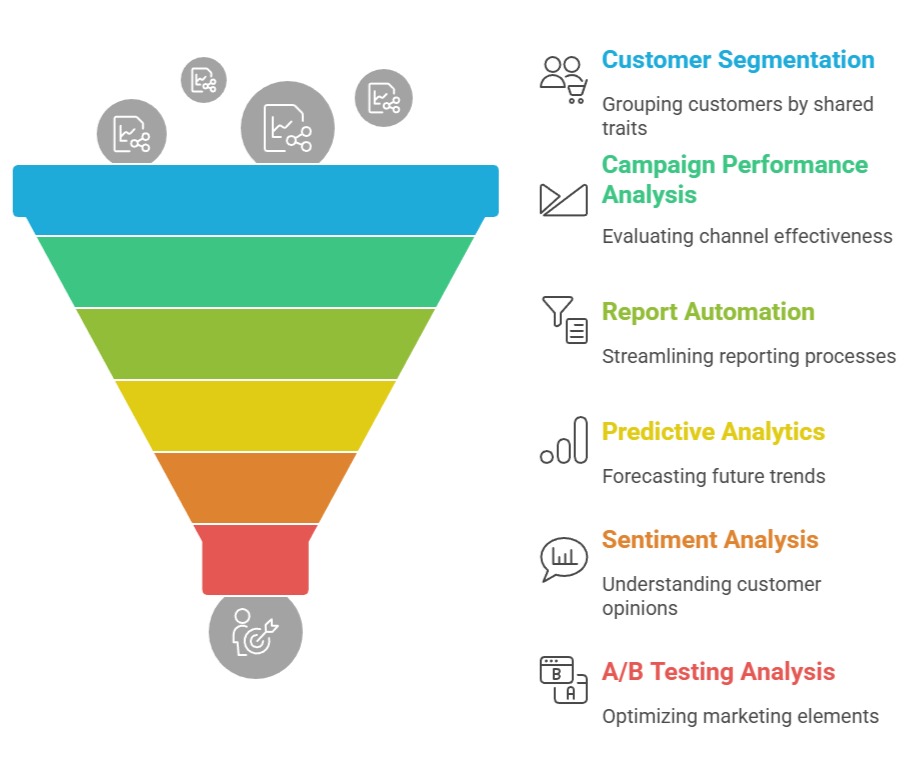
Python enables marketers to shift from manual data handling to automated, intelligent decision-making supported by real data.