Logistic regression is a powerful classification algorithm widely used in marketing analytics to predict binary outcomes—such as whether a customer will churn, convert, respond to a campaign, or belong to a particular segment.
Unlike linear regression, which predicts continuous values, logistic regression predicts probabilities and assigns customers to categories based on threshold values.
This makes it especially useful when marketing decisions depend on understanding the likelihood of customer behaviors.
In customer segmentation, logistic regression helps identify which customers are more likely to belong to specific behavioral or value-based groups.
By analyzing features like purchase frequency, average order value, demographics, and engagement metrics, the model provides insights into which variables differentiate one customer segment from another.
For churn prediction, logistic regression is considered one of the most reliable and interpretable models.
It can detect patterns that indicate dissatisfaction, declining engagement, reduced purchases, and weakening brand loyalty.
These probability-based predictions help marketers proactively intervene with retention campaigns, personalized offers, and targeted communication.
Modern logistic regression can be applied easily using Python, R, Excel, Google Sheets add-ons, and advanced marketing analytics platforms.
Its interpretability makes it valuable for executives and marketers who need transparent, data-driven justification for decisions.
With customer behavior becoming more dynamic in digital ecosystems, logistic regression remains a crucial tool for predicting outcomes, reducing churn, segmenting customers, and optimizing long-term marketing strategies.
Logistic Regression Modeling for Marketing Intelligence
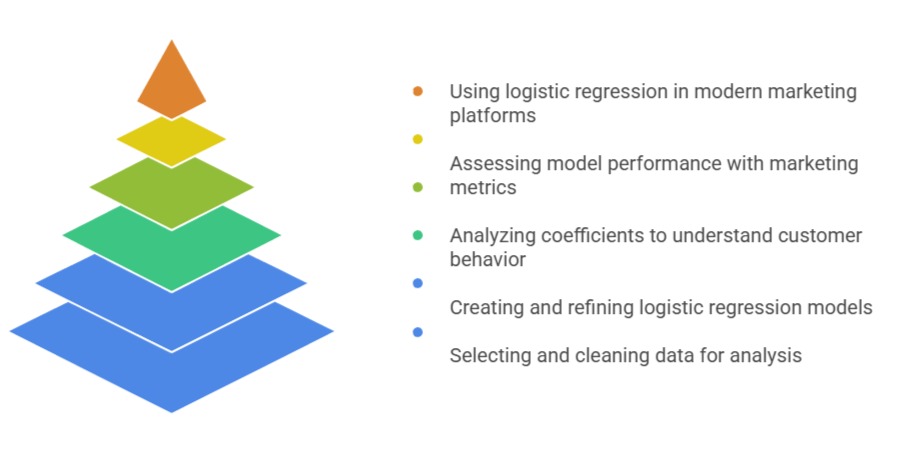
1. Understanding the Logic Behind Logistic Regression
Logistic regression works by converting a linear combination of inputs into a probability using the logistic (sigmoid) function.
Instead of producing a numeric forecast, it tells marketers how likely a customer is to belong to a specific category—churn or not churn, high-value or low-value, active or inactive.
This makes it extremely useful for binary decision-making where predicted probabilities directly drive marketing actions.
Logistic regression is interpretable, meaning marketers can understand why the model makes a certain prediction.
It also works well with normalized, structured data commonly found in marketing CRM systems.
Its simplicity, speed, and transparency make it a first-choice model for many marketing classification problems.
2. Logistic Regression for Customer Segmentation
Customer segmentation becomes more accurate when logistic regression is used to classify customers based on behaviour patterns.
The model analyzes features such as spending habits, engagement levels, product preferences, and demographic attributes to determine which segment a customer fits into.
Instead of manual rule-based segmentation, logistic regression creates data-driven segment boundaries. It can identify hidden behavioral differences that marketers may not see manually.
The model’s coefficients reveal which customer attributes contribute most to segment classification.
This helps businesses develop more personalized marketing strategies and improve targeting efficiency.
The result is more precise segmentation and better allocation of campaign resources.
3. Predicting Customer Churn Using Logistic Regression
Churn prediction is one of the most important applications of logistic regression in modern marketing.
The model evaluates indicators such as reduced purchase activity, lower website visits, declining app usage, customer complaints, or long gaps between transactions.
These patterns are converted into probabilities, enabling businesses to identify customers at high risk of leaving.
Marketers can then design targeted retention strategies—like discounted offers, loyalty rewards, or personalized communication—to win back these customers.
Logistic regression allows companies to focus retention efforts on the highest-risk individuals, reducing customer loss and improving lifetime value. Its clear interpretability helps managers understand exactly why churn risk is increasing.
4. Interpreting Coefficients to Understand Customer Behavior
One of the main strengths of logistic regression is the ability to interpret coefficients to understand which factors increase or decrease the probability of a certain customer outcome.
A positive coefficient indicates that the variable increases the likelihood of churn or belonging to a specific segment, while a negative coefficient decreases it.
In marketing, this helps identify the most influential behavioral, transactional, or demographic predictors.
For example, a high negative coefficient for “recent purchases” suggests loyal behavior, while a positive coefficient for “long inactivity period” indicates rising churn risk.
These insights help marketers refine strategy, messaging, and intervention timing to better influence customer actions.
5. Data Preparation and Feature Selection for Strong Predictions
Logistic regression performs best with well-prepared and relevant datasets.
Variables must be cleaned, encoded, and scaled to produce accurate predictions.
Feature selection is crucial in churn and segmentation models because irrelevant or redundant predictors can reduce accuracy.
Marketers often select meaningful features such as recency, frequency, monetary value, engagement scores, complaint logs, subscription duration, and campaign response history.
Including domain knowledge during feature design greatly improves predictive power.
Proper preprocessing ensures the model learns meaningful patterns rather than noise, resulting in more accurate and reliable forecasts.
6. Threshold Tuning for Better Marketing Decision-Making
A major advantage of logistic regression is the ability to choose different probability thresholds to adjust how predictions are classified. Instead of using the standard 0.5 threshold, marketers can lower or increase it based on objectives.
For retention campaigns, a business might use a lower threshold to catch more potential churners early.
Conversely, for premium loyalty campaigns, a higher threshold might be used to target only the most confident predictions.
This flexibility ensures marketing actions are aligned with financial priorities and risk tolerance.
Threshold tuning significantly enhances campaign precision and improves ROI.
7. Evaluating Model Performance with Marketing-Friendly Metrics
Logistic regression performance is assessed using metrics such as accuracy, precision, recall, F1-score, ROC-AUC, and confusion matrices.
In churn prediction, recall is crucial because missing high-risk customers can be costly. For segmentation classification, accuracy and precision help ensure customers are placed in the right groups.
ROC-AUC provides a holistic view of how well the model distinguishes between classes.
These metrics help marketers ensure the model is reliable before deploying it in real-world campaigns.
Continuous model monitoring enhances long-term accuracy in dynamic customer environments.
8. Using Logistic Regression in Modern Marketing Platforms
Today’s marketing analytics tools such as HubSpot, Salesforce Einstein, Google BigQuery ML, Python (scikit-learn), and Power BI offer built-in logistic regression capabilities.
These tools simplify the process of building churn and segmentation models without requiring deep programming skills.
Marketing teams can integrate CRM data, automate model updates, and visualize probabilities in dashboards.
This seamless integration allows businesses to implement predictive insights directly into campaigns, workflows, and retention strategies.
As customer data grows richer, logistic regression becomes even more valuable for predictive marketing at scale.
9. Using Interaction Terms to Capture Complex Customer Behavior
Logistic regression can incorporate interaction terms to capture situations where two variables work together to influence customer churn or segmentation.
In marketing, these interactions are common—for example, customers who both reduce purchase frequency and stop opening emails may have a much higher churn risk than those showing only one of these behaviors.
Interaction terms reveal nuanced behavioral relationships that simple variables cannot capture.
They allow marketers to detect multi-factor triggers that influence customer decisions.
This helps create more targeted retention campaigns. Using interaction features often significantly improves model performance in churn prediction.
10. Handling Imbalanced Customer Data for Better Predictions
Many churn datasets are highly imbalanced: only a small percentage of customers churn compared to those who remain active.
Logistic regression can struggle without proper handling.
Techniques like oversampling (SMOTE), undersampling, class weighting, and balanced threshold adjustments help improve prediction accuracy.
These methods ensure the model pays enough attention to minority churn cases.
Balanced datasets result in much better recall and F1-score—critical for capturing at-risk customers.
Handling imbalance is essential for preventing false negatives in churn prediction, making logistic regression more reliable in real-world marketing environments.
11. Real-Time Churn Prediction Using Streaming Data
With modern CRM and analytics systems, logistic regression can be deployed in real-time to predict customer churn as new data arrives.
For example, sudden drops in app usage or declined engagement events can trigger automated churn scoring.
Real-time predictions allow companies to intervene immediately with automated retention workflows—like personalized emails, push notifications, or loyalty rewards.
This significantly reduces customer loss by catching churn signals early.
Real-time application also ensures the model remains up to date with changing customer behavior. Logistic regression’s lightweight computational needs make it ideal for real-time systems.
12. Using Logistic Regression for Probability-Based Segmentation
Traditional segmentation methods assign users to groups based on cut-off rules, but logistic regression provides probability-based segmentation, giving a more flexible and dynamic view.
For Example, instead of labeling a customer as “high-value,” the model may assign a 0.78 probability, offering nuance.
Marketers can create tiers based on probability distributions—like low, medium, and high engagement likelihood.
This enables more refined targeting strategies and budget optimization.
Probability-based segmentation is increasingly used in recommendation systems, loyalty scoring, and personalized marketing. Logistic regression is ideal because of its natural probabilistic output.
13. Identifying Churn Root Causes with Odds Ratios
Logistic regression provides odds ratios that clearly show the strength of influence each variable has on customer churn.
Marketers can interpret these ratios to understand how different factors increase or decrease the odds of churn.
For example, a "no interaction for 90 days" variable may have an odds ratio of 4.5, meaning it's a strong churn driver.
Odds ratios help pinpoint the root causes of customer dissatisfaction, making them extremely actionable.
Businesses can then focus on reducing the impact of these key drivers through personalized retention strategies.
This transparency distinguishes logistic regression from black-box models.
14. Building Multi-Class Logistic Regression for Multi-Segment Classification
Beyond binary segmentation, logistic regression can be extended into multinomial logistic regression to classify customers into multiple segments—such as “new,” “active,” “at-risk,” and “loyal.”
This makes it an excellent tool for customer life-cycle modeling. By incorporating behavioral, transactional, and demographic features, the model predicts the likelihood of each customer being in a specific segment.
This is extremely valuable in subscription businesses, ecommerce, and SaaS environments.
It supports resource allocation for acquisition, activation, and retention. Multinomial logistic regression provides a structured method for dynamic customer segmentation.